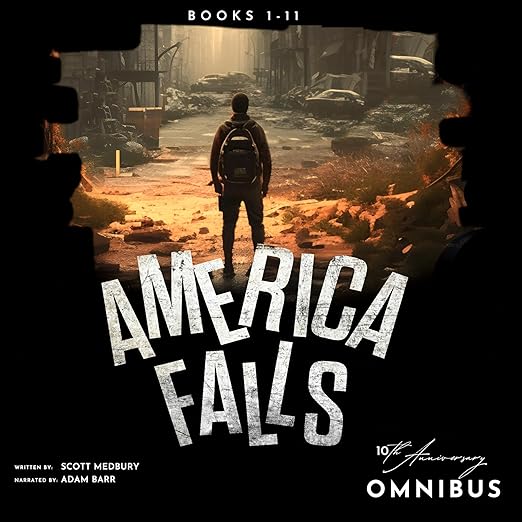
Quick Take
- Narration: Adam Barr maintains energy and character differentiation across nearly 60 hours of post-apocalyptic survival, a genuinely demanding feat that the series’ listenable reputation depends on.
- Themes: Biological collapse and social unraveling, survival community formation, teenage resilience under catastrophic loss
- Mood: Propulsive and grim, with episodic tension and occasional deus ex machina relief
- Verdict: A compulsively listenable post-apocalyptic epic with more plot momentum than literary ambition, exactly what the format and runtime promise.
There is a specific kind of audiobook that exists almost exclusively in audio form: the long-series omnibus that functions as immersive time-filling for people who spend hours in their car, at a desk job, on long shifts, or in transit. At 59 hours and 35 minutes, the America Falls Omnibus is unambiguously in that category. It’s not a book you crack open for the evening. It’s a world you inhabit for weeks. The question isn’t whether it deserves comparison to literary fiction. The question is whether it delivers what it promises: compelling characters, forward momentum, a convincingly collapsed world, and enough suspense to keep you coming back across eleven successive installments.
It delivers. Not without limitations, but it delivers.
Scott Medbury’s premise is economical and effective: a biological attack during the holidays devastates the United States. The virus is fast, deadly, and complete in its effect. For Isaac Race, already rebuilding after personal losses, the weaponized virus represents another destruction to survive. The story follows Isaac and a cast of characters who accumulate across the books, from the frozen mountains of New Hampshire to the depopulated cities of a post-viral America, facing not just the physical devastation but the human predation that follows any collapse of institutional order.
Our Take on the America Falls Omnibus
The series’ particular strength is exactly what one reviewer identifies: the multi-perspective structure. The core group introduced in book one remains the spine, but Medbury introduces offshoot storylines centered on characters like Joshua Raglan that develop separately before converging. This technique keeps a very long series from collapsing into repetition. The reader isn’t following the same characters through the same beats eleven times. They’re watching a world rebuild itself from multiple vantage points, each illuminating different aspects of the post-collapse landscape.
Medbury’s worldbuilding is granular and specific about the physical reality of post-societal survival. The details of the worst winter in years, the specific challenges of moving through a depopulated landscape with hostile weather and hostile humans, and the social dynamics of survivor groups are consistently well-observed. One reviewer notes that ‘the storyline about weaponized viruses seems to be a real possibility,’ which is the highest compliment you can pay to a speculative premise: it stays within the range of the genuinely plausible.
Why Listen to the America Falls Omnibus
Adam Barr carries the 60-hour runtime in a way that would defeat a less capable narrator. The character differentiation required by an ensemble cast that grows across eleven books is a substantial technical challenge, and Barr handles the increasing cast without confusion. His energy management across the length of the project is impressive: the later books don’t feel like a tired narrator pushing through. The post-apocalyptic atmosphere benefits from his measured delivery, which gives even the action sequences a quiet dread rather than thriller-style excitement.
The value proposition here is genuinely exceptional: 60 hours of quality entertainment at the Audible Whispersync price point that omnibus editions typically command. One reviewer describes it as ‘best for long drives,’ which undersells it slightly but isn’t wrong. This is a long-commute, long-project, long-trip companion.
What to Watch For in the America Falls Omnibus
One reviewer’s criticism about deus ex machina rescue moments is worth taking seriously. Medbury has a pattern of extracting characters from cliffhangers through convenient interventions, which is a structural habit that becomes visible at series length. It doesn’t break the story, but it does reduce the stakes of individual peril in a way that patient readers will notice. The series is marketed as YA-adjacent by one reviewer’s assessment, and that framing is accurate in the sense that the violence is present but not graphic, and the moral framework is relatively clean. Adult readers expecting the ambiguity of, say, The Road should recalibrate expectations.
The individual books are also episodic in a way that suits the omnibus format: each one has its own arc and momentum, which means the full package doesn’t feel like an eleven-part single novel. It feels like a sustained universe with recurring characters. That’s a distinction worth making for listeners deciding whether to commit at the outset.
Who Should Listen to the America Falls Omnibus
This is excellent terrain for listeners who have already worked through the major post-apocalyptic landmarks, the first Wave series, the Wool trilogy, Justin Cronin’s The Passage, and are looking for a long, fresh series that stays in the genre’s propulsive tradition without demanding the literary patience those titles sometimes require. It’s also genuinely good for listeners who need a high-engagement, long-duration audiobook for extended travel or work contexts. If you want literary complexity and carefully shaded moral ambiguity in your apocalyptic fiction, the series will feel slight. If you want a world you can live in for two months of commuting, it’s exactly right.
Frequently Asked Questions
Do all 11 books in the America Falls Omnibus follow Isaac Race, or does the cast change significantly?
The core group introduced in book one remains the central thread, but Medbury introduces separate perspective storylines around characters like Joshua Raglan that develop alongside the main group. The omnibus structure means multiple narrative strands running in parallel, with hints that the offshoots will eventually intersect with the core cast.
Is the violence and content in the America Falls series appropriate for younger teen listeners?
One reviewer describes the series as potentially aimed at YA readers, and that assessment matches the content level: survival violence is present but not gratuitous, and the moral framework is relatively straightforward. Adult listeners should be aware the series skews accessible rather than grimdark.
How does Adam Barr handle such a large ensemble cast across 60 hours of narration?
Reviewers consistently find his narration effective rather than confusing, which is a real achievement at this scale. The character differentiation holds across the length of the omnibus, and his energy maintains throughout. For a 60-hour project, consistent narrator performance is arguably more important than in shorter works.
Is the biological attack premise in America Falls scientifically plausible, or is it more of a genre device?
Reviewers with scientific backgrounds describe it as staying within the range of the genuinely plausible. Medbury doesn’t over-explain the virus’s mechanics, which is wise, but the social and environmental consequences he depicts are grounded in realistic modeling of what an actual pandemic collapse might produce, rather than generic genre catastrophe.