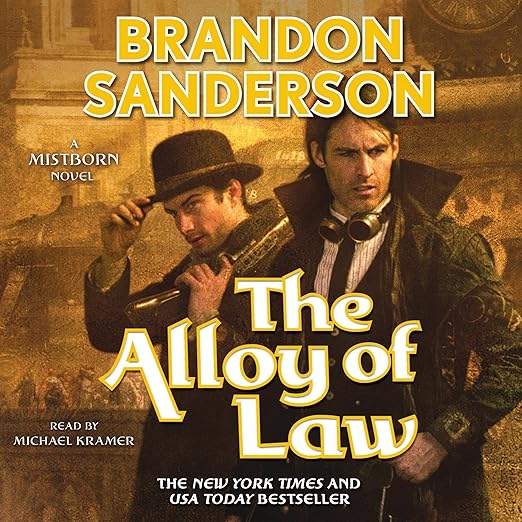
Quick Take
- Narration: Michael Kramer is as reliable here as across the original Mistborn trilogy – his command of Sanderson’s world and tonal range makes the Western-fantasy hybrid work better in audio than it might on the page.
- Themes: Legacy and duty, the collision of frontier justice with aristocratic obligation, expanding a magic system
- Mood: Lighter and faster-paced than the original trilogy, genre-blending and fun
- Verdict: A breezy, well-crafted entry into the Mistborn universe that rewards trilogy readers with a radically different tonal register – the Wax and Wayne series begins confidently here.
I came to The Alloy of Law having already spent considerable time with Brandon Sanderson. I had worked through the original Mistborn trilogy the previous year, which is a commitment both in page count and emotional weight. When a friend told me the Wax and Wayne series was considerably lighter, I was not immediately convinced that was a recommendation. It turned out to be exactly right. I listened to The Alloy of Law over two evenings, and the experience had the quality of a very well-made genre film after a run of literary cinema. Nothing wrong with that.
Three hundred years after the events of The Hero of Ages, Scadrial has reached something like its equivalent of the Industrial Revolution. Railroads run where once there were canals. Electric lighting has arrived. Steel-framed skyscrapers are under construction. The characters from the original trilogy, Kelsier, Vin, Elend, Sazed, are now part of religion and history rather than living protagonists, which creates an interesting dynamic for readers who knew them intimately. Sanderson uses this to demonstrate how mythology works: the legends have simplified and elevated the people, in ways both true and distorting.
Our Take on The Alloy of Law
The protagonist is Waxillium Ladrian, a Twinborn who can both Push on metals through Allomancy and use Feruchemy to alter his own weight. He has spent twenty years as a lawman in the frontier Roughs, and the novel opens on him being forced to return to the city of Elendel to take over as head of his noble house. The fish-out-of-water structure is deliberate and pleasurable: Wax is a gunslinger who now has to navigate inheritance politics and society dinners. Sanderson plays this with considerable dry humor.
The magic system work in this book is one of its specific satisfactions. Readers of the original trilogy understand Allomancy and Feruchemy as Sanderson originally built them. Here, he introduces Twinborns, individuals who have both abilities, and explores what happens when the two systems interact. The interactions are creative and internally consistent, which is Sanderson’s signature contribution to fantasy: rules-based magic that yields genuine surprises because the rules themselves are applied rigorously. One reviewer described the magic system as one of the finest in fantasy novels, and within the Mistborn world specifically, the Wax and Wayne additions hold up to that standard.
Why Listen to The Alloy of Law
Michael Kramer has narrated across Sanderson’s Cosmere works, and his familiarity with the Mistborn universe is audible. He knows these terms, these rhythms, these dramatic stakes. His Wax carries the right combination of world-weariness and competence, and his performance during the action sequences, which are more frequent and lighter in tone than the original trilogy’s battles, has energy without losing clarity. The novel’s Western-inflected atmosphere, think dime novel crossed with secondary-world fantasy, is something Kramer navigates well because he commits to it rather than playing it for irony.
At under eleven hours, this is also a genuinely efficient listen for Sanderson, whose work can extend to epic lengths. Sanderson himself has noted the book was originally conceived as a mental palate cleanser while working on A Memory of Light, the final Wheel of Time volume, and that origin story shows in its compactness. It reads fast because it was written fast, by an author in command of his craft, and that confidence in the prose translates to audio momentum.
What to Watch For in The Alloy of Law
The principal question reviewers raise is whether new readers should come to this before or after the original trilogy. The honest answer is: after. The Alloy of Law is marketed as standalone, and the surface-level plot can be followed without prior knowledge of the Mistborn books. But the emotional payoff of seeing how the world has transformed, the bittersweet quality of Kelsier and Vin having become religious figures, is entirely dependent on having spent time with those characters. The magic system, while introduced with some explanation, rewards listeners who understand its foundations.
The novel’s lighter tone is not a weakness, but it is a shift that some trilogy readers find disorienting at first. One reviewer described it as more casual than the original books, which is accurate. The stakes are smaller, the consequences are local rather than civilizational, and the humor is more present. Readers who loved the original trilogy’s darkness and philosophical weight should know they are entering a different register. Those who found the original trilogy somewhat heavy going will find this more approachable.
Who Should Listen to The Alloy of Law
Readers who completed the original Mistborn trilogy and want to continue in the Cosmere without immediately committing to The Stormlight Archive are the primary audience. The Wax and Wayne series is a lower-stakes, faster-moving entry point into Sanderson’s longer-term world-building, and The Alloy of Law is where it begins with the most energy.
Listeners new to Sanderson are better served starting with Mistborn: The Final Empire, the original trilogy’s opening book, before coming here. Michael Kramer fans who enjoy epic fantasy delivered with production quality will find his performance here satisfying. Those who want dense philosophical depth over genre fun should set expectations accordingly, but for what it is, The Alloy of Law is Sanderson operating with ease in a form he clearly enjoyed writing.
Frequently Asked Questions
Can I listen to The Alloy of Law without having read the original Mistborn trilogy?
Technically yes, but the experience is diminished. The surface plot is self-contained, but much of the emotional resonance, particularly around the transformation of the original trilogy’s characters into religious figures, depends on prior familiarity. The magic system explanation also goes more quickly than the original trilogy’s introduction.
How does Michael Kramer’s narration handle the Western genre elements in The Alloy of Law?
Well. Kramer commits to the genre hybrid rather than treating it as incongruous with epic fantasy. His delivery of Wax’s frontier pragmatism alongside the Allomancy sequences has the right rhythm, and he handles the novel’s dry humor without overselling it.
Is The Alloy of Law noticeably lighter in tone than the original Mistborn trilogy?
Yes, deliberately. Sanderson wrote this as a change of pace, and the stakes are local rather than civilizational. The humor is more present, the action is more frequent, and the philosophical density is lower. This is a feature for some readers and a disappointment for others depending on what they valued about the original trilogy.
Where does The Alloy of Law fit in the larger Cosmere reading order?
It is the fourth Mistborn book by internal chronology, beginning the Wax and Wayne series set three hundred years after the original trilogy. It can be read before or after The Stormlight Archive books without continuity issues, as Cosmere connections at this stage are primarily thematic rather than plot-dependent.