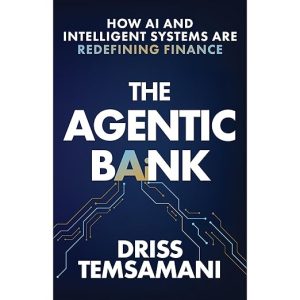
Driss Temsamani's The Agentic Bank opens with a specific scene that most AI-in-banking books avoid: Lisa, a corporate treasurer, working alongside three AI agents named Maria, Alejandro, and Sam. Together they manage cash flows, optimize liquidity, respond to compliance requirements, and adapt to risk in real time. This audiobook is unusual in the genre because it gives you a named, deployable use case rather than a strategic abstraction, and that specificity is Temsamani's strongest card. He is a practitioner, a three-decade banking leader with direct advisory experience with central banks and regulators on AI and blockchain integration, and it shows in the difference between how he frames the agentic AI problem and how most of the broader field talks about it.
The Virtual Voice narration handles the book's dense material clearly, maintaining consistent pacing across what is a substantively complex text. Where the narration is most limited is in the case study passages, particularly the Lisa framework, which is designed to read as a living, deployable scenario rather than a theoretical model. The AI narration flattens what Temsamani intends as a humanized illustration of the agentic treasury system in action. Listeners who engage primarily with the regulatory, governance, and implementation sections will find the narration fully adequate for the material.
Temsamani's Roadmap Treats Governance as an Advantage
Temsamani organizes the book around a concept he calls the AI-native financial institution, where humans and intelligent AI agents work together to create trust, speed, and efficiency at scale. What distinguishes his treatment from the genre's typical transformation narrative is the 12-month agentic AI pilot roadmap he provides, moving from beachhead use case to full institutional orchestration. This is not a book about why banks should adopt agentic AI. It is a book about how to do it, and the distinction matters enormously for its intended audience. The endorsements from figures like Ron Shevlin of Cornerstone Advisors and Rodrigo Luis Garcia of Western Union reflect the book's positioning in a serious professional conversation rather than a popular technology discussion.
The seven deployment-ready frameworks in the companion toolkit give the book practical weight. Temsamani's treatment of governance and regulatory compliance as competitive advantage rather than drag is particularly well-argued. Banking leaders who have watched AI initiatives stall at the compliance review stage will find his framing useful: he positions regulatory engagement as a design constraint that, when incorporated early, accelerates deployment rather than blocking it.
ESG Becomes Something Agentic Systems Can Embed
The six-hour-and-55-minute runtime makes this a substantive but manageable listen for the target audience, senior banking executives, CFOs, CIOs, treasurers, and policymakers who consume business content during travel, exercise, or structured professional development time. The audiobook covers the intersection of agentic AI with liquidity management, payments, risk management, client engagement, tokenization through blockchain, and ESG reporting. That breadth is handled systematically rather than superficially, with Temsamani returning consistently to implementation mechanics rather than staying at the level of potential.
The book's ESG section is worth noting specifically because it treats sustainability not as a reputational overlay but as something that agentic decision-making systems can actively embed and report on. That framing reflects a sophistication about how financial institutions are likely to use AI in the medium term, and the treatment is more integrated than the add-on ESG chapters that appear in most finance books of this type. The companion video featuring Lisa and her AI agents is available to readers and provides a visual walkthrough of the agentic treasury orchestration, which supplements the audiobook's necessarily text-based treatment.
Lisa's Framework Shows Virtual Voice's Limits
The Lisa framework, which runs through the book as a recurring illustrative thread, is where Temsamani is most innovative and where the Virtual Voice narration is most limited. The scenario is designed to function as a deployable model rather than a thought experiment, and readers who engage with the companion video alongside the audiobook will get the full picture that the audio format alone cannot deliver. Listen carefully to the sections on AI orchestration and the relationship between the three AI agents, because the dynamics Temsamani describes between Maria, Alejandro, and Sam reflect specific design decisions about role division in agentic systems that have practical implications.
The governance and regulatory sections, which Temsamani frames around turning oversight from drag to competitive advantage, are some of the book's most distinctive material. The treatment of how banks can design governance frameworks that satisfy regulators while enabling meaningful agentic AI deployment represents the kind of practitioner insight that consulting firms typically charge significant fees to deliver. Listeners in regulatory or compliance roles will find these sections particularly dense with applicable content.
Not an Introduction, Written for Banking Executives
This audiobook is for senior financial services professionals, banking executives, and policymakers who are actively engaged with questions of AI deployment and institutional transformation. It is not an introduction to artificial intelligence, and listeners without a working understanding of financial institutions will find some of the technical discussion opaque. Temsamani writes for people who already know what a treasury function does and why liquidity management matters; the value of the book lies in showing those people what agentic AI can specifically do in those contexts.
Fintech professionals, bank board members overseeing technology strategy, and academic researchers in financial technology will find the book's combination of practitioner credibility and structured framework genuinely useful. Those looking for a broader survey of AI's role across industry sectors will need to look elsewhere; Temsamani's focus on banking and financial institutions is deliberate and adds depth precisely because of its specificity.
A Few Questions About The Agentic Bank
Is The Agentic Bank audiobook suitable for listeners without a deep banking background?
The book assumes familiarity with financial institution structures, treasury functions, and the basic landscape of bank regulation. It is written for practitioners rather than general audiences, and listeners without that background will find key sections harder to contextualize, though the conceptual framework on agentic AI is accessible.
Does this audiobook provide actionable frameworks or is it primarily strategic in its focus?
It provides both, but the practical frameworks are its strongest feature. The seven deployment-ready frameworks, the 12-month pilot roadmap, and the governance design sections all go beyond strategic framing to operational specification. This is significantly more implementable than most AI-in-banking books.
At nearly seven hours, does The Agentic Bank audiobook maintain momentum or are there sections that feel repetitive for a practitioner audience?
The book covers a wide range of banking domains, from liquidity to ESG, which means sections are rarely repetitive on the same topic. Practitioners who find certain domains (e.g., blockchain tokenization) less central to their work may find those sections slower, but the implementation framework chapters are consistently dense and reward close attention.