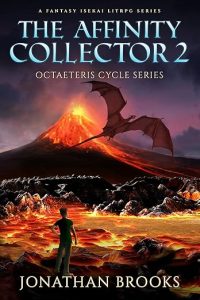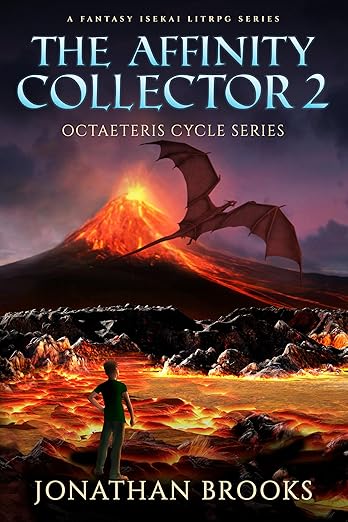
Jeremy is trapped in a Rift and everyone outside believes he is dead, which turns out to be a better position than it sounds. This audiobook picks up immediately after he got clear of two Academy Instructors who meant to dispose of him, and the escape left him somewhere with no easy exit and a great deal of loose energy lying around. Cores full of it, which can be dispersed into permanent increases to his Abilities. He might even unlock the Fire Affinity while he is down there. The complication is the Level 300 dragon sleeping in the same Rift, which has noticed him already and dislikes his mere presence.
Progression fantasy runs on one question, which is what a character may become and how fast, and Jonathan Brooks has built an unusually clean version of it. Jeremy sits sealed inside a space that is at once the most dangerous place available to him and the richest source of permanent advancement he is ever likely to reach. Every hour he stays makes him stronger and raises the odds of the Rift Overseer waking up irritated. That is a real engine rather than a premise. It also explains how the copy manages to promise stat growth and dread in the same breath, a combination the genre rarely pulls off, since most grinding happens somewhere nothing is at stake except time.
Miles Meili has the reading credit across thirteen hours and forty-two minutes, and the material sets a very particular problem. The copy states outright that the story contains LitRPG progression mechanics and stats, which in print means boxed tables a reader can skim past and in audio means numbers delivered as speech. Ability names, level notation, percentage increases and item descriptions all have to arrive spoken, at a pace that lets a listener take them in without the book turning into a spreadsheet read at dictation speed. Series regulars know that is the make-or-break element of any progression recording, and nothing on this page addresses it.
What Jonathan Brooks Gets Right
Dragons in this genre normally arrive as a reward. Here one functions as a permanent condition. The copy is precise about the arrangement: a single wrong move risks annoying a creature it describes as able to destroy an entire empire as easily as breathing, and nothing Jeremy could do would stop it. Power a protagonist cannot fight is difficult to sustain across thirteen hours, because everyone knows the story will not actually end that way, so the interest has to come from watching a character work carefully around an unbeatable object instead of toward defeating it. The description's closing line promises the collection keeps growing regardless, so the direction of travel was never in question.
Eighty-eight ratings support a 4.9 badge and not one person has written a word. That pairing deserves a moment. An average of 4.9 across eighty-eight votes allows somewhere between five and thirteen stars of deduction in the entire pool, meaning nearly every rater gave five and a small handful docked exactly one. It sits about as high as a real catalog number goes. It is also completely unexplained, since no review text exists here at all, so a browser receives a very confident figure with no reasoning attached to it, on a book released in April 2026 that has had under four months to gather anything.
Where Jonathan Brooks Loses Some Ground
Volume two is what this is, and the description opens by telling you how volume one ended. Freeing himself from the clutches of two treacherous Academy Instructors is the first clause on the page, a resolution rather than a premise, so anyone who has not started the Octaeteris Cycle has just been handed a plot point by the marketing copy. Past that, the record offers no help with sequence at all: no recap of what came before, no note on whether the book stands alone, and a series name that appears nowhere in the title a browser actually sees. Middle volumes are always awkward to sell, and the honest fix is one line telling a newcomer where to begin. This description has the room for that line, spends the room instead on recapping how the previous book ended, and leaves the sequencing question entirely to the buyer.
Publisher is the field this listing forgets entirely. It sits empty, which in progression fantasy usually signals self-publication or a small audio imprint, and it removes one of the few reliability cues a browser has to work with. The language field, meanwhile, carries a stray formatting character parked in front of the word English, the sort of artifact that shows up when copy gets pasted between systems. Neither affects the book itself. Both suggest a record assembled in a hurry. The one piece of consumer information the copy does volunteer is unusually direct: no sexual content and no harems, a disclaimer of absence rather than presence, which in this corner of the genre answers a question people genuinely have.
Who Should Pick Up The Affinity Collector
LitRPG listeners who finished the first volume are the obvious buyers and need no persuading. The more interesting audience is the isekai and portal fantasy reader who wants systems and numbers without the harem structure that dominates a good deal of the shelf, because the copy rules that out in writing rather than leaving it to be discovered. Thirteen hours and forty-two minutes sits at the usual length for the genre, and the confined setting suits listening particularly well: one location, one escalating threat, and a progression loop that never asks you to track a large cast of names. It suits anyone who prefers a tight stage to a sprawling one, since the whole book appears to unfold inside a single Rift rather than across a continent of quest markers.
Wait for the first volume if you have not read it. This is book two of the Octaeteris Cycle, the copy assumes you know who the Academy Instructors were and why their treachery mattered, and starting here means beginning with an escape whose setup you never heard. Anyone allergic to stat blocks should stay away too, since the description promises them plainly instead of burying them in the middle. And a browser buying on the average alone should register what that 4.9 actually represents: eighty-eight people agreeing in complete silence about a book none of them chose to describe.
- Narration: Thirteen hours in which ability names, level notation and percentage gains all have to arrive as speech, with Miles Meili taking them.
- Themes: Progression under confinement, an unbeatable neighbor, affinities collected one at a time, portal fantasy without the harem.
- Mood: Tense, systematic, and quietly obsessive.
- Verdict: A well-shaped middle volume for series readers, on a record that hands newcomers a spoiler and little else.