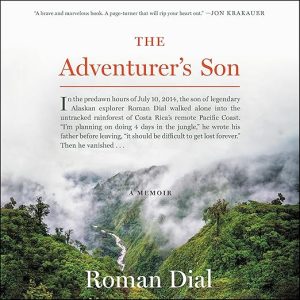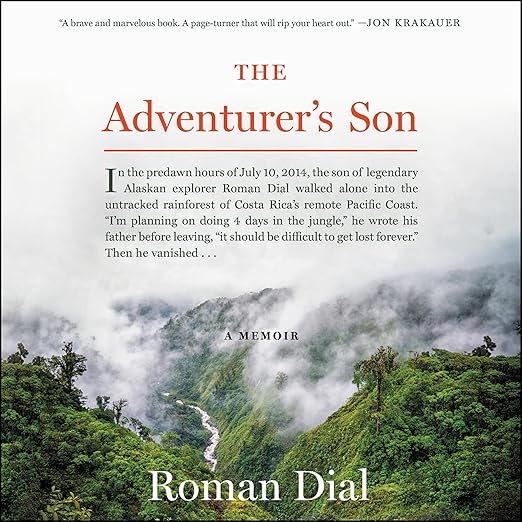
An email about four days in the jungle is the hinge this entire audiobook turns on. Cody Roman Dial, twenty-seven, wrote to his father that he would be bounded by a trail to the west and the coast everywhere else, so it should be difficult to get lost forever, then walked into Corcovado National Park before dawn on July 10, 2014 with a light pack and a machete. Nothing came after it. Roman Dial spent two years looking for an answer, and this is the book he wrote about the looking, which is a different book from the one the outdoor-adventure shelf usually produces.
What Roman Dial Delivers
Classification defeats most readers, and one May 2020 five-star gets closer than the publisher does by refusing to choose. Writing as one of two parents of three sons who took up similar pursuits without the same ending, that reader calls it a biography, a celebration of a life, a declaration of love and finally a eulogy, and adds the observation that matters most: without the biographical groundwork the search would be hard to care about. That is precisely right. The early chapters build a person, and every hour spent on Cody before Costa Rica is what makes the later chapters unbearable in the way they are supposed to be.
Structure is the second thing to understand before buying. A missing-person account has a natural shape, chronological and propulsive, and this one keeps interrupting it. The father searching the rainforest, interviewing locals, weighing the suspicion of murder the authorities raised, keeps having to stop and reckon with the fact that he taught this child to seek out exactly these places. The book that results is half investigation and half self-examination, and neither half would work alone. Ten hours and thirty-nine minutes gives both room without letting the search slacken.
What Roman Dial Gets Right
Candor is what the sympathetic responses keep naming. A November 2025 five-star, from somebody who had followed Dial's work long before this book existed, praises the honesty in it, and honesty here means something more uncomfortable than confession. Dial raised his son to be fearless, on purpose, as a stated philosophy of parenting, and then had to live inside the consequences of a philosophy that had until then looked like a gift. He does not resolve the question. He puts it on the page and lets the reader hold it.
Parents are the readers this destroys, and one April 2025 five-star explains why better than any summary could: the book reaches anyone who has raised a child, whether or not they have lost one, because everybody regrets some part of how they did it. That reframing is the reason the book outlives its news story. Strip away Costa Rica, the authorities and the two-year search and you still have a father asking what he made, which is a question with no floor to it and no comfortable answer at the bottom.
Where Roman Dial Loses Some Ground
The one dissent in the column is a three-star from January 2024, filed under a headline about being emotionally compelled but holding reservations. That entry rehearses the setup at length, quoting the same email the publisher's description quotes, before arriving at its qualification, which the visible text cuts off mid-sentence. Take the headline at face value and the reservation is legible enough: this is a book whose emotional force is not in question and whose construction is. Readers who want the search tightened will find the middle stretch repetitive, because a real search is repetitive.
Emotional load is the caveat nobody puts on a listing. The copy tells you the shape of the ending in its first paragraph, so surprise is not the issue; endurance is. Ten hours inside a bereaved parent's reconstruction of a death is not the same purchase as ten hours of adventure writing, and the comparison the copy invites, to Into the Wild, sets up the wrong expectation, since that book watched a stranger from the outside. Dial is writing about the person he raised, and no amount of landscape prose lets you off that hook.
Nothing in the column addresses this recording. Fred Sanders reads it, and none of the five entries says a word about how the book sounds. So the listener's central question, whether a hired voice can carry a father's own account without either flattening it or pushing it, goes unanswered here. The description has its own small unprofessionalism: the Krakauer endorsement at the top arrives wrapped in doubled quotation marks, an encoding artifact nobody bothered to clean up.
Who Roman Dial Is Writing For
Wilderness nonfiction readers will recognize the country and should still expect something harder than the genre usually delivers, since the terrain is described by a working scientist rather than a visitor and the stakes are domestic rather than heroic. Anyone drawn to accounts of searches, investigations and the slow accumulation of small facts will find the two-year reconstruction absorbing on its own terms. Parents of adventurous children are the audience this will mark most, which the response column bears out.
Grieving parents should approach with care, or with somebody nearby, because the book offers no consolation and does not pretend to. Listeners who want a straight adventure narrative should also pass, since the pleasure of the outdoors is present mainly as evidence in a case the author is building against himself. Everyone else gets a memoir that earns the two years it took, told by the one person who could neither look away nor claim objectivity. Bring more time than the runtime suggests.
- Read by: Fred Sanders reads a father's first-person account, a casting the response column never once addresses
- At its heart: A missing son, parenting toward risk, the limits of self-forgiveness
- Vibe: Patient and devastating, an investigation running under a eulogy
- Short version: A grief memoir that outclasses the adventure shelf it sits on, and a hard listen by design.
Common Questions
Is the audiobook as much about Costa Rica as about the search?
The setting matters, and one January 2022 four-star reports reading it while visiting Costa Rica and finding the experience sharper for it. Corcovado is described precisely, including the miners, poachers and smugglers who use it. The place is evidence in the case rather than scenery, so expect terrain rendered for what it explains.
Does the audiobook spoil its own ending?
The publisher's description already tells you the son disappeared and frames the book as an account of profound loss, so nothing is being withheld. What remains uncertain through the recording is how the answer was reached and what the father concludes about his own part in it, which is where the tension actually lives.
How much wilderness and expedition detail is there?
A good deal, since both father and son built their lives around it and the earlier chapters cover the trips that shaped Cody. The detail is functional rather than decorative: it establishes how competent he was, which is what makes his disappearance so difficult to explain and the search so painstaking.
Is it suitable for younger listeners?
It is written for adults. The subject is the death of a young man, the investigation includes a suspicion of murder, and the emotional register assumes a reader who has some experience of loss or of parenthood. Older teenagers with an interest in expedition writing could manage it, ideally alongside someone to talk to.