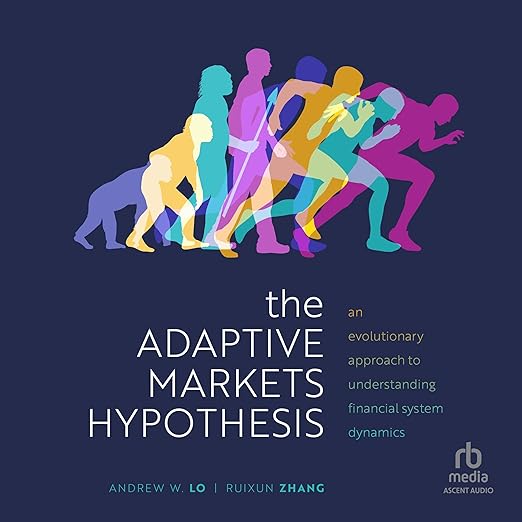
Rational investors and periods of temporary financial insanity are not supposed to fit inside the same theory, and reconciling them is precisely what this book sets out to do. The Adaptive Markets Hypothesis treats investors as intelligent and fallible at once, learning from environments that keep shifting underneath them, so that the efficiency of a market becomes a variable rather than a permanent property. The audiobook runs twenty-eight hours and one minute, which is an enormous commitment by any standard and the first thing a prospective listener has to weigh.
Ruixun Zhang's Name Is Missing From the Byline
What makes the argument more than a slogan is the machinery underneath it. Rather than asserting that markets adapt, the book builds evolutionary models of behavior and then shows how the most fundamental economic behaviors we take for granted can arise through natural selection alone, without assuming a rational agent at the start. Cognitive neuroscience and artificial intelligence get drawn in to explain how a brain shaped by one environment makes financial decisions in another. Markets stay competitive and innovative throughout; what changes is how efficient they happen to be as the population of investors changes around them.
Someone is missing from the byline, and it matters. The description states plainly that Andrew Lo and Ruixun Zhang develop the mathematical foundations together, yet the author field on this listing carries only one of those names. Whether the second author wrote a section, a chapter or half the formal apparatus, nothing on the page says, and a researcher searching for work under that name will never reach this recording. On a book whose selling point is its mathematics, carrying only one of the two names is an odd omission.
Institutional labels multiply on the page as well. Clarendon Lectures in Finance is what the series field says, with no number attached; Ascent Audio appears as the publisher of the recording; and a written response names Oxford University Press as the house responsible. Three different institutions appear on one product page, and the copy calls the book a volume, which is the vocabulary of an object that sits on a shelf. None of that changes the content, but it tells you the copy was written for print and reused unaltered.
Lenz Carries Lectures Built to Be Spoken
Practical stakes justify the hours. The book is aimed at anyone who has been puzzled and unsettled by how markets behave and who wants to know what that behavior means for their own wealth, which is a considerably more grounded target than most theoretical finance. If efficiency is a variable rather than a constant, then the strategies that work depend on which regime you are living through, and that reframing is useful to a private investor who has watched supposedly rational pricing evaporate more than once in living memory.
The derivation is the intellectual pleasure. Watching behaviors that economics normally assumes, risk aversion, probability matching, herding, emerge as consequences of selection pressure rather than as axioms is genuinely satisfying, and it is the kind of argument that benefits from being heard in sequence, because each step depends on the one before it. Skimming a chapter of this would lose the thread; listening obliges you to take the steps in order.
Mike Lenz carries the entire twenty-eight hours, and the material has an advantage most technical books lack: the series field places it among the Clarendon Lectures in Finance, and lecture writing is built to be spoken. Argument delivered in that register survives the move to audio better than a monograph assembled for the page, and a listener who has struggled with dense finance writing may find this considerably easier to follow aloud than in print.
Six Ratings Cannot Produce a 4.6 Average
Mathematics is the obvious hazard. A book that advertises formal foundations and evolutionary models will contain notation, and notation read aloud becomes a stream of subscripts and Greek letters with no visual structure to hold them. Expect the narrative chapters on behavior, neuroscience and market history to work fully, and the formal sections to function as a summary of what an equation is doing rather than as the equation itself. Anyone who wants the derivations will need the printed edition alongside.
The star rating cannot be what it says. Six ratings sit behind a displayed average of 4.6, and six whole-star votes cannot produce that figure: twenty-seven stars across six votes is 4.5 exactly, twenty-eight is 4.67, which displays as 4.7, and no total in between exists. The badge is damaged metadata rather than a verdict, so treat it as decoration and read the written entries instead, which is easy enough given how few of them are attached.
Those written entries are worth examining, because neither is about this recording. A four-star filed from Germany in February 2024, three months before the audio went on sale, praises the content and the price and then complains that the binding breaks after a few days, which is a physical object failing rather than a file. The other, a five-star from Spain written in Spanish, calls the work interesting, rigorous and novel on theories of market behavior. Both speak to the text itself. Neither was written about this edition of it.
Casual Listeners Should Expect No Quick Takeaways
Serious finance listeners with a tolerance for theory are the audience here, particularly anyone who has read around behavioral economics and wants a framework rather than another catalog of biases. Professionals who spend commuting hours on audio and want a single substantial work to occupy several weeks will find the length an asset rather than an obstacle, and the lecture structure keeps the argument moving even when the subject turns formal.
Casual finance listeners should be warned that this is not a book of takeaways. Nothing here is designed to be actionable by chapter three, the payoff is a way of thinking about market behavior rather than a set of instructions, and twenty-eight hours is a great deal of theory to absorb for a reader who mainly wants to know what to do with a retirement account. Anyone in that position would do better with a shorter book and come back to this one later.
How long is the audiobook, and who is credited with the reading?
Twenty-eight hours and one minute, read by Mike Lenz, in an Ascent Audio edition released in May 2024. At an hour a day that is a month of listening, so it suits a long commute or a training routine rather than a weekend, and it repays being taken in order.
Is the audiobook enough on its own, or do I need the print edition too?
It depends what you want from it. For the argument, the history and the implications for your own money, listening is sufficient and arguably clearer. For the models themselves, buy the book as well; the formal apparatus is the one part that cannot survive being spoken.