Quick Take
- Narration: Virtual Voice reads a book built entirely around guided meditation, breathwork, and somatic practice, the synthetic narrator strips the therapeutic mechanism from the content almost entirely, making this one of the clearest genre mismatches in the health catalog.
- Themes: Vagus nerve activation, polyvagal theory, somatic emotional regulation
- Mood: Calm and instructional in intent, though the Virtual Voice delivery cannot produce the contemplative register the content requires
- Verdict: Valuable nervous-system content fundamentally undermined by a narration format incompatible with guided meditation, the companion PDF tools are the more practically useful element of this product.
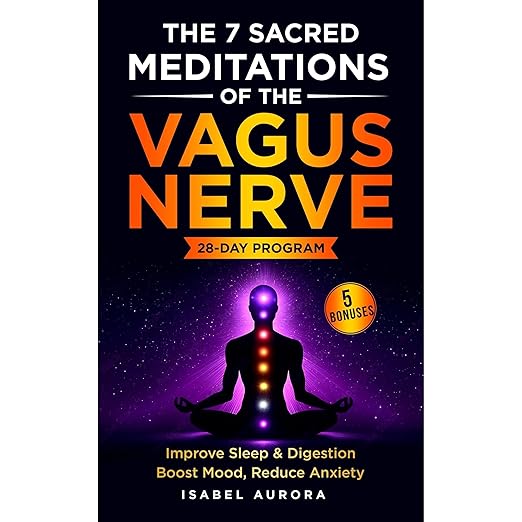
There is a category of book that simply should not exist as a Virtual Voice audiobook, and guided meditation is the clearest example. I want to be precise about why, because the content inside The 7 Sacred Meditations of the Vagus Nerve has genuine merit: the nervous-system-regulation material draws on polyvagal theory with more accuracy than most popular treatments, and the 28-day structure is thoughtfully designed. But the delivery mechanism here works directly against everything the content is trying to accomplish.
The vagus nerve is the primary component of the parasympathetic nervous system, running from the brainstem to the abdomen and playing a central role in regulating heart rate, digestion, and the body’s transition out of stress states. Polyvagal theory, developed by neuroscientist Stephen Porges, has been one of the more genuinely influential frameworks in trauma-informed therapy over the past two decades, and Aurora applies it here with reasonable fidelity. The 10-minute guided meditation format, structured around a 28-day rhythm, is a sensible container for this kind of practice.
The Mechanism That Synthetic Voice Removes
Guided meditation works partly through content, the instructions for breath, movement, or attention, and partly through voice quality: pace, warmth, silence, the felt sense of being accompanied rather than instructed. A synthetic voice delivers the content while removing the second element entirely. Reviewer LM1985 Tucson noted that the meditations are short, accessible, and effective after ten minutes a day, which suggests the content works in some form. But that review cannot tell us whether the audio product specifically is working, or whether the underlying techniques are being practiced through the companion PDF that comes with the Audible purchase.
This is not a minor distinction. The book’s synopsis lists an extensive collection of bonus materials: somatic exercise cards, vagus nerve reset practice cards, mandala and nature reverse coloring pages, and a seven-day somatic journaling guide. All of these are in the companion PDF. At two hours and forty-six minutes for a program that includes seven meditations, journal prompts, and a complete 28-day plan, each element necessarily receives limited audio development. The PDF tools are not supplementary; they are load-bearing.
What the Content Actually Gets Right
Setting aside the narration problem, Aurora’s framework is coherent. The 28-day rhythm addresses a real problem with meditation programs, which is that they ask for long-term habit formation without building the behavioral infrastructure that makes sustained practice possible. The Daily Rhythm Method described in the book addresses this by using micro-practices that accumulate across the day rather than requiring a single dedicated session. Reviewer Roxy, identifying as a healthcare provider, found the explanations of vagus nerve function and dysregulation symptoms genuinely instructive.
The book also avoids one of the more common failures in popular polyvagal content, which is to describe the theory accurately while offering techniques that do not actually engage the mechanisms the theory describes. The breathwork, sound-based, and movement practices outlined are consistent with what the research suggests about vagal tone improvement.
How to Approach This Product
If you are drawn to this content, you have two reasonable approaches. One is to engage with the print version alongside the companion PDF and use the audio only as a secondary reference. The other is to look for a human-narrated guided meditation audiobook on vagus nerve regulation and use this book’s PDF tools as a complement. The Secure Within Series that this title inaugurates would benefit significantly from professional recording.
Who Should Listen and Who Should Skip
Readers already familiar with polyvagal theory who want the somatic tool set in the companion PDF and do not mind synthetic narration will find the framework useful. Skip the audio version if you are buying a guided meditation specifically for the guided meditation experience: the Virtual Voice narration cannot deliver what this genre requires. The content has value; the format is the obstacle.
Frequently Asked Questions
Can the guided meditations in this audiobook actually be used as guided meditations with a Virtual Voice narrator?
In a limited sense the instructions are present, but guided meditation relies substantially on vocal presence, warmth, and pacing cues that a synthetic voice cannot deliver. Most listeners will find the companion PDF’s somatic tools more practically useful than the audio meditations themselves.
What does the companion PDF included with the Audible purchase actually contain?
The synopsis lists 50 somatic exercise cards, 50 vagus nerve reset practice cards, 30-plus mandala reverse coloring pages, 30-plus nature reverse coloring pages, and a 7-day somatic journaling guide. These are described as essential to the full program rather than supplementary.
Is the polyvagal theory referenced in this book applied accurately?
More accurately than in most popular treatments. Aurora connects the meditation and somatic practices to vagal tone mechanisms in ways consistent with the research literature, and the 28-day structure reflects genuine understanding of how habit formation intersects with nervous system regulation.
How does this compare to other audiobooks on vagus nerve healing?
The content is among the more structured and scientifically grounded popular treatments available. The narration is its most significant limitation. For a human-narrated alternative, look for vagus nerve or polyvagal-focused titles by therapists who record their own work, as self-narration is particularly important in this genre.