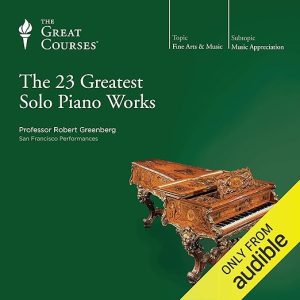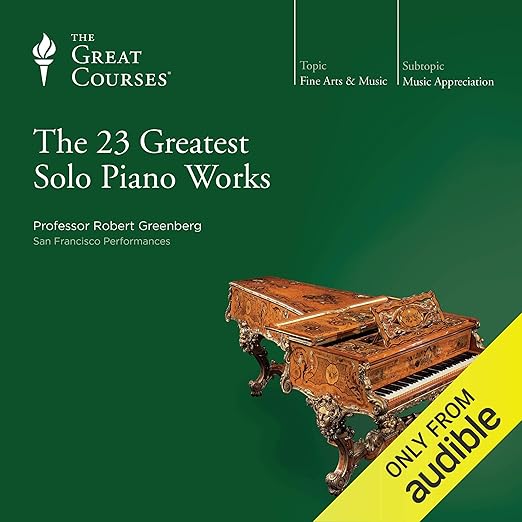
Twenty-four lectures, twenty-three works, and no line in the listing explaining the extra one. That small mismatch is the first honest thing to say about this audiobook, and it is nowhere near the largest thing the product page gets wrong. Robert Greenberg wrote the course and delivers it, which for a Great Courses release is less a casting decision than a job description, and the survey travels from Bach to Prokofiev across a little under twenty hours of material.
How The 23 Greatest Solo Piano Works Holds Up
What Greenberg builds here is not a listening guide in the usual sense. Each lecture takes a single work and gives it a full session, which means the course moves slowly on purpose. Three layers run in parallel throughout: the music itself, the artistic and cultural weather that produced it, and the piano as a machine that kept changing under the composers' hands. That third strand is the one that justifies the length. An instrument still being redesigned while composers wrote for it is not a neutral vessel, and hearing the music answer those redesigns is a different experience from hearing the pieces alone.
wbiro, grading the course four stars in December 2023, put a finger on the one quality no written description can capture, which is the playing. The assessment was that Greenberg "begins a bit plodding on the piano, but it picks up later, both when he plays and when he uses recordings of concert pianists." That is a precise account of what this format actually is: a teacher demonstrating at the keyboard, with professional recordings brought in when the argument needs them.
The listing's note about accompanying reference material is easy to skim past and should not be. A course organized one masterwork at a time hands you a document to sit alongside the audio, and for a subject where the examples are musical rather than verbal, that document is the difference between following the argument and taking the lecturer's word for it. Nothing in the audio collapses without it. Plenty of it lands harder with it open, particularly in the later sessions, where the works grow less familiar.
Why The 23 Greatest Solo Piano Works Works as an Audiobook
The strongest argument for pressing play is the sequencing. Bach opens the run, Mozart and Beethoven follow, then the nineteenth century arrives through Chopin, Schumann and Liszt before Scriabin, Debussy and Prokofiev close the arc. More than two centuries of writing for a single instrument, told through twenty-three specific pieces rather than through movements and isms, gives the whole thing a spine that most music-appreciation series never manage to find. Survey courses usually organize by period and then hunt for examples. This one starts from the pieces and lets the periods assemble themselves around them, which is both harder to write and much easier to remember.
A five-star response from September 2021 gets at the delivery directly: "Very engaging delivery, funny bits, and I learned a lot! Which was the point." The same listener reports buying several further Greenberg courses in download form afterward and relistening to some of them twice. Repeat listening is the useful signal in a survey this long, because a lecture you can stand a second time is a lecture that has been written rather than merely spoken.
It also works as history without pretending to be a history course. Each piece gets placed in the environment that produced it, and the instrument's own development runs underneath as a third thread, so you hear why the writing changed as the mechanism changed. For anyone who plays a little, that connection reorganizes how you approach the repertoire afterward. The question the lectures keep returning to is not what a piece means but what inspired it and how it was actually put together, which turns composers into working professionals rather than portraits on a concert-hall wall.
Weak Spots in The 23 Greatest Solo Piano Works
Two of the five visible responses have nothing to do with the lectures at all. Both are one-star, and both concern a physical package: jpbooklover, in December 2020, wrote "I received the book, but no CD. Please complete the order," and a December 2019 entry reports a single disc arriving out of three. Those complaints belong to a boxed edition. They are sitting on a listing where nothing ships, and they are pulling the displayed 3.2 down with them.
What remains is a thin pool of actual opinion: one four-star assessment with real detail, one five-star note about delivery, and a five-star entry from August 2016 whose entire body is the word "Thanks." Eight ratings altogether, on a course that has been available since September 2013. Reading that displayed average as a verdict on the teaching means reading a fulfillment record and calling it criticism. The dates make the problem clearer still: the graded opinions arrive in 2016, 2021 and 2023, spread across seven years, while both complaints land in December, in 2019 and again in 2020.
Scope is the second thing to weigh. Twenty-three works across two centuries is a curated list, not a canon, and the modernist end of it stops at Prokofiev. If your curiosity runs past the middle of the twentieth century, the course does not go there. The listing publishes no work-by-work index either, leaving no way to check those twenty-three choices against your own before committing to the full run. That weighs more here than it would on a novel, because the entire proposition rests on which pieces got picked.
The Right Listener for The 23 Greatest Solo Piano Works
This suits the listener who already enjoys concert music and wants to understand how it was built. Reading notation is not required, and the course says so plainly, welcoming newcomers alongside people who have been going to recitals for decades. What you do need is patience for a format where one work can occupy an entire session and where the teaching happens at the keyboard as often as at the lectern. It also suits the semi-lapsed player with an old upright and a folder of abandoned pieces, because the course keeps explaining why those pieces were shaped the way they were.
Anyone hoping the twenty-four lectures double as a recital should look elsewhere. The demonstrations are illustrative rather than performances, and the professional recordings that appear are excerpts inside an argument. Equally, if you want a reference to dip into by composer, the one-work-per-lecture structure works against you, because the value compounds across the run and dropping in on lecture seventeen gives you a well-made session with no scaffolding under it.
Approach it as a long argument about one instrument, made by someone who plainly still enjoys the sound of the material, and the run goes faster than the number on the page suggests.
Key Details
- Performance: Self-read by the professor who wrote it, so the keyboard demonstrations are part of the teaching rather than an add-on.
- What it covers: Two centuries of solo piano repertoire, composer biography, and the evolution of the instrument itself.
- Feel: Unhurried, classroom-warm, occasionally funny.
- Our call: A genuinely useful survey buried under a star average that is measuring a shipping problem.
Does the audiobook come with the reference material the listing mentions?
Yes. The product page notes that accompanying reference material is delivered to your library with the recording. For a course built one masterwork per lecture, that document carries the visual side of the examples, and it repays opening for the pieces you already half know. Nothing in the audio depends on it, but the teaching lands better with it in front of you.
Why does the audiobook list twenty-four lectures when the title names twenty-three works?
The listing never explains it, and no track index is published to check against. Twenty-three works are promised and twenty-four sessions are delivered across nineteen hours and twenty-eight minutes, which most plausibly reflects an introductory or framing session. Since nobody states that outright anywhere on the page, treat the extra one as unaccounted for until you press play.
Is the ability to read music required here?
No. The course explicitly welcomes listeners new to concert music alongside experienced concertgoers, and the lectures work from sound rather than from notation. Familiarity with the repertoire helps you place a piece faster, but the placing is done for you, and the demonstrations at the keyboard supply what a printed score would otherwise have to show.
Is this audiobook a sensible entry point if you only know the famous pieces?
It is, provided you take it in order. Each session presents one work as a self-contained encounter, so the famous pieces are approachable on their own terms. The through-line about the instrument's development only pays off cumulatively, though, and starting at the beginning makes the later modernist lectures considerably less abrupt than they would otherwise feel.