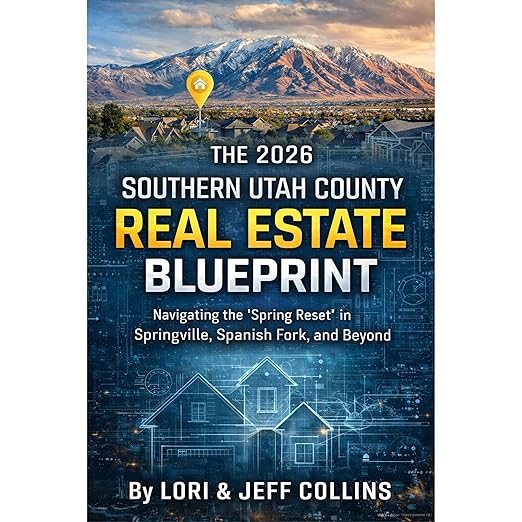
Key Details
- Narration: Virtual Voice narrates clearly and consistently, which suits the book's instructional and data-driven content , precision matters more than performance in this format.
- Themes: Rate buydown strategy, seller negotiation frameworks, navigating a high-interest-rate real estate market
- Mood: Analytical and market-specific, practical rather than motivational
- Verdict: A sharply focused real estate playbook for Southern Utah County buyers, sellers, and agents , most valuable for those active in the 2026 Spring Reset window.
868 Homes, Explained in Clear Narration
Lori Collins opens this audiobook with a statistic that sets the tone for everything that follows: in a single week in early 2026, 868 homes in Utah County had price reductions , and according to Collins, most of those reductions were the wrong move. That claim immediately defines the book's purpose. This is not a general guide to real estate investing. It is a specific, math-driven playbook for buyers and sellers in six cities: Springville, Spanish Fork, Mapleton, Payson, Salem, and Santaquin. The frame is the 2026 Spring Reset , a particular market moment Collins and her co-author Jeff Collins argue represents one of the best buying and selling opportunities the region has seen in years, for those who understand its mechanics.
The Virtual Voice narration delivers this information clearly and at appropriate pace for instructional content. For a book built around specific financial frameworks, negotiation scripts, and payment tables, clarity and consistency in narration matter more than character differentiation, and Virtual Voice meets that bar. Listeners following along with the PDF companion or taking notes will find the delivery functional for that purpose.
The Rate Buydown That Beats a Price Cut
The centerpiece of the book is the 2-1 Rate Buydown, and Collins explains it with the kind of arithmetic that changes how you think about a negotiation. The comparison is precise: a $10,000 price cut saves a buyer approximately $70 per month. The same $10,000 applied as a seller-paid rate buydown saves $590 per month in Year 1. Same seller cost, eight times the buyer impact. Collins then walks through the complete math, real payment tables, and what she calls a Refinance Bridge strategy for 2027 to 2028, accounting for what happens to buydown funds if the buyer refinances early.
The book also covers a tax strategy around seller-paid buydowns that Collins notes most agents will not raise with their clients: a seller-paid buydown can potentially reduce taxable capital gains under IRS Topic 504. This is the kind of specific, verifiable information that makes specialist nonfiction valuable. Collins is careful to note that the tax information is general and should be verified with a CPA, which is the appropriate caveat.
Four word-for-word negotiation scripts are included for buyers' agents, sellers, FSBO transactions, and new construction builder negotiations. These are among the most practically useful elements for listeners who are actively navigating a transaction. A regional market comparison across all six South Valley cities , with median prices, days on market, and buyer persona guidance , grounds the general strategies in the specific numbers of the region Collins knows from 25-plus years of practice.
March 2026 Numbers in a Moving Market
The scope is deliberately narrow. If you are not buying or selling in Southern Utah County, large portions of the book's regional data and city-specific guidance will not transfer directly to your situation. The conceptual frameworks , the rate buydown math, the ghost discount analysis, the negotiation scripts , travel better than the market data, but the book is designed for a specific audience in a specific geography at a specific moment.
All financial examples are based on market conditions as of March 2026. The interest rate environment, days-on-market figures, and price reduction patterns described may shift in the months following publication. Collins flags this clearly, which is responsible practice, but listeners using this audiobook for active transaction guidance should verify current figures against present market data rather than relying solely on the numbers provided.
Video Marketing Tips and a Closing Glossary
The section on AI video marketing for sellers is a more unusual inclusion. Collins argues that the 2026 listing environment is digital-first in ways that most agents have not fully adapted to, and that sellers who understand how to use short-form video with algorithmic distribution have a real advantage in a market where 68 to 83 days on market is the norm. This section is less detailed than the financial framework chapters but points toward a dimension of the current market that most real estate guides have not yet integrated into their advice.
The glossary and FAQ included at the end of the audiobook are worth noting specifically. Collins compiled a complete 2026 Real Estate Glossary covering the terminology that appears throughout the main text, which means listeners who encountered unfamiliar terms earlier can return to this section for clarification without needing to consult outside sources. For a first-time buyer who entered this audiobook because they did not know what a rate buydown was, the glossary represents the book completing its own educational loop rather than assuming vocabulary it spent the main text establishing.
Made for Utah Buyers in a 6% World
This audiobook suits buyers and sellers in the Southern Utah County market who want a math-grounded framework for navigating a high-rate environment rather than the general advice available from most real estate content. Real estate professionals in Utah County will find the negotiation scripts and the buydown framework immediately applicable. First-time buyers trying to make monthly payment math work in a 6-percent rate environment will find the rate buydown explanation particularly clarifying.
General real estate investors or listeners outside the Southern Utah County market should approach this as a framework guide with regional data that may not translate. The underlying financial logic of the rate buydown is broadly applicable; the city-specific market analysis is not. For its primary audience, the book provides a level of specificity and practical depth that generic real estate guides cannot match.
A Few Questions About The 2026 Southern Utah County Real Estate Blueprint
Is this audiobook useful for real estate investors outside of Southern Utah County?
Partially. The conceptual frameworks, particularly the 2-1 Rate Buydown math and the negotiation scripts, transfer to other high-rate markets. The city-specific market data for Springville, Spanish Fork, Mapleton, Payson, Salem, and Santaquin does not. Listeners outside the region should treat the regional sections as illustrative rather than directly applicable.
Are the negotiation scripts in the audiobook suitable for FSBO sellers without agent representation?
Yes, Collins includes a specific script for FSBO transactions alongside scripts for buyers' agents, sellers working with representation, and new construction builder negotiations. The FSBO script is designed for use without professional agent support and addresses the particular negotiating dynamics of direct seller-to-buyer transactions.