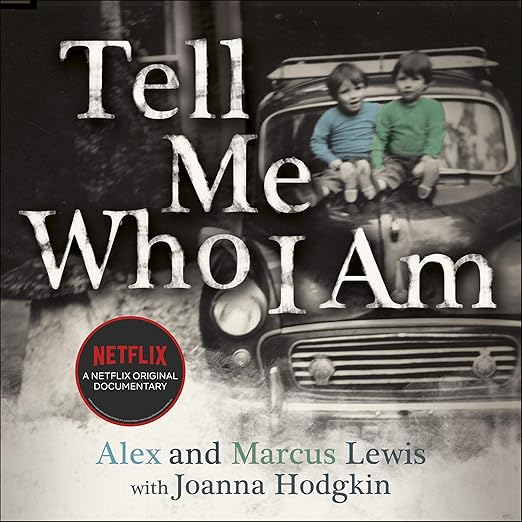
Quick Take
- Narration: Ben Allen handles the book’s three-part structure with sensitivity, moving between amnesia memoir, investigative family history, and trauma testimony without losing the emotional thread that holds all three together.
- Themes: Amnesia and identity, childhood abuse and its concealment, the competing loyalties of twin siblings
- Mood: Deeply affecting and at times harrowing, balanced by an insistence on love and survival
- Verdict: A memoir that goes significantly further than the Netflix documentary it inspired, documenting a family story of extraordinary complexity with care and unflinching honesty.
I watched the Netflix documentary first, as many listeners likely will, and came away shaken but also aware that the film was protecting something. The cameras were on the twins, Alex and Marcus Lewis, but the documentary kept a careful distance from the full weight of what had happened in their childhood home. A friend told me afterward that the book tells you what the film could not bring itself to say. She was right. I listened to Tell Me Who I Am on a series of quiet evenings, and by the third night I understood why one reviewer described reading it as two days of being unable to put it down. It is not a book that releases you easily.
The premise is genuinely unlike anything else in recent memoir. Alex Lewis, at eighteen, suffered a severe motorcycle accident that left him with total amnesia. He remembered nothing of his life except his twin brother Marcus. Over the following years, Marcus became Alex’s entire guide to his own past, reconstructing for him who he was, what their family was like, and what his childhood had contained. What Alex did not know was that Marcus was editing the reconstruction. The secrets Marcus kept, and the reasons he kept them, constitute the book’s central revelation.
Our Take on Tell Me Who I Am
Joanna Hodgkin built this narrative from extended conversations with both brothers, and the three-part structure reflects the layered truth of what happened to them. The first section covers Alex’s accident and his experience of living without the past that everyone else carried into every room. The second follows both brothers into the investigation of their family’s history, which includes a step-brother and step-sister whose existence the Netflix documentary never mentioned. The third grapples with what the truth does to people who have spent decades managing not to fully know it.
One reviewer noted that the book reveals the existence of a step-brother, Oliver, who was also abused by the twins’ mother, a detail completely absent from the documentary. Another described the full truth of what happened in that house of horrors as something the documentary wisely chose to partially withhold. Both responses suggest a book that contains more than most readers or listeners are prepared for, not in a gratuitous way but in the way that genuine memoir sometimes exceeds what documentary filmmaking can ethically present.
Why Listen to Tell Me Who I Am
Ben Allen’s narration is the right choice for material of this complexity. He reads Hodgkin’s prose with a register that respects both the horror and the extraordinary love at the center of the story. The relationship between Alex and Marcus, built on a lie that was also an act of protection, requires a narrator who can hold those two realities simultaneously. Allen does not editorialize; he allows the events to carry their own weight.
The book’s emotional argument, that redemption founded on brotherly love can survive even devastating revelations, is not sentimentality. It is a specific claim about what Alex and Marcus actually built together after the truth emerged. The listener who comes for the extraordinary story of amnesia and identity stays for the reckoning with what loyalty and concealment cost both of them.
What to Watch For in Tell Me Who I Am
One reviewer noted that the book drags in places, particularly for listeners who have seen the documentary and are waiting for the narrative to reach territory the film did not cover. The first section on Alex’s amnesia is genuinely fascinating as a study in identity and memory, but readers who arrived via the documentary will be familiar with its broad outlines.
The subject matter, childhood sexual abuse, is handled with care but not euphemistically. Listeners who found the documentary difficult should approach the audiobook knowing that the book goes further in its specificity. The additional family members and the full extent of what occurred in the Lewis household are not softened for the page.
Who Should Listen to Tell Me Who I Am
This audiobook is for listeners who watched the Netflix documentary and understood that they had not been told the complete story. It is also for anyone drawn to memoir that deals honestly with trauma, identity, and the complexity of sibling loyalty under extreme pressure. Readers interested in the psychology of memory, particularly the specific experience of amnesia and recovered truth, will find the first section extraordinary. This is not light listening, and it is not for everyone, but for those it suits, it is one of the more genuinely important memoirs of recent years.
Frequently Asked Questions
How much more does the book reveal compared to the Netflix documentary?
Significantly more. The book includes a step-brother, Oliver, and a step-sister not mentioned in the documentary, the full extent of the abuse both experienced, and the complete truth that Marcus withheld from Alex for years. Multiple reviewers specifically note that the book was stunning in how much more it contained than the film.
Is the three-part structure of the book evident in the audiobook format?
Yes, the three sections are clearly delineated. The first focuses on Alex’s amnesia and his experience of rebuilding an identity from Marcus’s reconstruction. The second investigates the family history. The third deals with the aftermath of full disclosure. Ben Allen’s narration respects the different emotional register each section requires.
Does the book give both Alex’s and Marcus’s perspectives on the central secret Marcus kept?
Yes, Joanna Hodgkin worked closely with both brothers. The book moves between their perspectives, including Marcus’s account of why he chose to protect Alex from the full truth and what that protection cost him over decades. The dual perspective is central to what makes the book more than a simple disclosure narrative.
How does Ben Allen’s narration handle the most difficult content in the book?
Allen maintains a measured, empathetic register throughout. He does not perform the distress of the material, which is the right choice. The events carry their own weight, and his restraint allows the listener to respond without being directed toward a specific emotional reaction. Several reviewers describe the book as hard to put down rather than hard to hear.