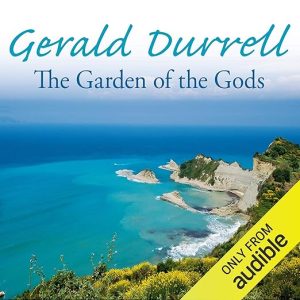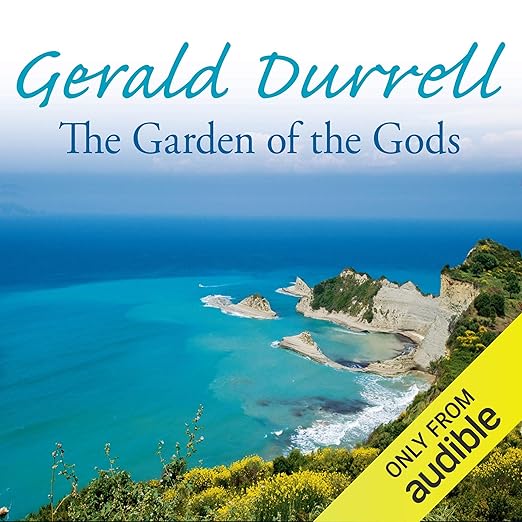
Quick Take
- Narration: Christopher Timothy brings exactly the right mix of dry wit and genuine wonder to Durrell’s boyhood voice, making the animal-collecting escapades feel both absurd and entirely believable.
- Themes: Childhood wonder and naturalist obsession, eccentric family life, pre-war Mediterranean idyll
- Mood: Sunny, gently comic, nostalgic without sentimentality
- Verdict: A fitting close to the Corfu Trilogy that holds up beautifully as an audiobook, with Christopher Timothy’s narration enhancing every comic set piece.
I first encountered Gerald Durrell’s Corfu books as a teenager, in battered paperbacks with sun-faded spines. Coming back to The Garden of the Gods decades later, through Christopher Timothy’s narration on a long drive through countryside that looked nothing like Corfu, I was genuinely surprised by how much it gave me. The humor I remembered was all there, but I had forgotten how precise Durrell’s eye was, how attentively he observed both the creatures he collected and the humans around him who tolerated, barely, his obsession.
This is the third and final book of the Corfu Trilogy, covering the last years of the Durrell family’s residence on the island before the Second World War changed everything. The young Gerald, passionate naturalist and chaotic household member, is in full form here. His family’s villa becomes, once again, a kind of involuntary menagerie, with animals ending up in places they should not be, most memorably the fridge. It is the kind of family memoir that feels unlikely and yet entirely plausible, because Durrell writes with the specificity of someone who lived it.
Our Take on The Garden of the Gods
What makes this final installment satisfying rather than merely pleasant is the sense of accumulation. By book three, the island’s human characters have become as vivid as the wildlife. The eccentric neighbors, the patient family members, the tutors and locals who orbit young Gerald’s obsessions, all of them have earned their places in the reader’s affections. Durrell treats them, as one reviewer noted, with consistent affection even when the comedy is at their expense. That generosity of spirit is what separates his work from the merely funny.
The naturalist detail remains the book’s distinguishing feature. Durrell was not yet the conservationist he would become, but the precision of his observation is already fully formed. The descriptions of specific birds, insects, and reptiles are not cataloguing exercises; they are portraits, written with the same attention to character that he brings to the humans. For listeners coming to this without prior knowledge of Durrell’s later career founding the Jersey Zoo, there is a pleasing irony in watching the obsession that would shape his entire life take root.
Why Listen to The Garden of the Gods
Christopher Timothy’s narration deserves particular attention. He has been narrating Durrell’s work for years, and the familiarity shows in the best possible way. He does not reach for comic exaggeration when Durrell’s prose is already doing the work; instead, he trusts the material and delivers it cleanly. The result is narration that feels like a conversation rather than a performance, which suits the memoir register of the book perfectly. At just over six hours, the runtime is ideal for a weekend afternoon or a longer train journey.
Listeners who know the ITV series The Durrells in Corfu will find plenty of connection points here, though the tone of the book is somewhat drier than the show. Durrell’s written humor tends toward the wry and observational rather than the broadly farcical, and Timothy calibrates accordingly. The book also covers some chronological ground that overlaps with the first Corfu book, My Family and Other Animals, but the perspective and the material are new enough that this does not feel repetitive.
What to Watch For in The Garden of the Gods
The book’s emotional undertow is worth paying attention to. Durrell does not dwell on it, but the approaching end of this Corfu chapter is present throughout. The family knows, even if young Gerald does not fully absorb it, that this particular life is ending. The Second World War is on the horizon, and the enchanted island of the book’s title is about to be left behind. Durrell handles this with remarkable restraint, letting the warmth of the details carry the elegiac weight rather than stating it directly.
The animal-in-the-fridge episode that anchors the synopsis is characteristic of the book’s comic method: a specific absurd incident, precisely observed, allowed to escalate at its own pace. The surrounding family chaos is equally precise. The mother who moved her family to Corfu, the siblings with their wildly different personalities, the household that somehow accommodates a small zoo, all of it is rendered with the affection that comes from actual memory rather than invention.
Who Should Listen to The Garden of the Gods
Anyone who loves natural history, particularly those with an interest in how great naturalists develop their passion, will find this rewarding. Fans of the Corfu Trilogy who have reached book three will not be disappointed; the series ends on a genuinely satisfying note. Listeners who enjoyed the BBC television adaptation of the Durrells will want to come here for the source material’s more literary texture. This is also a strong choice for families looking for something that genuinely entertains across age groups. Those seeking dramatic incident over atmosphere and character may find the pacing slow, but for the right listener, that pacing is exactly the point.
Frequently Asked Questions
Can The Garden of the Gods be listened to as a standalone, or is it better to start with My Family and Other Animals?
It works as a standalone because Durrell provides enough context to orient new readers, but the emotional resonance is considerably richer if you have spent time with the earlier books. My Family and Other Animals is one of the great comic memoirs in English and worth starting there.
Does Christopher Timothy narrate the full Corfu Trilogy, and is his approach consistent across all three books?
Yes, Timothy narrates all three books, and the consistency is one of the pleasures of listening to the trilogy in sequence. His interpretation of Durrell’s voice remains stable and well-judged throughout.
How does The Garden of the Gods compare to the first Corfu book in terms of subject matter and tone?
The tone is very similar, dry wit and natural history observation in equal measure, but some of the chronological events overlap with the first book from a different angle. The third book has a slightly more elegiac quality because the family’s time on the island is drawing to a close.
Is this audiobook appropriate for younger listeners who enjoyed the animal-focused content?
Yes, the content is entirely appropriate for older children and teenagers, and the animal-collecting material is particularly well-suited to young naturalists. The humor is gentle enough that it works across generations.