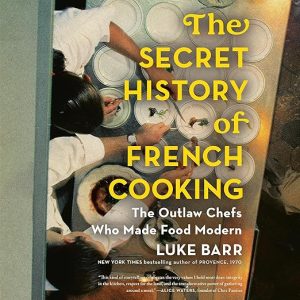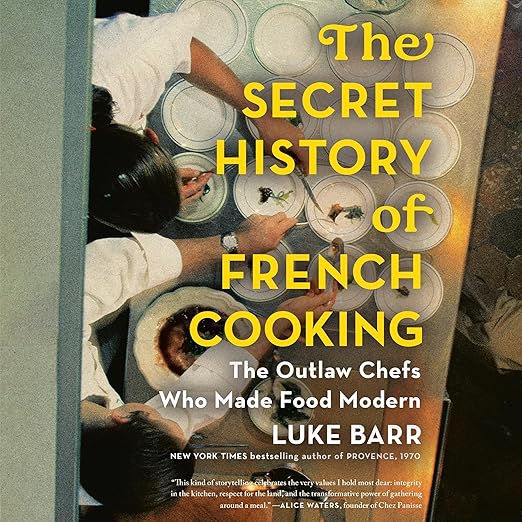
Quick Take
- Narration: Luke Barr self-narrates with the fluency of a practiced journalist, though his delivery is more conversational than theatrical, which suits the material’s cultural-history register rather than a dramatic one.
- Themes: Culinary revolution, male gatekeeping in the French kitchen, the politics of creative credit
- Mood: Lively and sharp-elbowed, with the energy of a world being overturned from the inside
- Verdict: A well-researched and absorbing account of how modern restaurant culture was invented, with the welcome addition of the women who were systematically written out of that story.
I spent a week in Lyon years ago eating in restaurants whose menus still bore the shadow of Paul Bocuse, and I remember thinking that the reverence afforded to nouvelle cuisine felt disproportionate for what was, when you stripped it back, food that was lighter and fresher than what preceded it. Reading about culinary history afterward, I understood better. The revolution mattered not just because the food changed but because the figure of the chef changed, from craftsman to auteur, from kitchen laborer to cultural celebrity. The Secret History of French Cooking is the story of how that transformation happened, told by someone who clearly loves the period and has done the research to do it justice.
Luke Barr previously wrote Provence, 1970, an account of the constellation of food writers, including M.F.K. Fisher, Julia Child, and James Beard, who gathered in the south of France and began to reshape American food culture. That book established his method: research-grounded narrative told through vivid characters, with food as the surface through which larger cultural arguments emerge. The Secret History of French Cooking applies the same approach to the renegade chefs of 1960s and 70s France who invented what we now call modern cuisine.
Our Take on The Secret History of French Cooking
The book’s central figures, Paul Bocuse, Michel Guerard, and the Troisgros brothers, are the architects of nouvelle cuisine, and Barr gives them their due as innovators who genuinely shocked the French food establishment with fresh ingredients, shorter cooking times, globally influenced flavors, and a willingness to treat cooking as an art form subject to the same creative questions as painting or music. That story has been told before, but Barr’s version has two elements that give it fresh authority.
The first is the political and commercial machinery surrounding the chefs: the rivalries, the celebrity endorsements, the all-powerful food critics who could make or destroy a restaurant’s reputation overnight. The villainous food critic the synopsis references adds a dimension of institutional power to what might otherwise read as a pure triumph narrative. The second, more significant element is the largely unknown story of the women chefs, including Simone Lemaire, Christiane Massia, and Olympe Nahmias, who were working at the same level of innovation but receiving a fraction of the recognition. The male culinary establishment of the 1970s was a closed system, and Barr documents its exclusions with the same specificity he brings to its celebrated achievements.
Why Listen to The Secret History of French Cooking
The single available review calls it a must-have and describes the rebellious kitchens as coming fully to life through Barr’s account, which matches the energy the material deserves. The audiobook benefits from Barr self-narrating his own research, which means the tone is that of a writer walking you through what he found rather than a narrator performing someone else’s discoveries. For cultural history of this kind, that distinction matters. You sense the author’s judgment behind each anecdote.
The book’s timeline spans roughly two decades of French culinary culture, which allows Barr to track not just the initial revolution but the backlash that followed. Movements tend to calcify into establishments, and the story of how nouvelle cuisine became the new orthodoxy is as interesting as the story of how it challenged the old one.
What to Watch For in The Secret History of French Cooking
Barr’s self-narration is fluent and engaged but not dramatically performed. Listeners expecting the kind of narration that uses vocal range and character differentiation to animate a story will find his delivery more essayistic than theatrical. This is not a criticism of the quality but a signal about the register. The book works as serious cultural history heard in the voice of its author; it does not work as performance in the way that some narrative nonfiction does when read by a professional.
The women chefs’ story, the most original element of the book, could arguably sustain its own full-length treatment. Barr weaves it through the main narrative rather than centering it, which means it illuminates rather than dominates. Listeners who come specifically for that history may wish for more.
Who Should Listen to The Secret History of French Cooking
This audiobook suits anyone interested in the history of modern restaurant culture, food writing, or the social and political dimensions of culinary innovation. Listeners who loved Barr’s Provence, 1970 will find this a natural companion volume. It is also valuable for anyone curious about how creative industries construct celebrity and manage credit, with the women chefs’ story providing a sharp counterpoint to the official hagiography surrounding Bocuse and his peers. Food-indifferent listeners who simply want cultural history told with color and rigor will find it rewarding.
Frequently Asked Questions
Do I need to have read Provence, 1970 before listening to this?
No, the books are independent. Provence, 1970 focuses on the American food writers who gathered in the south of France, while The Secret History of French Cooking focuses on the French chefs who were remaking Paris restaurants in the same era. They complement each other but do not require prior knowledge of each other.
How prominent is the story of the women chefs in the overall narrative?
Barr weaves the stories of Simone Lemaire, Christiane Massia, and Olympe Nahmias through the main narrative rather than giving them dedicated chapters. Their experiences illuminate the gendered power structure of 1970s French cuisine and provide a counterpoint to the official story of nouvelle cuisine as a male-led revolution.
Does the book cover Julia Child or other American figures familiar to US audiences?
The focus is on French chefs and the French culinary establishment. American figures appear at the margins, through the transatlantic influence of nouvelle cuisine on American restaurants, but this is primarily the story of what was happening inside France’s professional kitchens rather than how that influenced American food culture.
Is Luke Barr’s self-narration effective for a book of this length and density?
At seven hours and twenty-one minutes, his conversational authorial delivery works well. The tone never becomes fatiguing because Barr moves between anecdote, cultural analysis, and character portrait with reasonable fluency. Listeners who prefer performance-driven narration may find it somewhat flat, but for cultural history, the author’s own voice is a genuine asset.