Quick Take
- Narration: Virtual Voice narration on an economics book creates a flat, reference-manual quality, the material is already dense, and without human inflection to signal which points matter most, the listening experience requires more active effort than usual.
- Themes: Trade protectionism versus free trade, American economic nationalism, unintended consequences of tariff policy
- Mood: Informative but repetitive, more reference primer than sustained argument
- Verdict: A useful orientation to tariff history and its current relevance, but reviewers consistently note it could have been a third of the length without losing anything, best treated as background reading rather than a primary source.
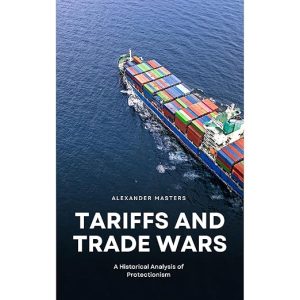
I picked up Tariffs and Trade Wars in April 2025, when the subject had become impossible to avoid. Every news cycle was producing another announcement about import taxes, retaliatory measures, and global supply chain reconfiguration. I wanted something that would give me historical context rather than moment-to-moment commentary. Alexander Masters provides that context, with some significant caveats that honest reviewing requires naming.
The book traces the history of tariff policy from early American trade decisions through modern disputes with China and the European Union. It is organized thematically, protectionism, economic nationalism, retaliatory cycles, the relationship between tariffs and political power, rather than chronologically, which means it doubles back on itself periodically. This is either a feature or a problem depending on how you engage with it.
Our Take on Tariffs and Trade Wars
The book’s primary virtue is accessibility. Masters takes a genuinely complex subject, the interaction between import policy, domestic industry, political leverage, and international relations, and renders it in plain language without significant oversimplification. For a listener who comes to the subject cold, that accessibility is real value. One reviewer notes it does a good job making a complex topic clear without oversimplifying, and that assessment is fair.
The problem is repetition. Multiple reviewers, including the most substantively engaged ones, writing from the UK, flag that the same points are made multiple times across the book’s nine-plus hours. One UK reviewer suggests cutting it to a quarter of its size without losing anything. Another notes it could have been 75 to 100 pages rather than over 300 without losing its core argument. The concluding chapter, they suggest, says it all, and you could save time by reading that first and dipping into the rest. That is damning praise.
Why Listen to Tariffs and Trade Wars
The Virtual Voice narration adds a layer of difficulty that a book this dense does not need. Economics writing relies on emphasis, on a narrator’s ability to signal which data point matters more than the one preceding it, which reversal of fortune changes the argument’s direction. AI narration delivers these distinctions with the same flat confidence it delivers everything else, which means the listener must do more work to construct the argument’s hierarchy. At nine hours and forty-four minutes, that additional cognitive load is non-trivial.
If you are already engaged with this subject professionally, in trade policy, international business, or economic journalism, the audio format may be less necessary. The material is best approached as reference rather than narrative, and reference material is naturally better served by formats you can scan and search. For a commuter who wants a solid orientation to the history and wants to absorb it passively, the audio version serves that purpose, imperfectly.
What to Watch For in Tariffs and Trade Wars
The book is explicitly American-centric in its framing. Reviewers writing from outside the US note the lack of international perspective as a genuine limitation, the EU, China, and other major trade actors appear primarily as counterparties to American policy rather than as agents with their own developmental logic. For a global audience, this creates blind spots that a more balanced treatment would avoid.
The title was released in June 2025, and the trade policy landscape it describes was already evolving rapidly by that point. The historical analysis is durable; specific claims about current policy, Trump-era tariff structures, ongoing negotiations, may have shifted. Treat those sections as snapshots rather than as current reporting.
Who Should Listen to Tariffs and Trade Wars
Listeners who want a primer on tariff history and have no existing background will find this a serviceable orientation. It is the kind of book that makes sense as preparation for more specialized reading, a foundation before engaging with academic work in trade economics or more analytically rigorous policy books. Readers already familiar with the basic history of the Smoot-Hawley Tariff, the GATT, or the WTO will find little here they do not know. Anyone for whom AI narration is a dealbreaker should read the ebook version of this one.
Frequently Asked Questions
Is the repetition in Tariffs and Trade Wars bad enough to make it not worth finishing?
Multiple reviewers flag significant repetition but still found value in the book as background orientation. One practical suggestion from UK reviewers: read the concluding chapter first, then dip selectively into the sections most relevant to your interests, rather than listening linearly.
How up to date is the information on current tariff disputes with China and the EU?
The book was released June 2025 and covers developments through roughly that period. The trade policy landscape evolves quickly, so specific claims about ongoing disputes should be supplemented with current sources. The historical analysis, covering pre-WWII tariff history through recent decades, is more durable.
Is the book balanced between free trade and protectionist perspectives, or does it take sides?
Reviewers suggest the book is broadly skeptical of tariffs as effective long-term policy instruments, consistent with mainstream trade economics. It does not read as partisan advocacy but does reflect a particular economic school of thought.
How does the Virtual Voice narration affect the experience of an already dense economics text?
Significantly. Economics writing depends on emphasis and inflection to signal hierarchy of importance, and AI narration delivers all material with similar confidence. Listeners will need to work harder to distinguish central arguments from supporting detail than they would with a human narrator.