Quick Take
- Narration: Adam Boardman reads with the kind of reassuring clarity that suits retirement planning content, authoritative without being stiff.
- Themes: Identity after work, holistic retirement planning, the psychology of spending after a lifetime of saving
- Mood: Warm and practical, with genuine humor threaded through financial complexity
- Verdict: A genuinely useful retirement planning audiobook that takes the psychological and identity dimensions as seriously as the financial mechanics.
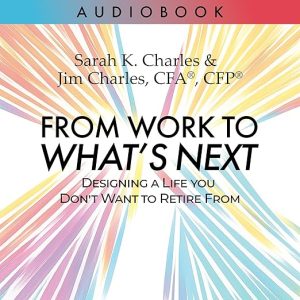
I put this one on one Saturday morning while doing things around the apartment, the kind of low-demand listening that personal finance audiobooks often suit, where you can absorb the argument without needing to give it your full visual attention. From Work to What's Next surprised me by demanding more than I expected. Not because the material is technically complex, but because Sarah Charles and Jim Charles keep asking questions I had not thought to ask about what retirement actually means beyond the balance sheet.
The book was released in March 2026, written by a husband-and-wife team with more than sixty combined years of experience in financial planning and related work. Jim Charles holds the CFP and CFA credentials. The writing, though, is Sarah's, and it is accessible in a way that genuinely earns the word, not simplified, but written for people who are smart and busy rather than people who are financially trained.
Our Take on From Work to What's Next
The book's distinctive contribution is its insistence that the standard retirement planning conversation, what is your number, do you have enough, what is your withdrawal rate, leaves out the questions that actually make retirement difficult for many people. Who are you when you are no longer defined by your job title? How do you spend money without guilt after decades of disciplined saving? What fills the space that meetings used to fill?
These are not soft questions. They are the ones that make perfectly financially prepared retirees profoundly unhappy in their first years of not working, and the book is direct about that. The framing the authors use, they call it Financial Ikigai, borrowing the Japanese concept of finding purpose and meaning, gives the psychological material a practical anchor that prevents it from floating away into self-help vagueness.
One reviewer wrote that the book helped them realize they were "nowhere near where they needed to be" despite thinking their bases were covered, and that the real lesson was understanding "the complexity and breadth of retirement planning." Another called it "clear, real-life advice written with common sense and sprinkled with a sense of humor, a book about retirement planning that didn't make my eyes glaze over." That second review captures something genuine about the tone. The humor is light but real, and it prevents the material from becoming grim.
Why Listen Rather Than Read It
Adam Boardman narrates with a calm, measured authority that works well for financial content. He does not overpitch the material, there are no moments where the narration tries to make tax bucket strategy sound more thrilling than it is, which is exactly right. The content earns its own interest through clarity and applicability, and Boardman's job is to deliver it cleanly, which he does.
At two hours and twenty-six minutes, this is among the shorter audiobooks in the personal finance space that is attempting to cover substantive ground. The compression shows in places, the section on the SECURE Act and estate planning in particular feels like a checklist rather than an exploration. But for listeners who want a navigational overview of retirement planning that they can actually finish in an afternoon, the length is an asset.
What to Watch For in the Authors' Framework
The Three Tax Buckets strategy and the Retirement Paycheck concept are the most actionable frameworks in the book, and they are explained with enough clarity that listeners without financial backgrounds can follow the logic. The guardrails approach to dynamic income planning is similarly well-explained. These sections reward close attention and might benefit from a second listen or from having a notepad nearby.
The client stories are illustrative rather than deeply developed, they appear to make a point rather than to tell a sustained narrative. That is a common choice in this genre and the right one here, but readers who are looking for the kind of immersive case study that, say, Bad Blood provides will find the anecdotal sections compressed. This is a how-to book that deploys storytelling as a vehicle rather than as its primary mode.
Who Should Listen to From Work to What's Next
People within five to ten years of retirement who want a framework that addresses both the financial mechanics and the identity and psychological dimensions of the transition will get the most from this. It is also useful for those who have recently retired and are struggling with the "now what" question that the book directly addresses. Those who have already worked extensively with a financial planner on the technical dimensions of retirement will find less new here in the mechanics sections, though the psychological framing may still offer useful language. Very young investors who are decades from retirement will find this premature, the audience is people who can see the horizon.
Frequently Asked Questions
Does the book require prior financial knowledge to follow?
No. The authors explicitly pitch the book as written without jargon and without judgment, and multiple reviewers confirm that it is accessible to people without financial backgrounds. The Three Tax Buckets concept and the Retirement Paycheck framework are explained from first principles.
Is this written for people already retired or people approaching retirement?
Both. The authors address the pre-retirement planning questions, when to claim Social Security, how to structure withdrawals, estate planning, alongside the post-retirement adjustment questions about identity, purpose, and spending psychology. The book is probably most useful for people within five years of retirement on either side.
How specific is the advice on Medicare and estate planning, given how complex those topics are?
The treatment is introductory rather than comprehensive. The book raises the right questions and explains the general stakes of decisions like Medicare enrollment timing and estate plan structure, but it is not a substitute for working with a specialist. The authors are clear that their goal is orientation and awareness rather than complete coverage.
The book is co-written by a married couple. Does the dual authorship affect the narrative voice?
The writing is credited to Sarah Charles, with Jim Charles bringing the CFP and CFA credentials to the technical content. The voice reads as unified rather than collaborative in an awkward way. The personal stories they share from their own experience as a couple add warmth without making the content feel personal rather than broadly applicable.