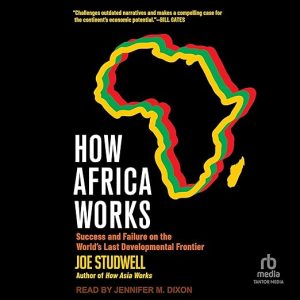
Quick Take
- Narration: Jennifer M. Dixon delivers a professional, well-paced reading that handles the book’s mix of economic analysis and country case studies without losing the thread.
- Themes: Development economics, African agency versus foreign intervention, demographic dividend
- Mood: Analytically optimistic, a counterweight to the poverty-and-corruption narrative that dominates Western coverage
- Verdict: Essential listening for anyone tracking the next chapter of global economic development, and a welcome corrective to the standard Western framing of Africa.
I finished How Africa Works on a Saturday afternoon, and then I spent the evening re-reading parts of Joe Studwell’s earlier book, How Asia Works, which I had flagged and dog-eared years ago. The pairing clarified something important: Studwell is not writing about Africa the way most Western economists and journalists write about Africa. He is writing about it the way he wrote about Asia, as a region of real policy choices made by real governments, with real consequences that can be studied and understood.
That framing shift is the book’s central contribution. Where coverage of Africa’s economic situation tends to lead with corruption, conflict, or aid dependency, Studwell leads with what has worked. He identifies four countries that have achieved exceptional economic growth, Botswana, Mauritius, Ethiopia, and Rwanda, and treats them as data points rather than anomalies. The question driving the book is not why Africa is poor but how successful development has happened and can happen again.
Our Take on How Africa Works
Studwell’s analytical framework, which he honed in his Asia work, centers on a developmental path that he argues successful economies have consistently followed: land reform, export-oriented manufacturing, and strategic use of finance. He applies this framework to the African context with care, acknowledging the genuine differences, colonial legacy, geography, the compressed timeline of demographic change, without using those differences as reasons to abandon the framework entirely.
The spotlight on African leaders rather than the international community that presumes to know better is a deliberate and worthwhile choice. Studwell is arguing against the development-aid complex and its tendency to export Western solutions to contexts they do not fit. The reviewers who engage most seriously with the book note his optimism about Africa’s rapidly rising population, which he frames as foundational to flourishing rather than as a crisis, a direct challenge to the Malthusian anxiety that runs through so much Western coverage.
Why Listen to How Africa Works
Jennifer M. Dixon narrates, and she handles a text that moves between economic theory, country histories, and policy prescription with steady competence. The book is fifteen hours of substantive material, and Dixon maintains clarity throughout, no small thing with a text this information-dense. The listening experience is good, though this is primarily a book of ideas rather than narrative, and some listeners may find the chapter-by-chapter country analysis more engaging in print form where they can flip back.
The audio format works well for Studwell’s argumentative chapters, where the logical structure is clear enough to follow by ear. The case study sections, on Ethiopia’s manufacturing push or Rwanda’s governance model, are sufficiently narrative that they also hold up aurally.
What to Watch For in How Africa Works
Studwell wrote this book with extensive research and travel across the continent, but the field of African development economics moves quickly. Some of the country cases he profiles, particularly Ethiopia and Rwanda, have experienced significant political shifts since the research period, and listeners should treat specific policy claims as accurate to their time rather than as current reporting. The analytical framework is durable; the political details require supplementing with current sources.
The book is also primarily an argument, not a survey. Studwell has a thesis and marshals evidence in service of it. Readers looking for a more balanced, multiple-perspective overview of African economic challenges will need other sources alongside this one. That is a feature, not a flaw, the argument is well-made, but it shapes what kind of book this is.
Who Should Listen to How Africa Works
Essential for anyone engaged with development economics, global investment, or international policy who wants an analytically rigorous, non-paternalistic account of African economic potential. Business leaders and investors considering African markets will find the country case studies genuinely useful. Readers who responded to How Asia Works should come here directly. Those looking for narrative memoir or travel writing about Africa are in the wrong section; this is serious economics writing dressed in accessible prose.
Frequently Asked Questions
Do I need to have read How Asia Works to follow How Africa Works?
No, though familiarity with Studwell’s earlier book deepens the experience. He applies the same developmental framework, so prior readers will recognize his analytical approach immediately. The Africa book stands alone.
Which four African countries does Studwell focus on as development success stories?
Studwell highlights Botswana, Mauritius, Ethiopia, and Rwanda as countries that have demonstrated exceptional economic growth and that illustrate both the promise and the particular challenges of the African development context.
How does Studwell address the colonial legacy as a factor in African economic development?
He acknowledges the crippling legacies of colonialism directly but does not treat them as determinative. His argument is that policy choices made by African governments, rather than external conditions inherited from colonialism, are the primary lever for development.
Is the book current, or has significant time passed since Studwell’s research?
Released in early 2026, the research reflects a specific period. Countries like Ethiopia and Rwanda have seen political developments since Studwell’s field work, so listeners should supplement specific policy claims with current sources while treating the analytical framework as durable.