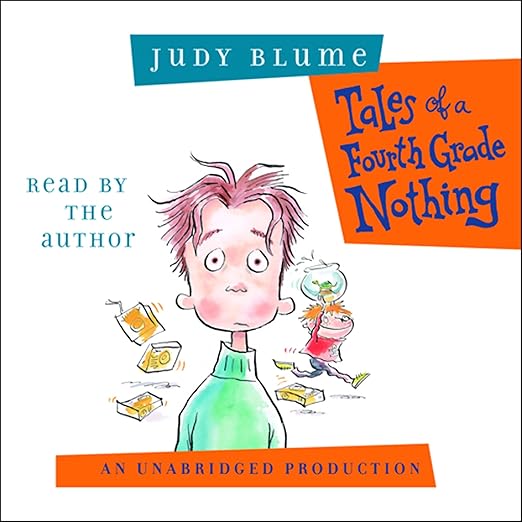
Judy Blume reads Judy Blume here, and that is the whole case for choosing this audiobook over a paperback. Two hours and thirty-three minutes from Listening Library, in which a fourth grader named Peter Hatcher explains precisely how unbearable it is to share a household with a two-year-old brother who is adored by everyone and answerable to no one. Fudge throws himself on the floor of a shoe store. Fudge smears smashed potatoes on the walls at Hamburger Heaven. Fudge scribbles all over the homework. And then Fudge walks off with the turtle.
Fudge Gets Away With Everything, Again
Peter is a completely reliable narrator of an unfair situation. That is the trick the whole book runs on. No adult is brought in to explain that his resentment is reasonable; the novel simply lets him list the evidence, and the list is devastating because every item on it is accurate. Fudge does get away with everything. The parents are not villains, they are tired, and their tiredness is exactly what makes them useless. A teacher on this page reports building a literature circle around the book, which makes sense: it is an argument about fairness that children can run without adult help.
Fudge is the engine, and the comedy is physical in a way that suits being spoken aloud. The shoe store collapse, the potatoes going up a restaurant wall, the homework buried under scribble: these are scenes built on escalation and timing, and out loud they land the way a good anecdote lands at a dinner table. One respondent describes a child unable to stop laughing at Peter's adventures and frustrations, and the order of those two nouns is exactly right.
The Real Reason Peter Wants Attention
Underneath the slapstick something quieter is running. Peter's real grievance is not that Fudge is annoying but that nobody has looked at Peter in months, and the question the description asks in its closing line, how to make his parents pay attention for a change, is the actual plot. One reviewer, an adult who first met the story in fourth grade and is neither male nor an older sibling, reports that it still worked, a fair measure of how far Peter's complaint carries.
Blume's Reading Fits Two Very Different Ages
Author narration is the entire proposition, and the credit carries the same name in both fields. That is not a stunt. Peter's comedy lives in emphasis, in which word takes the weight of the outrage, and the person who chose those words is the person delivering them. Two hours and thirty-three minutes also means one car journey, or two bedtimes, which is unusually manageable for a chapter book. Nothing on the listing mentions music, a second reader, or any framing material wrapped around the text.
The format argument sharpens when you look at what one response is actually praising. It recommends the book as a transition into chapter books, and the reason given is that the print edition runs a hundred and ten pages with no pictures. That is a very specific virtue of paper, and a recording removes it entirely. What audio offers in exchange is a different kind of bridge: a child who is not yet fluent gets the whole story at full speed, and a fluent one gets it delivered by the author.
Age guidance from the responses is unusually specific for a children's listing. One recommends it to fourth graders and up, arguing that younger children would lose the plot. Another calls it a fun read-aloud for families, which points considerably younger. Both can be right, because the humor operates on two levels at once: a small child laughs at the potatoes, an older one recognizes the injustice. At two and a half hours, nobody is committing much either way.
A Four-Star Rating Hides the Students' Reviews
Look closely at the four-star rating, because it does not represent a four-star opinion. It belongs to a fourth grade teacher who used the book for a literature circle and novel study, then posted what the entry itself calls honest reviews from some of the students. What follows is children's writing: a recommendation for fourth graders and up, a favorite part involving a surprise meant for Peter alone, and a student verdict of four and a half stars. The star attached to all of that is four. The lowest score on this page is a container for several opinions, and none of them is a four.
Spoilers are loose in the column as well. One five-star response, evidently written by a young reader, names what happens to the turtle and what happens afterward, in a single sentence that gives away the book's largest turn. The description behaves better, stopping at the moment Fudge walks off with Dribble and leaving the consequence alone. If you are lining this up for a child who does not already know the story, the blurb is safe and the reviews are not.
Nothing here dates the novel itself, either. No publication year for the book appears in any field; the recording is dated March 2007, and the only dating signal available is that two responses reach for the word classic. Some of the household detail will read as historical to a child now, which is less a problem than an expectation to adjust before pressing play. The series field says Fudge Series, book one, although the title on the cover never mentions Fudge anywhere.
Siblings Will Recognize Themselves in Fudge
Families with a child anywhere between read-aloud age and fourth grade have the easiest possible sell here: two and a half hours, funny out loud, delivered by the author. Older siblings will recognize themselves and feel thoroughly vindicated; younger ones will take Fudge's side, which is its own useful conversation to have in a car. Teachers after a short shared text will find one response on this page describing exactly that use, with a novel study already built around it.
Households with no sibling rivalry to recognize will get much less out of it, since a great deal of the comedy depends on the specific injustice of being the older one. Nor is it for a listener who wants plot, because this is a sequence of episodes and the episodes are the point of it. What remains is the shortest and funniest thing on the children's shelf, in the only voice with a real claim on it. Blume's own reading is the reason to take this edition, and a two hour thirty-three minute runtime is barely a cost at all.
- Performance: Judy Blume reads Judy Blume, and that alone is the argument for this edition over a paperback.
- What it covers: Sibling injustice, a two-year-old with no consequences, parental attention as a scarce resource, slapstick.
- Feel: Fast, funny and quietly aggrieved.
- Our call: The best sibling comedy in children's fiction, over in one short afternoon, in the author's own voice.