Before You Press Play
- Narrator: Sam Stafford anchors a full voice cast with no prior track record to judge against, though the ensemble format itself carries much of the performance weight.
- Subjects: cursed love, transformation, a princess trapped between two worlds.
- Tone: Enchanted and theatrical.
- Bottom line: A charming, compact introduction to Swan Lake for young children, best enjoyed as a family listen rather than solo background audio.
Prince Siegfried's birthday ball takes up only a few minutes of this audioplay's forty-five minutes, and that pacing choice is exactly right for a fairy tale built on a single moonlit encounter rather than a sprawling plot. This full-cast audiobook adaptation of Swan Lake compresses the ballet's story into a tight, theatrical listen that trusts young audiences to follow a curse-and-true-love plot without needing an hour of court intrigue to get there first.
Odette appears on the shores of Swan Lake as a princess transformed by the sorcerer Rothbart's curse, and Siegfried's immediate vow of eternal love sets the entire plot in motion within the story's opening minutes, giving young listeners very little setup to sit through before the actual fairy tale begins.
Tchaikovsky Gets Author Credit for His Score
The full-cast format, distinct voices for Siegfried, Odette, and Rothbart, plus a musical score underneath the dialogue, makes this closer to a mini radio drama than a single narrator reading a story aloud, and that structural choice suits Swan Lake specifically well. A story built around a ball, a moonlit transformation, and a climactic confrontation benefits from actual sonic staging: distinct voices for the hero, the cursed princess, and the villain, plus music marking the emotional turns a narrator alone would otherwise have to describe.
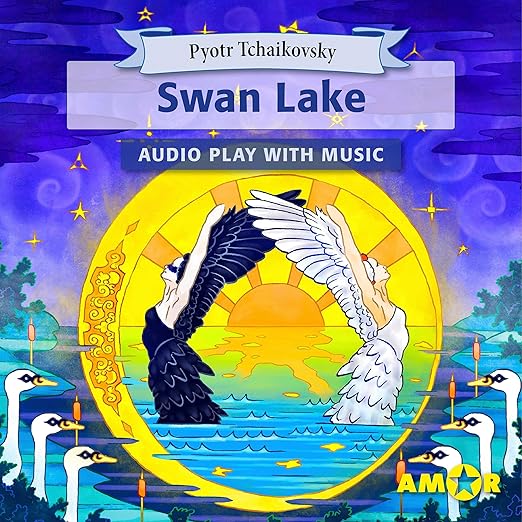
Worth flagging directly: Pyotr Tchaikovsky is credited as the author here, which is a slightly unusual credit for an audioplay rather than a straightforward misattribution. Tchaikovsky composed the ballet's original score in the 1870s; the audioplay adapts that same music and the underlying story, which itself draws on older European folk traditions about swan maidens and broken curses, predating the ballet by a considerable stretch. Crediting the composer as author reflects how central his score is to this specific production, even though he did not write narration or dialogue.
Music Marks the Story's Turns Before Dialogue Does
The music does real narrative work throughout, marking the shift from the celebratory ball to the moonlit lakeside scene to the climactic confrontation with Rothbart, so that young listeners register the story's emotional turns even before dialogue catches up to explain them. That layering, dialogue, sound design, and score working together rather than music simply playing underneath a reading, is the format's clearest advantage over a standard narrated picture book.
Tchaikovsky went on to compose two more of the most performed ballet scores in the classical repertoire after Swan Lake, and this early work already shows the same instinct for using music to carry a story's emotional logic that made his later ballets equally enduring, a detail worth knowing even in an audioplay aimed primarily at children.
Sam Stafford Leads an Untested but Full Cast
Sam Stafford narrates, with no prior track record in this format to draw on, so the fit is assessed here on the strength of the production rather than a confirmed individual performance. What the format demands is clear differentiation between characters within a tight forty-five minutes, and a full cast built around that specific need generally serves young listeners better than a single voice attempting every part.
For families, this works well as an introduction to both the Swan Lake story and, informally, to the feel of Tchaikovsky's music before a child ever sits through an actual ballet performance. Hearing the melodies underneath a familiar fairy tale structure gives young listeners a gentler entry point into classical music than a standalone orchestral recording would, since the story gives the music somewhere to land emotionally.
Forty-Five Minutes Avoids a Bloated Adaptation
Forty-five minutes sits comfortably within the normal range for children's audio dramas, long enough to tell a complete story with a real beginning, middle, and end, but short enough to hold a young child's attention across a single car ride or bedtime session without needing to be split across multiple listens. That runtime discipline is itself a craft choice worth crediting, since a bloated adaptation would risk losing exactly the audience this format targets.
Classical music education for young children often relies on abstract listening exercises disconnected from any narrative context, and pairing a full orchestral-adjacent score with an actual character-driven plot gives this production a meaningfully different entry point than a standard music-appreciation recording aimed at the same age group.
Five Stars Rest on Just Two Early Ratings
At forty-five minutes, this is a deliberately compressed retelling, appropriate for its intended young audience but simplified compared to a full ballet production's actual scope, which typically carries more court intrigue and subplot depending on the specific staging. Listeners wanting a more elaborate or psychologically complex version of the Swan Lake story should look toward the full ballet or a longer prose retelling instead.
The current five-star rating comes from only two ratings, which is a promising early signal but far too small a sample to treat as a confirmed consensus. Anyone drawn in by the perfect score should treat it as encouraging rather than definitive until more listeners weigh in.
Beyond the numeric rating, no written listener reviews are attached to this title yet, so no firsthand account exists describing how specific children responded to the pacing or the voice cast. Parents choosing between this and a longer, more traditional narrated version of the story should weigh that gap alongside the strong early rating.
Because the story compresses a great deal of ballet into forty-five minutes, some of the mime-and-gesture storytelling techniques that carry meaning in a live staged performance, court customs, formal greetings, symbolic dances, do not translate directly into audio and are instead handled through narration and dialogue instead, a reasonable trade-off for the format but worth knowing if a child later attends an actual live performance expecting the same level of detail.
Parents Get a Gentle Way Into Sad Endings
Families with young children being introduced to classical music and ballet stories for the first time are the ideal audience, along with anyone looking for a short, theatrical primer before taking a child to see an actual Swan Lake performance staged live.
Skip this one if you want a novel-length narrative experience or a more psychologically layered adult retelling of the Swan Lake myth, since this stays squarely, and appropriately, within children's-audiobook territory throughout its brief runtime.
This also works nicely as a shared family listen rather than solo independent listening for very young children, since the multiple voices and musical cues give parents natural moments to pause and explain what is happening in the story.
This is also a reasonable choice for a child's very first exposure to a tragic or bittersweet ending in a story, since Swan Lake's traditional conclusion carries real emotional weight without straying into content unsuitable for a young audience, giving parents a gentle way to introduce the idea that not every story resolves purely happily.