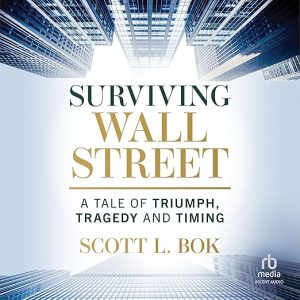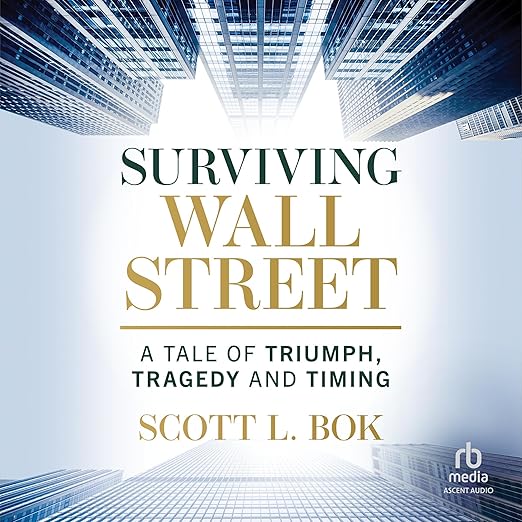
Quick Take
- Narration: Chris Sorensen delivers Bok’s insider account with the right balance of authority and personal warmth, keeping 18 hours of finance and institutional history from feeling like a lecture.
- Themes: Investment banking from inside the boardroom, resilience through institutional crisis, the intersection of higher education politics and finance
- Mood: Candid and propulsive, unexpectedly personal for a Wall Street memoir
- Verdict: Scott Bok’s account of building Greenhill and surviving three decades of financial crises delivers genuine insider perspective without the score-settling tone that makes many Wall Street memoirs feel narrow.
I finished the bulk of Surviving Wall Street during a week when the financial press was full of the usual noise about dealmaking and market volatility, and the contrast with Bok’s account was instructive. Where business journalism tends to cover events as though they appeared from nowhere, Bok traces the accumulated decisions, institutional pressures, and human miscalculations that produced the crises he lived through: the dot-com crash, the 2008 global financial crisis, the pandemic. He was in the room for all of them in a specific and useful way, as the CEO of Greenhill and Company, an independent mergers and acquisitions advisory firm that went from startup to landmark IPO to eventual acquisition by a major global bank over the period he describes.
Scott Bok is not a household name outside finance, which is part of what makes this book interesting. He is not writing from the position of a celebrity banker whose every pronouncement is already part of the public record. Greenhill was significant but not systemically famous, which means Bok has something rarer than the standard Wall Street memoir offers: a perspective from close enough to the center to see the machinery clearly, but independent enough to say things about it that insiders at larger institutions often cannot.
Our Take on Surviving Wall Street
One reviewer described this as three terrific books in one, which is accurate. The first is an account of how Greenhill was built, how an independent M&A boutique found its niche in a market dominated by full-service banks, and how that positioning shaped everything from recruiting decisions to client relationships to the firm’s eventual vulnerability. The second is a chronicle of financial crises experienced from inside a boutique advisory firm, which offers a different vantage point from the big-bank memoirs that have dominated this genre. The third is something unexpected: a detailed account of Bok’s role in a governance battle at the University of Pennsylvania that deployed corporate takeover tactics in an academic setting. This section alone would make the book worth reading for anyone interested in how institutional power works in contexts outside finance.
The writing style is described in the synopsis as an adventure tale, and Bok does deliver propulsive pacing for material that could easily feel like a management history textbook. The personal dimension, the naive young man arriving on Wall Street and building something over thirty years of genuine uncertainty, gives the structural and analytical material an anchor in individual experience that keeps the eighteen hours from feeling abstract.
Why Listen to Surviving Wall Street
Chris Sorensen’s narration suits the material well. Bok is writing in a register that is personal but not confessional, candid but not performatively vulnerable, and Sorensen matches that register with delivery that is warm without being soft and authoritative without being stiff. At eighteen hours, this is a substantial investment, and the pacing earns that time rather than diluting it. The University of Pennsylvania battle is particularly well-handled in narration, as the stakes shift from financial to institutional in ways that require a different emotional register.
One reviewer compared the book favorably to Ron Chernow’s The House of Morgan as an account of Wall Street and the people who drive it, which gives you a sense of the ambition here. Bok is not just writing a professional memoir; he is situating Greenhill’s story within the broader evolution of investment banking over a period of genuinely dramatic change. The collapse of Long-Term Capital Management and the 2008 crisis are not background events here; they are moments that tested the firm’s existence and forced consequential decisions that Bok examines with the specific candor of someone who was responsible for making them.
What to Watch For in Surviving Wall Street
Listeners who come to this expecting a conventional rags-to-riches Wall Street story will find something more complicated. Bok is honest about the constraints and uncertainties that shaped Greenhill’s trajectory, including periods where the firm’s independence felt like a liability rather than an asset. The narrative is not triumphalist, and the eventual sale of Greenhill to a major bank is treated with the kind of ambivalence that reflects real institutional decision-making rather than retrospective vindication.
The M&A technical material is kept accessible, and reviewers confirm that the book works for listeners without a finance background. But the deeper rewards of this audiobook go to listeners who come in with enough context to appreciate what Bok is revealing about how dealmaking and institutional loyalty actually function. The University of Pennsylvania chapter, for instance, is more resonant if you know something about how activist shareholder tactics work, even though Bok explains the mechanics clearly enough for general listeners.
Who Should Listen to Surviving Wall Street
Finance professionals, particularly those in M&A or advisory roles, will find the insider perspective genuinely valuable. General readers with an interest in how financial institutions work under pressure, and how leadership decisions accumulate into institutional fate, will find the book accessible and the University of Pennsylvania section a rewarding surprise. Those looking for finance memoir as character study rather than purely as industry history will find Bok’s personal candor more substantive than most entries in the genre.
Frequently Asked Questions
Do you need a finance background to follow Surviving Wall Street?
Bok writes accessibly enough that readers without finance expertise can follow the narrative and absorb the key insights. Reviewers without industry backgrounds describe the book as engaging and clear. That said, listeners with some familiarity with M&A, the 2008 financial crisis, and investment banking culture will get more from the analytical passages than complete newcomers.
How does the University of Pennsylvania governance battle fit into a book about Wall Street?
Bok was deeply involved in a battle for control of the University of Pennsylvania that used activist shareholder and corporate takeover tactics typically associated with corporate finance. He dedicates significant attention to this episode because it illustrates how the skills and mindset of investment banking translate, uncomfortably, into institutional academic settings. It is one of the more surprising and genuinely interesting sections of the book.
Is Chris Sorensen’s narration well suited to the personal and analytical register of Bok’s writing?
Yes. Sorensen handles the blend of personal memoir, institutional history, and financial analysis with consistent authority and warmth. The eighteen-hour runtime is a real commitment, and Sorensen’s ability to keep the material from feeling like a lecture is a meaningful contribution to the listening experience.
Does Surviving Wall Street cover the sale of Greenhill and does Bok discuss it candidly?
The book covers Greenhill’s trajectory from startup through its pioneering IPO and through to acquisition by a major global bank. Bok’s treatment of the sale reflects real ambivalence rather than retrospective endorsement, and he examines the pressures that led to that outcome with the kind of candor that distinguishes this memoir from the more triumphalist entries in the Wall Street genre.