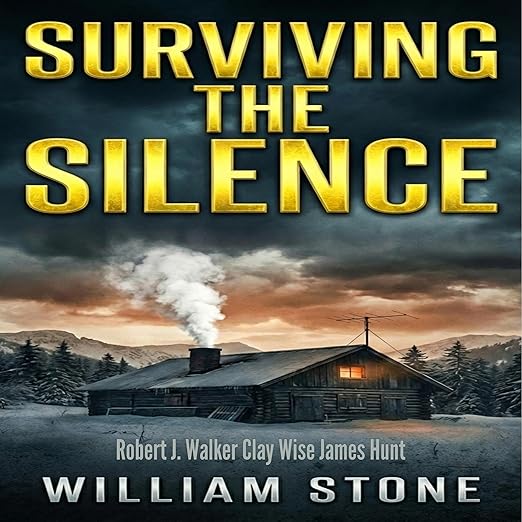
I came to Surviving the Silence with straightforward expectations: grid-down scenario, survivalist protagonist, high stakes, fast pace. The setup in the synopsis delivers on that brief. Stephanie is a mother who deliberately buried her survivalist upbringing to build a normal life for her twin daughters. When the power grid collapses and cities begin dissolving into violence, those buried skills claw back up. That premise is solid, and for significant stretches of this thirty-hour listen, the execution matches it.
Cheryl May's narration is strong. She gives Stephanie a voice that carries both the mom-in-crisis register and the predator-emerging-from-dormancy register that the character requires, and she manages the transition between them with real skill. The best sequences, Stephanie making rapid tactical decisions while protecting the twins in an environment that has abandoned all social rules, have genuine momentum. May keeps pace with them.
Is Surviving the Silence Worth Your Time?
The book is, according to one reviewer, actually a boxset of three separate books rather than a single novel. That structural information matters for expectations. Each book is "totally different" in the words of the same reviewer, meaning the thirty hours cover more territory than a single post-collapse narrative would. The characters and scenario carry across, but the tone and situation shift meaningfully between volumes. That variety keeps the runtime from feeling repetitive, though it also means tonal consistency is harder to maintain across the full listening experience.
Stephanie's arc is this series' most interesting element. Her father forced survival skills on her that she spent years trying to disown, and the collapse does not so much restore those skills as it forces her to admit she never entirely lost them. The psychological dimension of that admission, becoming the predator she once feared most in the words of the synopsis, is handled with more nuance than the genre typically offers. She does not become competent cleanly. There is friction and cost and choices that leave marks.
The strongest case for this audiobook is Cheryl May's performance and the book's twin daughters, who are written as actual characters rather than simple stakes. Too many survival thrillers reduce the protagonist's dependents to walking motivations. Here, the girls have distinct personalities and responses to the collapse, which raises the emotional stakes above the standard genre floor. When Stephanie makes decisions that protect them at significant cost to herself or to others, those decisions feel specific rather than generic.
At thirty hours, this is a substantial commitment, and it rewards listeners who want to be fully inside a post-collapse world rather than visiting it briefly. The pacing in the early volumes is confident. The writing at its best has the fast-cut efficiency of a thriller that knows how to keep moving, and May's narration amplifies that quality.
Before You Commit to Surviving the Silence
The negative reviews deserve honest treatment. One listener stopped early after encountering continuity errors serious enough to disrupt immersion: a character face-down on the floor in one sentence and standing with a gun in the next, a vehicle scene that resets itself between paragraphs. These are the kinds of editorial lapses that create the AI-slop accusation in the reviews, though whether that characterization is accurate or fair is a separate question. What is accurate is that the book has not been as carefully line-edited as its best sequences deserve. Attentive listeners will encounter these moments and have to decide whether to push through or set the book aside.
The 4.2 average rating across 69 reviews reflects that division. The listeners who found the book excellent found it genuinely excellent. The listeners who encountered the continuity problems found them disqualifying. That split maps fairly neatly onto readers' tolerance for rough-edged genre fiction versus those who require clean professional editing as a baseline condition for engagement.
Should You Listen to Surviving the Silence?
This audiobook suits listeners who are already committed fans of grid-down survival fiction and want a protagonist whose competence is complicated by psychological history. If you have read and enjoyed similar titles in the EMP and post-collapse genre and are not particularly troubled by editorial inconsistencies when the action is working, Surviving the Silence delivers more of what you came for. If you have low tolerance for continuity errors or require polished prose as a minimum, the uneven execution will likely be a dealbreaker. Cheryl May's narration is strong enough to carry the best sections. Whether the best sections outweigh the rough ones is a judgment call each listener will make differently.
Before You Listen
Does Cheryl May's narration add enough to justify the audiobook format over the ebook?
For the material that works, yes. May handles Stephanie's psychological complexity well and brings real urgency to the action sequences. The narration is consistently stronger than some of the prose it is delivering, which is either an endorsement of her skill or a criticism of the source text, depending on how you weigh it.
How does Stephanie's survivalist backstory affect the character beyond providing plot justification for her skills?
More than most survival thrillers attempt. Her deliberate suppression of her father's training is a psychological wound the collapse forces her to reopen, and the book treats the process of reassuming those skills as morally and emotionally complicated rather than as pure empowerment.