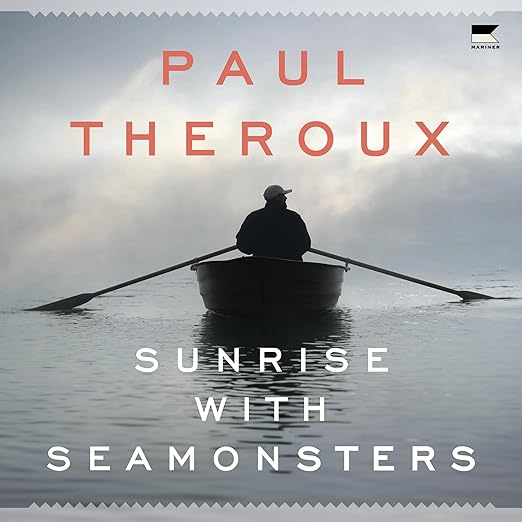
Fifty Glittering Pieces of Gold, By His Own Description
Paul Theroux has always insisted that journeys take place inside the traveler as much as on the road. Sunrise with Seamonsters, his collection of fifty essays and short pieces narrated by Charlie Anson as an audiobook running seventeen hours and fifty-one minutes, makes that argument explicitly and then demonstrates it across a range of modes that no single travel book could contain. The description Theroux gives his own work here is useful: a gathering of people, places, and ideas in fifty glittering pieces of gold. That self-assessment is an accurate account of what this collection contains and what it demands. It is not a single journey. It is a mind across decades, moving between continents and ideas with the particular quality of attention Theroux has built a career on.
The structural challenge of this audiobook is real, and it is worth naming at the outset. Fifty pieces in a collection of this kind do not accumulate toward a unified argument. They coexist. Each essay or story is a discrete act of observation, and the transitions between them require the listener to reset rather than continue. One reader described the collection as not very cohesive, but interesting as Theroux's books always are, which is both a criticism and a fair characterization. Cohesion is not what Theroux is after here. What he offers instead is range: political essays, travel sketches, literary portraits, autobiographical fragments, and short fiction, all in the same unmistakable voice.
Anson Delivers Theroux's Prose Precise and Cold
Charlie Anson's narration is well matched to this kind of material. Theroux's prose at its best is precise and slightly cold, built on observation rather than warmth, and Anson delivers it without trying to soften or sentimentalize the edges. One reviewer, a Vietnam veteran who has worked in construction across more than thirty countries, praised specifically Theroux's insight into locals and the depth of his knowledge about the places he visits. That depth is a product of engaged curiosity rather than affective sympathy, and Anson's clean, articulate delivery preserves that quality. The audiobook format suits the collection's essayistic mode better than one might expect, because Anson treats each piece as a complete unit rather than as a chapter in a longer narrative.
At seventeen hours and fifty-one minutes, this is a commitment. The length is a function of the breadth: fifty pieces, covering multiple decades of Theroux's work across multiple continents and literary modes. The reward for listeners who stay with it is a portrait of a writer's intellectual life that no single travel book provides. Theroux's train experiences, highlighted as a particular strength in the reviews, appear within the larger context of his engagement with place, politics, and the people who inhabit both. His political perspective has always been distinctly his own rather than any orthodoxy's, which gives the political essays here a friction that more comfortable travel writing routinely avoids.
The Seamonsters Are the Unexpected and Threatening
The essays were previously published in various contexts, and the collection's eclecticism is therefore a curatorial choice rather than an accident of composition. Listeners who approach it as a representative sample of Theroux's range will get the most from it. Those seeking a single sustained argument or a coherent narrative arc will find the episodic structure frustrating regardless of how good any individual piece is.
The seamonsters of the title is worth holding onto as a conceptual key. Theroux uses the phrase to describe the unexpected, the threatening, the grotesque element that surfaces in journeys that should have been orderly. The essays here regularly find their subject matter in that space: the thing that was not supposed to be there, the encounter that resisted the expected frame. That orientation gives even the shorter pieces a slight unease, a sense that the world being observed is not quite domesticated, which is precisely the quality Theroux at his best delivers. Anson holds this tone steadily across the runtime, never pushing Theroux's prose toward warmth it is not reaching for.
Theroux's relationship to the essay form is worth noting as a context for this collection. He is primarily known as a travel writer of long books, and the shorter work collected here shows a different kind of precision, the kind that a fixed length demands. Some of the fifty pieces are genuinely compressed arguments, observations that in longer form would be expanded into chapters but that here must do their work quickly. Others are more impressionistic, closer to the atmospheric sketches of the best travel journalism. Anson navigates between these modes without losing consistency, which is the performance challenge the collection presents and which he meets capably across the full seventeen hours.
Newcomers Should Start With the Railway Bazaar
This audiobook rewards readers who already value Theroux's writing and want access to a wider range of his shorter work than any single travel book provides. Listeners new to Theroux would benefit more from starting with The Great Railway Bazaar or The Old Patagonian Express before entering this collection, as the essays will mean more with a sense of the writer's larger project in hand. Those who find essay collections difficult to sustain in audio form over seventeen hours should approach this as something to be listened to in carefully spaced sessions rather than consumed in long sittings, treating each group of three or four pieces as a complete listening unit before returning for the next session.
How does the audiobook format handle a fifty-piece essay collection at nearly eighteen hours?
Charlie Anson treats each piece as a complete unit, which helps. The listening experience works best in focused sessions of three to five pieces rather than marathon sittings, because the essays do not build on each other narratively. The audio format suits Theroux's essayistic prose well when approached with appropriate pacing.
Does this audiobook contain the same material as the original print edition of Sunrise with Seamonsters?
The audiobook presents the same essay collection that appeared in the original print edition. No significant material is known to have been abridged or omitted for the audio format, though listeners concerned about completeness can verify this against the print edition's table of contents.
Is Sunrise with Seamonsters appropriate for listeners who primarily enjoy narrative travel writing rather than essays?
The collection contains travel pieces but also literary criticism, autobiographical fragments, and short fiction, and the fifty pieces do not form a single journey. Listeners who specifically want Theroux's sustained travel narratives will find his longer books more satisfying; this collection is for those interested in his range as a writer rather than a single extended journey.