Quick Take
- Narration: Will Damron captures the sweltering, claustrophobic quality of Andrew’s grief perfectly, keeping the Southern Gothic atmosphere present even in the quieter academic scenes.
- Themes: Queer grief and denial, the violence of close friendship, inherited family trauma
- Mood: Humid and haunted, slow-burning in the literary sense rather than the romantic one
- Verdict: Lee Mandelo’s debut is a genuinely ambitious queer Southern Gothic that earns its twelve-hour commitment, though Andrew’s toxicity is not softened for the audience.
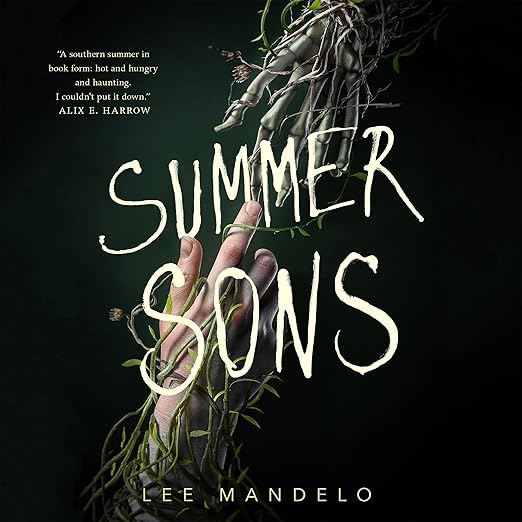
I listened to Summer Sons over the course of a particularly gray week, which turned out to suit it. This is a book about sweltering Nashville heat and fast cars and the particular hunger of a ghost, but it is also a book about the kinds of things we refuse to understand about the people we love, and that subject has a gray-day quality regardless of the weather it describes. Lee Mandelo’s debut arrived with significant genre attention and a Macmillan Audio production that understood what the material needed.
Andrew and Eddie were the kind of close that people around them never quite had language for. When Eddie dies, apparently by suicide, days before Andrew was supposed to join him at Vanderbilt, what Andrew inherits is not just grief but confusion. The roommate he does not know, the friends he never heard about, the circle of boys and cars and drugs that apparently constituted Eddie’s Nashville nights: all of this is new. The phantom that hungers for Andrew is not.
Our Take on Summer Sons
Mandelo is doing something specific with Andrew’s refusal to understand his own relationship with Eddie, and the novel is honest enough to let that refusal be ugly. Andrew is described by reviewers as toxic and confused in ways that feel true to grief rather than designed for reader sympathy. The Southern Gothic tradition has always been interested in characters whose denial shapes their reality, and Andrew fits that lineage: he is in a haunting, partly because a ghost is literally pursuing him, and partly because he has spent years haunting himself with a feeling he would not name.
The dual setting, the academic world where Eddie spent his days and the street racing circuit where he spent his nights, generates the book’s structural tension. These two worlds reveal different Eddies, and the gap between them is where the truth of the book lives. Andrew is not investigating a death so much as he is investigating a person he thought he knew and discovering the gap between his understanding and the reality. That gap is where the horror comes from.
Why Listen to Summer Sons
Will Damron’s narration is a strong match for this material. The Southern Gothic atmosphere requires a voice that can carry the heat and the dread simultaneously without tipping into melodrama, and Damron maintains that balance across twelve hours. Andrew’s interiority is often uncomfortable: he is grieving, confused, and periodically doing things that are bad ideas. Damron voices all of this without editorializing, which is the right call. The reader is meant to observe Andrew clearly, not to be guided toward judgment.
The Macmillan Audio production quality is evident throughout. The pacing of the narration suits the book’s rhythm: Mandelo writes in a style that rewards attention rather than demanding speed, and the audio format gives that style room to breathe. Reviewers who found the book long-winded are responding to something real, but it is length in service of atmosphere rather than padding, and audio makes the atmospheric work feel intentional.
What to Watch For in Summer Sons
The phantom is not a metaphor, though it functions as one. The horror elements are literal and genuinely unsettling: something is hungry for Andrew, the thing that killed Eddie may not have been his own hand, and the family history soaked in blood and death has a specific shape that the novel reveals gradually. Some readers come in expecting queer literary fiction and encounter more outright horror than they anticipated. Both elements are fully present and fully integrated.
The street racing scenes are viscerally written and give the book its most kinetic energy. The contrast between those sequences and the slower-moving academic investigation creates the book’s pacing: long atmospheric stretches punctuated by moments of physical velocity. Audio makes that alternation feel particularly embodied.
Who Should Listen to Summer Sons
Readers who love Southern Gothic literary fiction and want it done with queer content integrated rather than appended. Horror readers who want their dread to come from both supernatural and psychological sources simultaneously. If you found the dark academia genre appealing but wanted it without the glamorization of institutional prestige, Mandelo explicitly refuses that glamorization. Readers who need a protagonist they can root for without reservations may find Andrew genuinely difficult. His toxicity is not resolved by the end, though it is examined. That choice is deliberate, and it is what makes this a literary novel rather than a genre entertainment.
Frequently Asked Questions
Is Summer Sons primarily a horror novel, a romance, or literary fiction?
All three simultaneously, which is part of its ambition. The horror is literal, the queerness is central to the protagonist’s psychology rather than decorative, and the literary attention to style and atmosphere puts it firmly in the literary fiction tradition. Readers expecting any one of these elements to dominate will need to adjust.
Does the novel explicitly address Andrew’s feelings for Eddie, or does it leave that ambiguous?
Mandelo leaves a deliberate ambiguity around the exact nature of Andrew and Eddie’s bond, but the weight of the novel is invested in Andrew’s denial and its consequences. The book does not require you to name what they were to each other, but it does require you to feel the cost of not naming it.
How does Will Damron handle the supernatural elements of the narration?
With restraint that makes them more effective. The phantom sequences are not performed with theatrical horror but with the same matter-of-fact dread that the book’s prose uses. The horror registers in the content rather than the vocal performance, which suits the literary Gothic register.
Is Summer Sons a standalone novel?
Yes. The story is complete within this volume. There is no series to continue into, which makes the ending’s ambiguities intentional rather than deferred to future installments.