Quick Take
- Narration: Nick Podehl is one of the most reliable voices in fantasy audio, and he brings genuine texture to Corin Cadence, a reserved, methodical protagonist who could easily feel flat in lesser hands.
- Themes: Magic systems and attunements, sibling loyalty, found family, identity and neurodivergent-coded characterization
- Mood: Cerebral and quietly propulsive, with the slow-burn satisfaction of a well-designed game
- Verdict: A standout LitRPG-adjacent fantasy that rewards patient listeners with a richly constructed world and a protagonist whose interiority drives the story as much as any action sequence.
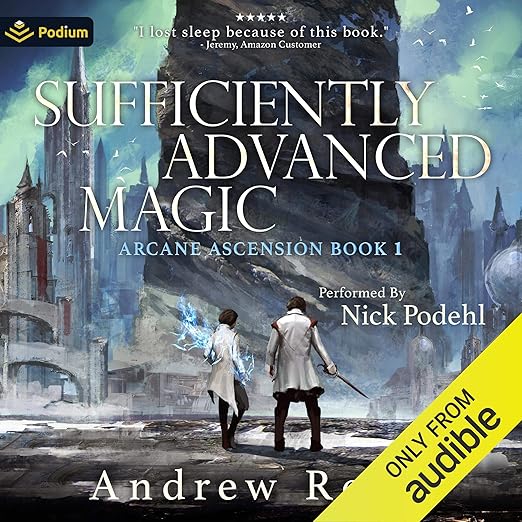
I was halfway through my Tuesday commute when I noticed I had stopped registering anything outside my headphones. That kind of absorption does not happen often, and it usually signals something specific: a world that has been built with enough internal logic that I start to trust it. Sufficiently Advanced Magic, Andrew Rowe’s first book in the Arcane Ascension series, had me in that state by the second hour.
The premise is tightly constructed. Five years before the story begins, Corin Cadence’s brother entered the Serpent Spire, a colossal tower with shifting rooms, traps, and monsters, and never came out. Now Corin is making the same ascent, not for glory or power but to reach the goddess at the top and bring his brother back. Along the way, he earns an attunement: a mark that grants magical abilities. Then he has to figure out what to do with it.
Our Take on Sufficiently Advanced Magic
What separates this from many fantasy tower-climb premises is the depth of the magic system. Rowe is a designer before he is a romantic, and the attunement system, different marks granting different magical frameworks, each with its own logic and limitations, has the kind of internal consistency that makes you want to understand it fully. Corin is methodical, analytical, and more interested in understanding how magic works than in performing heroics, and that intellectual disposition shapes the entire narrative. One reviewer compares it favorably to Will Wight’s Cradle series, noting a similar quality of escalating competence built on solid foundational rules.
Some reviewers have noted that the book has same-sex relationships and an asexual character prominently in its cast, and that certain low-star reviews reflect discomfort with that representation rather than craft assessment. That context is worth knowing: the rating is slightly suppressed by reviews that have nothing to do with the quality of the work. Adjust accordingly.
Why Listen to Sufficiently Advanced Magic
Nick Podehl is one of the established voices of fantasy audio, and his work here is one of the reasons this series has built the following it has. Corin is reserved, sometimes stiff, and emotionally guarded, all characteristics that could register as flatness in narration. Podehl understands the character and plays the interiority rather than the performance, which makes the moments where Corin’s control slips feel earned. At nearly 22 hours, this is a long commitment, but the runtime reflects actual world and character building rather than padding. A reviewer describing the story as having “an amazing plot with all the right twists and great development” captures the sustained quality of the construction.
The school setting that emerges after the tower opening gives the book a secondary structure that works well: Corin must navigate training, political dynamics among students, and alliances that may or may not be trustworthy, all while continuing to investigate the mystery of the spire and his brother’s disappearance. The combination of dungeon-crawl and academic fantasy is handled with more sophistication than either genre alone would suggest.
What to Watch For in Sufficiently Advanced Magic
Rowe has been praised for his magic system and criticized, occasionally, for exposition. One reviewer notes the “too much exposition” concern but found it felt right to the tone. That is probably the accurate verdict: listeners who enjoy understanding systems and want to know how things work will find the explanatory passages satisfying. Listeners who prefer action-forward pacing will find the first quarter slow.
Character depth is also a genuine concern for some readers: a reviewer notes the characters “could have been more fleshed” while suggesting subsequent books address this. For an opening entry in a long series, Rowe is more interested in world architecture than psychological excavation. If you need deeply rendered interiority from the start, note that caveat. The emotional complexity builds across the series rather than front-loading it.
Who Should Listen to Sufficiently Advanced Magic
This is made for readers who love a magic system they can learn alongside the protagonist, who enjoy stories where intelligence is a genuine asset, and who are comfortable with slow reveals paid off over time. If LitRPG or progression fantasy appeals to you but you want the prose quality of traditional fantasy alongside it, this series occupies that useful middle ground. Listeners expecting action-heavy adventure without downtime should look elsewhere. And the queer representation is central to the cast, not incidental, approach it knowing that, and you will have an accurate picture of what you are walking into.
Frequently Asked Questions
Is Sufficiently Advanced Magic the first book in the Arcane Ascension series?
Yes, it is book one. No prior reading is required.
How does Nick Podehl handle the exposition-heavy sections about the magic system?
Podehl is an experienced narrator and manages the denser explanatory passages with enough variation in pacing and tone that they hold attention rather than blur together.
Is this suitable for listeners new to LitRPG or progression fantasy?
Yes. Rowe builds from first principles and the magic system is explained as Corin encounters it. No genre familiarity is assumed.
Does the cliffhanger ending require the next book immediately?
One reviewer mentions a one-year cliffhanger that was difficult to sit with. The ending is purposefully open rather than resolved, so listeners who dislike unresolved conclusions should have the sequel ready.