In Brief
- Performance: Willam Belli's self-narration is the only way this material could work - his delivery is sharp, self-deprecating, and completely unwilling to perform sincerity he doesn't feel. The voice matches the brand precisely.
- What it covers: Self-improvement through candor, LGBTQ+ community identity, humor as a survival and growth tool
- Feel: Irreverent and direct, with more genuine substance than the title suggests
- Our call: Belli's self-narration and his refusal to dress up practical advice in motivational-poster language makes this audiobook a more honest listen than most self-improvement content in the category.
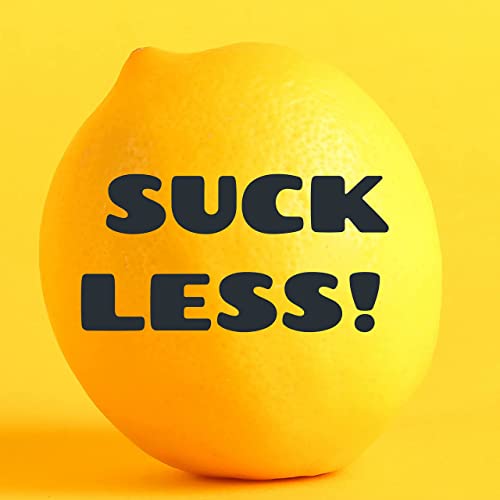
Willam Belli's Suck Less is as honest a piece of self-improvement content as the audiobook category currently offers, and its honesty is inseparable from its packaging. The title is the premise: the goal is not transformation, not finding your best self, not becoming extraordinary - it is simply doing slightly less badly than you did yesterday. Belli, best known for his appearance on RuPaul's Drag Race and his subsequent career as a performer, writer, and commentator in LGBTQ+ media, narrates every word of this audiobook himself, and his voice is the product's entire value proposition.
The synopsis describes what appears to be podcast content: a motivational podcast about getting better every day, with the social media handles and merch links embedded in the description. That origin context is worth noting for listeners making purchasing decisions. At five hours and twenty-two minutes, this is a more substantial runtime than similar podcast-origin audiobooks, suggesting that what is here has been curated and organized beyond a simple episode compilation. The 4.7 rating across nearly a thousand listeners reflects both the quality of the content and the loyalty of Belli's existing audience, and that rating holds up under scrutiny once you understand what the format actually offers.
The LGBTQ+ Studies classification understates what Belli is doing here. Suck Less is not primarily a cultural studies text or a community history - it is self-improvement content that happens to speak with specific clarity to experiences familiar to queer listeners without excluding those outside the community. Belli's approach to improvement is consistently pragmatic: he is not interested in telling you who you should become, but he is very interested in identifying the specific behaviors and thought patterns that are making your present situation worse than it needs to be.
His self-deprecation is not a performance of humility but a methodology. By being specific about his own failures, missteps, and ongoing areas for improvement, Belli creates the credibility to address those same patterns in the listener without the condescension that characterizes most motivational content. He is not speaking from a position of achieved excellence down to an audience still struggling. He is speaking from a position of someone actively engaged in the same project, with specific observations about what has and has not worked - and that peer-level positioning is rare enough in the self-help genre to be genuinely refreshing.
What Willam Belli Gets Right
The audiobook format suits Belli's delivery particularly well. His comic timing - the pause before a punchline, the slight shift in register when moving from the funny thing to the serious thing underneath it - works in audio in ways that a transcribed text version would flatten. He has a performer's understanding of when to land a joke and when to let a serious point breathe, and the five-hour runtime gives him space to develop ideas past the surface level.
The LGBTQ+ perspective that runs through the content is not segregated into a separate section for queer listeners. It informs the entire framework of how Belli thinks about authenticity, identity, performance, and the relationship between who you present yourself as and who you actually are. These are not niche concerns. The experience of navigating a world that has repeatedly required you to perform a version of yourself that is not quite right is one that resonates well beyond the LGBTQ+ community, and Belli's insights on it are practically useful regardless of the listener's own relationship to that experience. The translation is built into the content rather than requiring the listener to do the interpretive work.
Where Willam Belli Loses Some Ground
Belli's humor is dry and occasionally sharp in directions that not every listener will find comfortable. He does not soften criticism of behaviors he finds counterproductive, and his assessments of self-defeating patterns are delivered with the same candor he applies to his own failures. Listeners who want motivational content that maintains warmth throughout and never challenges the listener's self-image may find his directness an acquired taste.
The podcast origin of the content means the organizational structure follows a conversational rather than systematic logic. There is not a chapter-by-chapter progression from foundational principle to advanced application. The value is distributed across the runtime in a way that rewards full engagement rather than chapter-skipping. Listeners who prefer highly structured self-help content with clear frameworks will find Belli's approach more organic than systematic, which is either a feature or a limitation depending on what you came for.
Who Should Pick Up Suck Less
LGBTQ+ listeners looking for self-improvement content that speaks to their specific experience without treating that experience as exceptional or requiring constant translation will find this audiobook meets them where they are. Listeners outside the community who want self-improvement content delivered with humor, candor, and zero tolerance for self-congratulatory abstraction will find Belli's approach a refreshing departure from the category's defaults.
Skip this if you want systematically organized self-help with clear frameworks and a sustained warm tone. Belli is funny and direct before he is structured, and the podcast-origin organization means the content flows associatively rather than architecturally. Those qualities are assets for the right listener and obstacles for the wrong one. Belli himself would be the first to tell you that not all advice is for all people, and the self-aware framing of Suck Less applies to the audiobook format as much as to anything it advocates.
The five-hour runtime also gives Belli room to return to ideas across multiple conversations, which is how the podcast format builds persuasive depth that a single essay cannot. Listeners who might resist a direct piece of advice delivered once will find it lands differently the third time it appears in a slightly different context. That repetition with variation is one of the genuine pedagogical advantages of the podcast-origin format when the curator has a strong enough perspective to sustain the recurring theme. Belli does, and the five hours feel earned rather than extended as a result.