The Short Version
- Narration: Jeremy Frazier juggles five distinct comic voices, including a sarcastic banana slug, without losing clarity across a 15-hour runtime.
- Themes: Underdog progression fantasy, found-family party dynamics, quarter-life crisis as adventure premise
- Mood: Comedic and warm, with real emotional stakes underneath the jokes
- Verdict: A strong pick for character-first LitRPG fans who want Dungeon Crawler Carl energy without heavy system crunch.
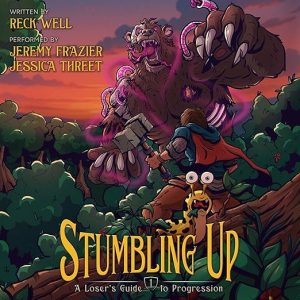
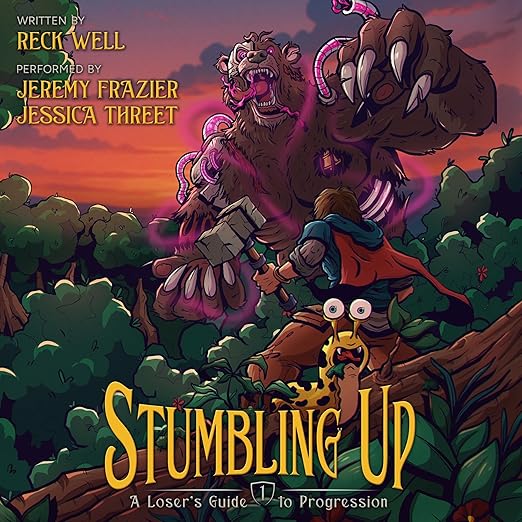
A foot-long telepathic banana slug named Richard is not a detail most fantasy audiobooks lead with, but Stumbling Up puts him front and center as Cole's dungeon life coach, emotional terrorist, and self-declared immortal. Cole himself rolled the worst specialization imaginable, Self Criticism, in a world split between ordinary Mundanes and magical Adventurers, and one drunken mistake later he is conscripted into the Adventurer's Guild for a deadly Trial Dungeon. This audiobook is the first in Reck Well's Loser's Guide to Progression series, and it wears its underdog premise honestly from the opening chapter.
The Review
The party Cole ends up with is the real engine of the book: Leo, a pink-sweater-wearing himbo with a double-bladed axe and a hit-first mentality; Tandy, a genius crafter with an irrational hatred of sheep; and Meredeath, described in the synopsis as not being in Kansas anymore but 'kicking monster butt in platform boots.' Reviewer Stacy F specifically praised how the characters have depth despite the constant joking, while noting the story stays well paced across a nearly 15-hour runtime that could easily have sagged in a lesser LitRPG.
Jeremy Frazier narrates, and the job here is genuinely difficult: five distinct comic voices, including a sarcastic, foot-long slug, need to stay differentiated across dungeon crawls, guild politics, and quieter emotional beats about a group of friends who are, as the synopsis puts it, tackling their quarter-life crisis by pursuing adventure instead of therapy.
The Mundane-versus-Adventurer split at the center of the worldbuilding gives Stumbling Up a clean, legible premise from its opening pages: two visibly different classes of people living side by side, one able to access dungeons, specializations, and power, the other locked out of it entirely by circumstance rather than choice. Cole's drunken conscription into the Adventurer side, without any real preparation, sets up the underdog framing the series title promises.
Tandy's single-minded determination to keep sheep as far away as possible is a small but telling example of the book's comedic method: give a character one specific, absurd fixation rather than a generic quirky-friend personality, and let that fixation resurface as a running gag rather than a one-time joke. Guild politics thread through the background of the Trial Dungeon sequence too, giving the world a sense of institutional structure beyond the immediate party dynamics.
What Makes Stumbling Up Worth Hearing
The synopsis draws its own comparison to Matt Dinniman's Dungeon Crawler Carl and Shirtaloon's He Who Fights With Monsters, and that comp is earned rather than aspirational marketing. Like those two benchmarks, Stumbling Up is explicitly stat-light, meaning listeners who want deep, crunchy progression systems with detailed number-crunching will find less of that here than in denser LitRPG series. What replaces the system-heavy approach is character comedy and genuine emotional stakes, reviewer jessica worgo called the setup insanely fun, with Cole waking up hungover to discover what he agreed to the night before.
Cole's assigned specialization, Self Criticism, does real thematic work beyond being a punchline. A LitRPG system that turns a character's anxiety and self-doubt into an actual in-world stat externalizes quarter-life-crisis psychology into game mechanics built directly into the plot, giving the comedy an emotional undercurrent that pure parody LitRPG often skips entirely. The party's chosen name, Your Mom's Party, previews the book's comedic register well: broad, a little juvenile, entirely self-aware about it.
The series title itself, A Loser's Guide to Progression, is a small piece of genre commentary worth noticing: progression fantasy as a subgenre typically celebrates steady, satisfying power growth, and framing that same structure explicitly through a self-described loser's perspective signals the comedy is baked into the premise at the structural level, not layered on top of a standard power-fantasy arc afterward. Cole rolling the worst possible specialization is the mechanical expression of that same joke.
The synopsis's own tagline, 'stumble towards glory treasure power adventure,' deliberately runs those nouns together without punctuation, mimicking a breathless, half-drunk momentum that matches Cole's actual state at the story's opening.
The Caveats
Jeremy Frazier has no extensive prior track record in this specific genre, so the comedic differentiation between five main voices is worth sampling before committing to the full 15-hour runtime, since that vocal range is the single biggest technical demand the book makes of its narrator. The synopsis also bills the story as heart-wrenching alongside the comedy, and listeners should expect real tonal swings between banana-slug jokes and genuine quarter-life-crisis anxiety, rather than a purely comic tone throughout.
Worth noting too that with only 6 ratings on record so far, this is an early-reputation title rather than one with a long track record of listener feedback. The enthusiasm in the three available reviews is specific and consistent, but the sample size is genuinely small.
New LitRPG listeners should know the bracketed terms, [Mundanes], [Adventurers], [Self Criticism], [Immortal], are standard genre notation marking system-recognized classifications within the story's world, not typos carried over from the page. Listening rather than reading removes the visual bracket cue entirely, so Jeremy Frazier's narration has to signal that distinction through tone alone, a subtle but real adjustment from the print or ebook edition.
The Right Listener for Stumbling Up
LitRPG and GameLit fans who want the comedic, character-first register of Dungeon Crawler Carl without its heavier stat-tracking, and anyone drawn to a self-aware underpowered-losers premise, are the clearest audience for this one. Reviewer 2545CASE kept it simple: a great read, thoroughly enjoyed, and that kind of uncomplicated enthusiasm tracks with a book that never takes its own genre conventions too seriously.
Dense, mechanically detailed progression systems, stat blocks, and skill trees take a back seat here, so anyone chasing that specific appeal should look toward crunchier entries in the genre instead. Stumbling Up trades that depth for comedy, party chemistry, and a banana slug with real emotional range, and it is worth choosing on those terms rather than for tactical system depth.
Reviewer jessica worgo specifically highlighted how fast the emotional hook lands, noting sympathy for Cole's situation builds almost immediately once the hungover conscription premise kicks in, before Richard the banana slug even enters the story. That quick emotional buy-in matters for a 15-hour commitment, since it gives listeners a reason to stay invested well before the full party assembles.
Meredeath's platform boots and monster-fighting competence, introduced with a direct nod to the Wizard of Oz's not-in-Kansas-anymore framing, signal a character confident and capable from her first appearance rather than one who needs to grow into competence over the course of the book. The comparison the synopsis draws to He Who Fights With Monsters is apt for tone as much as structure, both find humor in an underqualified protagonist thrown into a system he does not fully understand yet.
Before You Listen
Is the Stumbling Up audiobook heavy on LitRPG stats and systems, or more story focused?
More story focused. The synopsis describes it as stat-light, comparing it to Matt Dinniman's Dungeon Crawler Carl and Shirtaloon's He Who Fights With Monsters, so listeners wanting detailed stat blocks and crunchy progression systems will find less of that here than in denser LitRPG series.
How does Jeremy Frazier's narration handle a talking banana slug and four other main characters?
The audiobook leans on Frazier to differentiate five very different voices, including Richard the sarcastic telepathic slug, Leo the axe-wielding himbo, and Tandy the sheep-hating crafter, across a nearly 15-hour runtime without letting the comedy blur the characters together.
Do I need to read other LitRPG series before starting the Stumbling Up audiobook?
No prior series knowledge is required. This is book one of Stumbling Up: A Loser's Guide to Progression, and it introduces its world, party, and system from scratch.
Is the Stumbling Up audiobook a complete story or the start of an ongoing series?
It is the start of an ongoing series. The Trial Dungeon and the formation of the party resolve as a single adventure, but the synopsis frames this as book one of a longer progression story still being built out.