The Short Version
- Narrator: Mark Sanderlin handles Jackson's voice with the right mix of middle-grade confidence and underlying anxiety - he keeps the fantasy premise plausible by playing the emotional logic straight rather than for laughs.
- Subjects: Fear of growing up, consequences of avoidance, bullying and its lasting effects
- Tone: Warm and occasionally wistful, with a genuinely bittersweet undercurrent
- Bottom line: Grabenstein's Groundhog Day premise for middle-grade listeners works because he takes the emotional cost of Jackson's wish seriously - this audiobook does not resolve the way readers expect, and that honesty is its real strength.
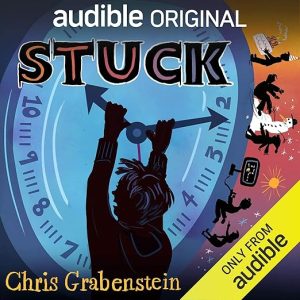
Grabenstein's premise for Stuck is the kind of idea that announces itself immediately as either inspired or exhausting, depending on execution. An eleven-year-old makes a birthday wish never to grow up, and the wish comes true. Chris Grabenstein - whose Escape from Mr. Lemoncello's Library demonstrated a gift for middle-grade premises with psychological depth - uses the setup not as comic material but as an extended meditation on what it actually costs a child to stop time. Narrated by Mark Sanderlin, this audiobook runs three hours and twelve minutes, which is the right length for the age range and the material. Jackson's situation is clarified quickly, and Grabenstein does not overstay the premise or mine it for easy laughs when harder questions are available.
The novel's critical move is to take Jackson's wish seriously as a response to genuine fear. The bully across the street is not cartoon menace but a specific social threat: the older kids at middle school who will make the transition from fifth grade an exercise in humiliation. Jackson's logic, from an eleven-year-old's perspective, is not irrational. He wants to stay in a world where he is competent, respected, and safe. What Grabenstein then shows is the escalating cost of that competence as the wish persists: Jackson becomes the best in his class, the star of the baseball team, the first-chair musician - and completely alone, because the friends who shared his world are growing up without him. His little sister becomes his big sister. His former friends are driving. The world he stopped has kept moving around the fixed point of his refusal.
One reviewer identified the ending as tragic, and while that may be too strong a characterization, the novel does not deliver the cleanly redemptive finale that middle-grade fantasy often provides. Jackson figures out how to move forward, but his lost years do not come back, and the people who grew past him are not waiting where he left them. The moral - that actions have consequences and avoidance has a price - is handled with enough specificity to feel true rather than instructional. A reviewer who works in children's publishing noted Grabenstein's particular skill at capturing the nuanced struggles of childhood without flattening them into lessons, which is an accurate summary of what distinguishes this novel from more formula-driven middle-grade fantasy. The audiobook carries those nuances effectively because Sanderlin treats the premise as emotional rather than comedic from the opening chapter.
What Chris Grabenstein Gets Right
Mark Sanderlin's narration serves the material precisely because he resists the temptation to play Jackson as a comic protagonist. The premise has obvious comedic potential - an eleven-year-old stuck in fifth grade while the world ages around him - and Sanderlin's measured delivery signals from the start that Grabenstein is using that premise to get somewhere more complicated. The moment where Jackson realizes his little sister is now his big sister is handled in the audiobook with quiet impact rather than broad effect, and that restraint is sustained through the more difficult later sections when the full cost of the wish becomes undeniable. Sanderlin tracks the emotional arc from initial delight through growing unease to genuine loss without losing the fundamental warmth that keeps the audiobook accessible for younger listeners.
For a children's audiobook at three hours and twelve minutes, the pacing is efficient without feeling rushed. Grabenstein structures the wish's consequences in escalating stages: the initial delight of being the most capable in the room, the first signs of wrongness as time passes, the full weight of isolation as the years compound. Each stage has distinct emotional texture, and Sanderlin tracks the shifts without losing the thread of Jackson's fundamental voice. For listeners in the eight-to-twelve range, this is a book that will prompt real conversation about fear, avoidance, and the difference between the safety of staying small and the harder work of growing through something difficult.
Where Chris Grabenstein Loses Some Ground
Pay attention to the baseball sequences, which Grabenstein uses as a compressed timeline of Jackson's changing relationship to his wish. Initially the sport is pure triumph - Jackson's retained physical coordination and tactical knowledge make him exceptional in ways his younger teammates cannot match. As the years pass, the same exceptionalism becomes a kind of prison, since his teammates rotate away and he remains. The baseball thread carries the novel's central argument about what it means to grow through challenge rather than around it, and Sanderlin's delivery in those sequences treats the sport's specificity with the seriousness it deserves.
The relationship with the bully, who is the original trigger for the wish, is handled with more nuance than the setup suggests. Grabenstein does not resolve it through confrontation or simple reversal. The bully grows up and changes, partly without Jackson's involvement, which is a more honest rendering of how that particular dynamic usually resolves - or fails to - than the genre's typical climactic confrontation provides. It is a detail that distinguishes this book from wish-fulfillment fantasy that treats the central fear as something to be defeated through courage alone rather than outgrown through time and experience.
Who Should Pick Up Stuck
Middle-grade listeners aged eight through twelve will find this most directly relevant, particularly those facing transitions - elementary to middle school, a move, a social disruption - that make the appeal of stopping time feel psychologically real rather than fantastical. Parents and teachers who want to use fiction to open conversations about fear of change will find the audiobook a useful entry point, since the consequences of Jackson's wish are concrete enough to discuss without requiring extensive abstract reasoning. Skip it if you are looking for a lighter, adventure-driven children's audiobook - this is emotionally serious work dressed in a comic premise, and the ending does not deliver uncomplicated reassurance.
Is the Stuck audiobook narrated in a way that keeps young listeners engaged through the more serious middle sections?
Mark Sanderlin plays Jackson's emotional truth rather than the premise's comedic potential, which keeps the audiobook engaging even when the material becomes more somber. The pacing is efficient enough that the tone shifts do not cause momentum problems, and the seriousness feels earned rather than imposed.
How does Stuck compare to other Chris Grabenstein audiobooks for middle-grade listeners?
Grabenstein is best known for the Escape from Mr. Lemoncello's Library series, which is faster-paced and puzzle-driven. Stuck is more emotionally interior and thematically focused - it shares Grabenstein's skill with relatable child protagonists but operates at a more reflective register than the library adventure books.