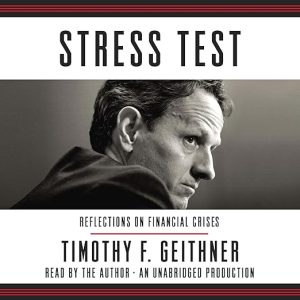
Bear Stearns, Lehman Brothers and AIG all appear in the second half of the description, named individually, which is a fair signal of how granular this memoir intends to be. Not a general account of 2008, then, but a week-by-week reconstruction from inside the rooms where the decisions were made. The audiobook runs 18 hours and 23 minutes, and the byline and the narrator field carry the same name: Timothy F. Geithner reads his own account of the worst financial crisis since the Great Depression.
Geithner Reads His Own Defense as Testimony
Self-narration changes what this book is. A Treasury secretary reading his own defense of the AIG rescue is doing something closer to testimony than to publishing, and the choice is legible before a single sentence of content arrives. Random House Audio released it on May 12, 2014, close enough to the events that the argument was still live and the people criticized were still in office.
Curiously, the most quoted line in this column is not Geithner's at all. A five-star filed in June 2014 opens with Mike Tyson on strategy surviving until the first punch lands, then applies it: the plan existed, and then Congress and an administration the response describes as bent on punishing business changed how the game had to be played. That is the book's own thesis restated by a reader, and it names the $700 billion intervention at the center of it.
What the copy admits is unusual for a political memoir. It states outright that this small group of policy makers, working in a thick fog of uncertainty, helped avoid a second depression and lost the American people while doing it. A book that concedes its own unpopularity in the sales description is not planning to spend 18 hours seeking your affection, and that candor is the reason to trust the rest.
From Bear Stearns to a Childhood Abroad
Access is what you are buying. The description promises the Bear Stearns rescue, the weekend Lehman Brothers failed, the AIG bailout and the fury over its bonuses, the internal Obama administration fights over a widely criticized plan, and the passage of the broadest financial reforms in more than seventy years. Nobody outside that circle can narrate those days from the inside, and the number of people who can has not grown since.
Scope runs wider than 2008 as well. It starts with a childhood spent abroad as an American, moves through work as a young Treasury official during the international crises of the 1990s, and continues past the rescue into unemployment, the deficit fights and Europe's repeated approaches to the economic abyss. Crises rhyme, and a career spent inside several of them is more instructive than a single postmortem.
Four countries are represented in this column, which suggests the appeal travels. A five-star written in Portuguese and filed from Brazil recommends the book for seeing the crisis from the position of the person making the calls, the decisions and the consequences alike, which is exactly the promise of a first-person account by the official who made them. A decade on, the crisis reads as everybody's history rather than only as American history.
No Opposing Voice, Only the Official Record
Arithmetic is where this record falls apart. The badge displays 4.4 while the counter beside it reports a single rating, and one vote can only produce a whole number of stars. Five written entries are visible beside it, every one of them at four stars or five, so the count is not measuring the column either. Read the number as a broken field rather than as a verdict, and read the responses themselves.
Criticism is what deserves the most weight. A four-star headed Geithner on Geithner sets out the three questions a crisis account has to answer, what caused the markets to fail, whether the government's response worked, and how a repeat can be prevented, and concludes that the book sort of addresses all three. That response still credits the analysis of overconfidence in the housing market curdling into mania, which is a precise summary of what the book does well and where it hedges.
Bear in mind who is talking. This is a defense written by the person who signed the decisions, and the copy says outright that it revisits the most controversial episodes of both his tenures on his own terms. No opposing voice is built into it. Anyone using this as their only account of the crisis should plan to read something adversarial afterward, because the fog of uncertainty is a generous frame for choices other people have judged less kindly.
Crisis Management as Geithner's Policy Case Study
Anyone working in finance, policy or public administration gets a case study with the internal deliberations attached, which textbooks cannot supply. A January 2026 five-star, filed from Singapore, argues the book will define the working manual for fighting a crisis and imagines it being filmed one day, and the underlying instinct is right: the material is dramatic because the stakes were absurd and the clock was always running.
General readers curious about recent history will get further into this than they expect, because the book is not primarily technical. The mechanics arrive through people and deadlines rather than through equations, and the chapters on a childhood spent abroad and the Treasury work of the 1990s give the collapse a long runway. The copy sells a candid memoir rather than an economics text, and that description holds.
Skeptics of institutional voices should choose differently, and so should anyone who wants the crisis explained from outside power, because this is a career official describing institutional decisions in the institutional voice; this is a career official describing institutional decisions in institutional language, and the politics chapters carry real bitterness about the silliness and the nastiness of the process. Coming to it as one testimony among several, delivered in the voice of the man who has the most to answer for, it is close to indispensable.
Quick Take
- Read by: The man defending the decisions is also the man reading them aloud, which is not a neutral choice on a memoir this contested.
- At its heart: The 2008 financial crisis, bailouts and their politics, public service under fire, institutional decision-making
- Vibe: Measured, defensive, occasionally bitter
- Short version: The essential inside account of the rescue, as long as you pair it with a version written by somebody outside the room.
Before You Listen
Does the audiobook assume a finance background?
Not much of one. The copy sells a candid memoir rather than an economics text, and the crisis arrives through people, rooms and deadlines: Bear Stearns, the weekend Lehman failed, the fury over the AIG bonuses. Technical terms surface, but the through-line is a career and a sequence of decisions.
Which crisis moments does the audiobook actually cover?
The description names the Bear Stearns rescue, the weekend Lehman Brothers failed, the AIG bailout and the bonus furor, the internal fights over the plan that ended the crisis, and the passage of the broadest financial reforms in more than seventy years, plus the aftershocks in Europe.