
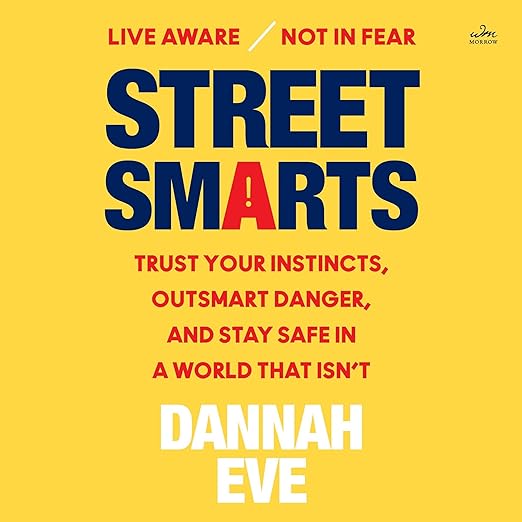
A pair of men's shoes by the front door doesn't need an explanation, just a look that suggests someone else lives here too, and that small staged deception is exactly the kind of practical thinking this audiobook spends seven and a half hours teaching. Street Smarts arrives as a catalog of tactics like that one: specific, slightly sly, aimed less at dramatic self-defense than at making a woman look like a harder target before anything happens at all. The catalog credits Jim Rogers as author, but the voice behind this material is Dannah Eve's, a safety educator who built her platform on social media before bringing these lessons to audio, and I mention that mismatch upfront because listeners searching for the well known commodities investor of the same name are going to end up somewhere else entirely.
Bybee Delivers These Rules Like a Trusted Friend
Eve's whole approach rests on a single reframe: stop thinking about safety as a reaction to danger and start thinking about it as a mindset you carry into every ordinary errand. That shows up in the structure, a running list of situational rules organized by context, a date, a commute, a walk to the car after a concert, rather than a single narrative arc, and it works well for audio because each rule stands on its own. You don't need to remember chapter three to use chapter nine.
Michael Bybee is credited as narrator on this edition, and whatever the marketing copy claims about author narration, his delivery suits the material regardless: calm, unhurried, closer to a trusted friend walking you through a checklist than a lecturer. The tone the synopsis promises, an encouraging older sister rather than a paranoid alarmist, comes through clearly in how each rule is paced, with enough space after each one to actually land before the next begins.
The phrase 'weaponize your intuition' in the synopsis is doing real work as a rhetorical choice. Intuition gets treated culturally as a soft, unreliable instinct, something to second-guess rather than trust, and Eve's reframing turns it into an active skill you sharpen on purpose rather than a vague feeling you either have or don't. That shift in framing, from passive hunch to trained tool, runs through nearly every rule in the book, and it's a genuinely useful mental model independent of any specific tactic.
The 'calculated deception' tactic, lying to a stranger about a nonexistent boyfriend, staging evidence of a man living at your address, treats dishonesty as a legitimate safety tool rather than a moral failing, which is a genuinely different stance than most etiquette-conscious safety guides take. Eve's implicit argument is that a stranger's comfort with your honesty matters far less than your own safety, and that reframing alone is worth the price of admission for listeners who've been taught to prioritize politeness over self-protection.
Essential Reading Before a Teenager Leaves for a Dorm
The specificity is what separates this from generic safety platitudes. Never leave a workplace badge, a nametag, or a package label visible while commuting. Don't pull over for an unmarked vehicle, since anyone can buy police lights online now. Plan an exit route before you need one at a concert or a crowded venue. None of these require special equipment or training, and that accessibility is precisely the point reviewer Rhonda makes when she says the book surfaces ideas she had never even considered.
Reviewer Suzan Haverty singles out the material aimed at women living away at college for the first time, calling it essential reading before a teenager leaves for a dorm, and that's a genuinely useful way to think about the book's core audience. A supplemental enhancement PDF ships alongside the audio, and while nothing in the audio itself depends on it, it's a reasonable download for anyone who wants a written reference to revisit specific scenarios later.
Eve's background as a social media safety educator places this book inside a real and growing publishing trend: creators who built large followings teaching everyday safety online, then expanded that material into a longer, more structured audio format. That lineage matters because it explains the book's tone, direct, list-driven, built for quick recall under stress, rather than the denser academic register of an older-school security manual.
Filed Under Money and Finance by Mistake
This is not a physical self-defense manual. No fighting technique appears here, no wrist-lock instruction, nothing you'd find in a martial arts course. The value is entirely in prevention, awareness, and de-escalation, spotting danger early enough that you never need the physical skills at all. Listeners hoping for combat training specifically should look elsewhere, though Eve would probably argue that's exactly the point: the best fight is the one you avoid.
The genre tag attached to this listing reads money-finance, almost certainly a metadata artifact from whatever system pulled in the wrong Jim Rogers, and it's worth flagging again here because a shopper skimming categories could easily scroll past a book that has nothing to do with investing. The actual content sits far closer to personal safety and emergency preparedness, exactly where its own tags correctly place it.
Readers familiar with Gavin de Becker's The Gift of Fear will recognize a similar core premise here, that intuition is data your brain has already processed faster than your conscious mind, even though Eve's book is far more tactical and checklist-driven than de Becker's more narrative approach. Listeners who found de Becker's book compelling but wanted more concrete, repeatable rules will likely find this a good next step.
List-heavy nonfiction like this asks something specific of narration that flowing narrative doesn't: enough of a pause between distinct rules that a listener's ear can register a new topic starting, without so much pause that individual items start to feel disconnected from a coherent whole. Bybee gets this balance right throughout, which matters more here than it would in a book built around a single continuous argument.
A 4.4 average rating across 680 reviews signals broad, sustained approval rather than a small enthusiast niche finding each other online, which matters for a personal-safety guide competing against far more heavily marketed titles in the same crowded category.
Young Women Living Alone for the First Time
Young women heading off to college, anyone living alone for the first time, frequent solo travelers, and commuters who want a sharper eye for the small warning signs before a bad situation develops will all get real, usable value here. Parents looking for something concrete to hand a teenager leaving home will find this does that job better than a generic lecture ever could.
Skip this one if you're specifically hunting for physical self-defense instruction, or if you came here looking for the real Jim Rogers's investing wisdom and got redirected by a catalog error. Listeners who find rule-by-rule, checklist-style nonfiction tedious rather than useful may also want a more narrative true-crime-adjacent alternative instead.
Does this audiobook's Street Smarts have any connection to investor Jim Rogers?
No. The catalog credits Jim Rogers as author, likely a metadata mix-up with the well known commodities investor of the same name, but the actual content is Dannah Eve's personal safety guide, built from her work as a social media safety educator. Listeners looking for investment advice should search elsewhere.
Who actually narrates the Street Smarts audiobook, Dannah Eve or Michael Bybee?
The listing credits Michael Bybee as narrator, even though the synopsis describes the audiobook as narrated by the author. Bybee's calm, unhurried delivery suits the material regardless of which name belongs on the credit.
Is the safety advice in Street Smarts aimed mainly at women?
Yes, most of the specific scenarios, dating, living alone, college life, are framed around situations women commonly face, though the underlying principles of situational awareness apply broadly to any listener.
Do I need the companion PDF to get value from this book?
No. Each safety rule is designed to stand on its own in audio form. The supplemental PDF adds a written reference for revisiting specific tips later, but nothing in the audio depends on having it open.







