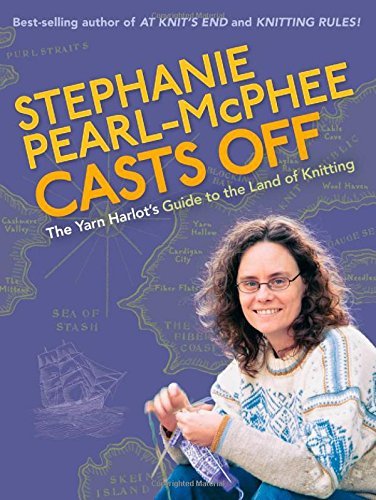
Casts Off is a phrase that belongs to knitters and to sailors, and this audiobook listing never says which one it means. It does not say much of anything, in fact, because the description field is empty. What the page does supply is one name entered twice, once as author and once as narrator, a runtime given as 2 hrs 26 mins in the abbreviated form the field happens to carry, a single five-star rating with no words attached to it, and a publisher line that plainly belongs to a printed book.
A Print Colophon Mislabeled as Middle English
Storey Books; First Printing edition (1 Aug. 2007) is the entire publisher field. That is a colophon rather than an audio credit. First printing is a phrase about paper. The date is formatted in the British convention. The string arrives with an invisible control character in front of it, which is the signature of text pulled out of a product table rather than typed in by a person. Whatever else is true here, this record was assembled from a print listing, and nobody went back afterward to fill in the parts that only apply to a recording. The ASIN is the one identifier doing honest work, and it points at a file rather than at an object with a spine.
No release date is recorded for the audio itself. No series, no subtitle, no publisher blurb, no cast note, no chapter count. The one field filled in beyond the bare minimum is the language field, and it reads Middle English. That is not a translation decision, and nobody entered it as a joke. It is an error, and it is the kind with consequences, because language metadata is what routes a title into search filters, recommendation shelves and the accessibility tools that let people find recordings in the language they actually speak. A title tagged as Middle English will not appear where an English speaker is looking, which is a quiet way for a short book by a working author to vanish.
Pearl-McPhee Reads Herself for Two and a Half Hours
Author-read recordings usually signal one of two things: a personal book, or a small budget. On this record the author field and the narrator field carry the same name, and nothing else indicates which case applies. The runtime is worth reading as a clue on its own. One hundred and forty-six minutes is essay length rather than manual length. A technique guide runs long because it has to be exhaustive; a collection of short pieces runs to roughly this, and a single voice reading a single voice's writing fits the second shape considerably better than the first. Two and a half hours is also roughly the length of a drive, a long walk or an afternoon of repetitive handwork, which is worth saying out loud on a page shelved under crafts.
Nothing on the page confirms that reading, which is the honest limit of what a listing this thin allows anybody to say. The Crafts and Hobbies tag and the home and garden shelving both point toward instruction, and instruction is precisely the category that suffers most in audio, since it depends on figures, ordered sequences and the ability to stop on one specific line and stay there. If this is a book of essays about a craft, the format is close to ideal. If it is a book of instructions for one, the format is a problem. The listing declines to say which, and a buyer has no way to establish it without paying first or finding the print edition somewhere else and reading its contents page.
What the record does establish is worth stating plainly, because thin pages tend to get dismissed rather than read. The author and the narrator are one person. The recording is short enough to finish in an afternoon. It carries an ASIN, so it exists as a purchasable file rather than as a placeholder. And it has been sitting under a 2007 print date long enough that whatever audience found it was never going to be routed there by the metadata. Those four facts are not much, and they are more than the page presents in any organized form, which is the argument for reading a thin listing carefully rather than scrolling past it.
One Rating Proves Nothing About the Recording
Five stars from one rating is the only figure here that holds together. A lone vote can land only on a whole star, and five is a whole star, so badge and counter are consistent with each other for once. What that consistency buys a buyer is nothing whatsoever. One person pressed a button and wrote no words, and a sample of one describes that person rather than the recording. The page has carried a 2007 date for long enough to accumulate more than that, and it has not. Silence of that kind is usually a distribution problem rather than a quality signal, and the broken language field is a plausible reason for it.
Duration and voice are therefore the whole of the available evidence, and both of them argue for sampling before buying. Two and a half hours is short enough that five minutes of sample represents a meaningful fraction of the experience, which is rarely true of the twelve-hour and twenty-hour titles beside it. Author narration is also the variable most likely to settle the question outright, since a writer reading their own comic timing either works within a paragraph or does not work at all. Listen to the opening minutes and you will know more than this page can tell you.
Curiosity Makes This a Cheap Two-and-a-Half-Hour Bet
Curiosity is the right reason to be here. Anybody who already knows this author's writing and wants to hear it in the voice that wrote it has everything they need from the two credit fields, and the runtime makes the experiment cheap. Listeners who enjoy short-form personal writing about an obsession, whichever obsession it turns out to be, are also reasonably served, because two and a half hours of one voice on one subject is a companionable shape that suits a single sitting. Anybody who has enjoyed a writer talking at length about a hobby that outsiders find inexplicable already knows whether this shape appeals.
Gift buyers should be careful, since a listing with no description gives you nothing to check against a recipient's taste, and the title alone points at two different hobbies with equal confidence. Anybody hoping for step-by-step technique should read the silence as a warning rather than an invitation. The recording itself may well be excellent. The page selling it was assembled out of a print record, mislabeled by language, stripped of its description and left to stand on one wordless vote, and a buyer deserves to know all four of those things before spending a credit.
Why does this audiobook listing have no description at all?
Because the blurb never made the crossing from the paper edition. What survived is a colophon in the publisher field and a language tag that is simply wrong. Nothing suggests the recording itself is incomplete; only the page selling it appears to have been left half finished.
Does Stephanie Pearl-McPhee narrate this audiobook?
One name fills both credit slots, so the record has the author reading it aloud. No listener response exists to confirm how that delivery lands, and no publisher note describes the production. The sample is the only evidence on offer, and against a runtime this short it represents a large share of the whole.
Why does the language field say Middle English?
It is a metadata error, almost certainly inherited from the same bad import that left a print colophon in the publisher field. Nothing about the credits, the title or the shelving suggests a historical text. The practical risk is discovery: a wrong language tag drops a title out of the filters most listeners browse with.