Quick Take
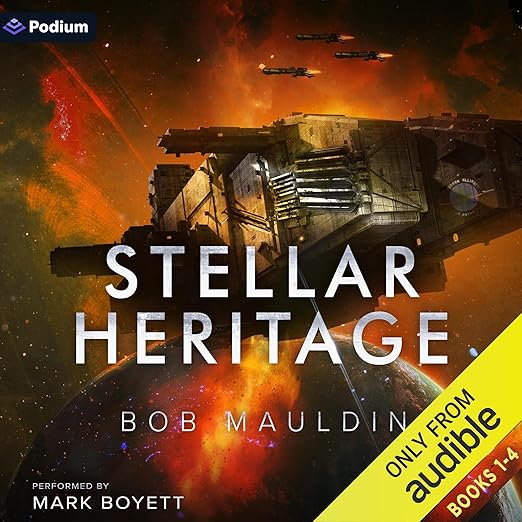
- Narration: Mark Boyett brings range and authority to a large cast across 64+ hours, making the Terran Alliance feel like a real institution populated by distinct voices.
- Themes: First contact diplomacy, political ambition, humanity’s place among alien civilizations
- Mood: Expansive and adventure-driven, with regular detours into political intrigue
- Verdict: A satisfying complete-series listen for fans of classic first-contact science fiction who can invest in a multi-book arc without needing relentless action as the throughline.
When the complete Stellar Heritage series dropped as a single audiobook package, I added it to my library with the half-formed intention of listening across a long vacation. Sixty-four hours and forty-six minutes is not a casual undertaking, and Bob Mauldin’s four-book saga covering the rise of humanity’s first galactic federation is exactly the kind of science fiction that rewards that investment: slow-build, world-spanning, and interested in political mechanics as much as adventure. I listened to Legacy and Spheres of Influence over about a week before circling back. By the time I reached Far Horizons, I had developed strong opinions about the Senate of the Terran Alliance and their collective inability to think past their own interests. That’s a sign the fiction is working.
The story begins with a discovery that has powered science fiction for decades: an ordinary couple, Simon and Katherine Hawke, stumble upon an alien shuttle that has landed on Earth. What distinguishes Mauldin’s version of this premise is what happens immediately after. Rather than treating the discovery as an isolated adventure, the series rapidly expands outward to explore the consequences of first contact for human civilization as a whole. The shuttle leads to a derelict ship in orbit, which leads to contact with alien civilizations, which leads to the founding of the Terran Alliance, which leads to the political complications that dominate the later books. The Hawkes are the entry point, but humanity is the protagonist.
Our Take on Stellar Heritage: The Complete Series
Mauldin’s scientific and technical imagination is one of the series’ consistent pleasures. The spacecraft descriptions, which one reviewer specifically highlighted as a standout element, reflect genuine enthusiasm for the engineering and operational realities of space travel. This is not the kind of science fiction that treats its ships as background props; the vessels have characters of their own, and the tactical and navigational details are worked through with care. Reviewers who mention loving ‘the classic references’ are responding to a series that clearly grew out of a deep familiarity with the genre’s history, from early space opera through the political science fiction of the 1980s.
The political dimension is where the series most clearly distinguishes itself from simpler first-contact narratives. One reviewer noted that the series deals with ‘the weakness of human’s resistance to ambition to gain power over others,’ which is an accurate description of its sustained thematic concern. The Terran Alliance’s internal conflicts, the attempts by various factions to exploit the first-contact situation for personal or national advantage, are not subplots that interrupt the adventure. They are the substance of the story. This will delight some listeners and test the patience of others who came in expecting more kinetic action.
Why Listen to Stellar Heritage: The Complete Series
Mark Boyett is an accomplished narrator with a long track record in science fiction, and at sixty-four hours, a series like this requires someone who can maintain distinct character voices across a large cast without losing the thread. He succeeds. The Hawkes remain consistent and recognizable from Legacy through When One Door Closes, and the alien characters, whose vocal profiles Boyett develops with care, feel genuinely other without being caricatured. This is exactly the kind of performance that makes a long science fiction series listenable rather than endurance.
The complete-series format also means listeners don’t have to wait between books or maintain separate libraries. The four volumes transition without interruption, which matters for a series that builds its worldbuilding across all four books. The Terran Alliance that exists at the end of When One Door Closes is a genuinely different institution from the nascent organization in Legacy, and experiencing that evolution in a single continuous listen amplifies the sense of historical sweep that Mauldin is clearly going for.
What to Watch For in Stellar Heritage: The Complete Series
The pacing in the political sections can be slow by the standards of high-action science fiction. A reviewer who described taking ‘nearly a week to read with some late nights’ was someone who found the pace immersive rather than taxing, but listeners who want continual forward momentum may find the Alliance Senate scenes less gripping than the exploration and first-contact sequences. Mauldin’s interest in how political institutions work, and how they fail, requires patience with scenes that don’t resolve immediately.
Character development is competent but not the series’ primary focus. The Hawkes are likable and function well as reader proxies for the sense of wonder that drives the first books, but as the series expands into institutional politics, individual character arcs become somewhat less prominent than the broader civilizational stakes. This is a feature of the genre tradition Mauldin is working in, and it’s worth knowing if you listen primarily for character-driven fiction.
Who Should Listen to Stellar Heritage: The Complete Series
This complete series is well-matched to listeners who grew up on classic space opera and first-contact science fiction and want a contemporary series that takes that tradition seriously. It rewards the kind of listener who enjoys political complexity alongside their alien encounters, and who finds pleasure in a slowly building sense of galactic scope. Listeners who want relentless action, tight individual character arcs, or brisk pacing should adjust their expectations. The sixty-four-hour commitment is real, and the payoff is proportional to your investment in the genre’s pleasures rather than in spite of them.
Frequently Asked Questions
Does listening to the complete Stellar Heritage series require having read the individual books separately?
No. The complete series packages all four books, Legacy, Spheres of Influence, Far Horizons, and When One Door Closes, in sequence. This is the recommended starting point for new listeners, as the story builds continuously across all four volumes.
How political is the Stellar Heritage series compared to action-focused science fiction?
Quite political. The series centers on the founding and internal conflicts of the Terran Alliance, humanity’s first galactic federation. One reviewer described it as ‘strong on politics at times,’ which is accurate. Listeners who want primarily action-driven science fiction should be aware that the political maneuvering is a central feature, not a background element.
How does Mark Boyett handle the large cast across 64 hours?
Boyett is an experienced narrator in science fiction and maintains distinct voices for major characters throughout the full runtime. The alien characters in particular are given vocal profiles that feel consistent and distinct from the human characters. At this length, narrator consistency is crucial, and Boyett delivers it.
Is the science in Stellar Heritage hard science fiction or more space opera?
It sits closer to the space opera tradition but with genuine attention to technical and engineering detail, particularly in its spacecraft descriptions. It’s not hard science fiction in the mode of Kim Stanley Robinson, but it’s not technobabble-driven either. Mauldin clearly has thought through the operational realities of space travel and it shows.