Quick Take
- Narration: Marc Thompson is the gold standard for Star Wars audio; his full-cast-style delivery and iconic character voices are unmatched in the licensed fiction space.
- Themes: Obsession with power over death, the cost of surrendering humanity, loyalty under an authoritarian regime
- Mood: Dark and contemplative, with Thompson’s production elevating the material considerably
- Verdict: A nuanced post-Revenge of the Sith story that works best if you approach it as a Royal Guard drama with Vader in orbit rather than a Vader-centric narrative.
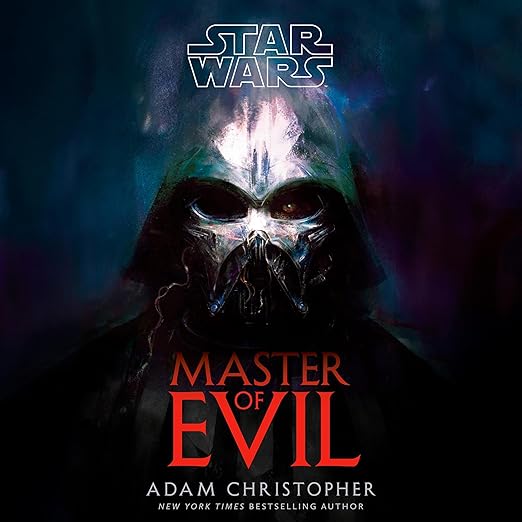
I went into Star Wars: Master of Evil with calibrated expectations. National bestseller status and the Early Empire setting, the years immediately following Revenge of the Sith, are reliable ingredients. What I did not anticipate was how much the book would redirect my attention away from Darth Vader himself and toward Colonel Halland Goth, the Royal Guard commander who travels alongside him. By the midpoint I had stopped expecting a Vader character study and started genuinely caring about Goth and his vintage protocol droid. That pivot took some adjusting, but it ultimately works.
Adam Christopher constructs a Vader who is deliberately unknowable to those around him, which is historically accurate to this period. The Empire’s enforcers, its officials, even its top brass, have no real purchase on who or what Vader is. He is myth before he is man. Christopher leans into that opacity rather than fighting it, which means the book’s dramatic engine runs through Goth, a decorated soldier with a very personal investment in Vader’s mission to find a Force-wielding shaman capable of raising the dead. The reader review warning that Vader is the third character rather than the first is accurate, and it is worth stating clearly upfront.
Our Take on Star Wars: Master of Evil
The central quest, Vader pursuing the power to conquer death itself in defiance of Palpatine’s cautious withholding, is one of the most compelling threads available in the post-Revenge of the Sith continuity. Christopher does not waste it. The scene of Vader bleeding a kyber crystal on Mustafar to forge his lightsaber, and the wave of Force power that act unleashes, is handled with genuine weight. The book understands that this period of Vader’s existence is one of profound spiritual violence, a man becoming something else while haunted by what he lost.
Marc Thompson as narrator elevates everything. His production of Star Wars audiobooks is genuinely distinctive in the licensed audio space: he differentiates characters with precision, he understands the emotional register of each scene, and his delivery of Vader’s presence, even when Vader is not speaking, carries the atmospheric dread the character requires. Listener reviews consistently note that Thompson transforms competent Star Wars fiction into something closer to a cinematic experience, and Master of Evil is no exception.
Why Listen to Star Wars: Master of Evil
The novel’s most interesting formal choice is treating the Imperial power structure as a social world with texture. Goth and his protocol droid are not cardboard authority figures; they have personal histories and motivations that the book takes seriously. Christopher’s research into the Star Wars universe, noted in listener reviews, shows in how he handles the political and logistical reality of the early Empire. This is not a book that uses the setting as wallpaper. The Diso system investigation, the rumors of a shaman who can raise the dead, these feel grounded in the internal logic of the Force rather than arbitrarily exotic.
For readers who have worn through James Luceno’s Darth Plagueis or the earlier Revenge of the Sith novelization, Master of Evil offers a companion perspective: what the early Vader era looks like from slightly outside Vader’s point of view. It is a legitimate angle on a well-documented period, and Christopher executes it with care.
What to Watch For in Star Wars: Master of Evil
The title and marketing position this as a Darth Vader novel, and multiple listener reviews flag disappointment when expectations based on that positioning meet the actual structure of the book. One reviewer notes unnecessary imagery at points, and another explicitly states this is not a book they would reread, finding it a good page-turner but light on extractable meaning. These are fair criticisms. Master of Evil is more entertainment than literature, more adventure than character study in the Vader sense. The Goth and droid dynamic is engaging, but whether it justifies the book’s length is a question that depends on how much you want Vader specifically versus a well-constructed Imperial-era story.
Who Should Listen to Star Wars: Master of Evil
Listeners who enjoy Marc Thompson’s narration, who want an early-Empire story told from an Imperial point of view, and who can set aside expectations of a pure Vader character arc will find genuine enjoyment here. Avoid it if you specifically want a Vader-centric psychological portrait in the tradition of Luceno’s work, or if the Royal Guard-as-protagonist structure will frustrate rather than intrigue you. At 4.2 stars across 423 ratings, the book earns its reception honestly.
Frequently Asked Questions
Is Darth Vader actually the main character of Master of Evil, or is the title misleading?
Multiple listener reviews confirm that Vader functions more as a looming presence and secondary figure than as the true protagonist. Colonel Halland Goth, the Royal Guard commander, and his protocol droid carry most of the narrative weight. Readers expecting a Vader character study should adjust expectations accordingly.
Does Master of Evil require familiarity with other Star Wars Legends or current canon novels?
The book is set in the post-Revenge of the Sith period and is accessible to readers with general Star Wars knowledge. Familiarity with Vader’s origin and the rise of the Empire is helpful context, but Christopher provides enough grounding that deep Legends continuity knowledge is not required.
How does Marc Thompson’s narration compare to other Star Wars audiobooks?
Thompson is widely considered the definitive Star Wars audiobook narrator, known for his character differentiation and cinematic delivery. His work on Master of Evil is consistent with his broader Star Wars catalog, and his handling of Vader’s presence and the Imperial atmosphere is a significant part of the listening experience.
How does Master of Evil compare to James Luceno’s Darth Vader novels?
Luceno’s work, particularly The Rise of Darth Vader, is considered the benchmark for Vader-focused novels and provides deeper interiority and psychological depth. Master of Evil offers a complementary angle rather than a replacement, prioritizing the Imperial world around Vader over Vader himself.