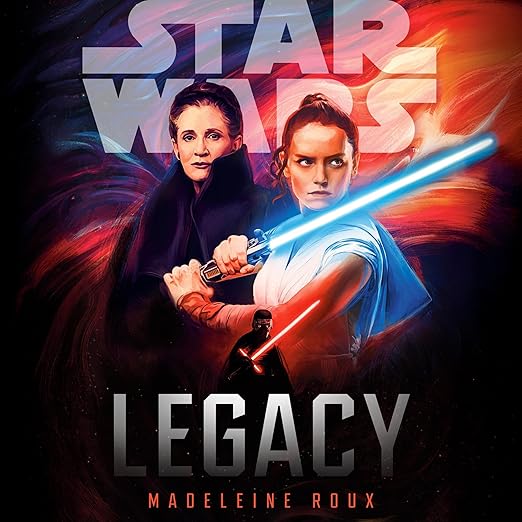
Rey's lightsaber is broken when the book opens, and the audiobook that follows is built around the errand of repairing it. That is a modest engine for thirteen hours of story, and Madeleine Roux appears to know it, which is why the repair is never really the point. What the trip to Tython is for is a conversation between two people who have each lost the person who taught them, and who now have to work out whether one of them can teach the other. Wedged between Episodes VIII and IX, the novel occupies the narrowest gap in the film sequence, and the constraints of that gap shape both its best stretches and its most predictable ones.
Nobody is credited with reading it. Random House Audio has put thirteen hours of Star Wars on sale with the narrator field empty, on a title twelve days old, and on tie-in fiction that omission carries more weight than it would elsewhere. People choosing between the book and the recording choose largely on the voice, because so much of the pleasure of franchise audio is hearing a familiar character sound like herself. Leia carries something close to half of this story. Whether the recording works at all turns on how that voice is handled, and the listing declines to say who handles it, which leaves the format decision resting on nothing.
Setup is deliberately unglamorous. Rey and the Resistance have barely escaped Crait and are struggling to rebuild, her teacher is gone, and Jedi tradition assumes a master she does not have. Leia Organa steps into the gap with the training Luke once gave her and the honest admission that her own knowledge runs out quickly. Then the ancient Jedi texts turn up a lead: a long-forgotten temple on Tython that might hold the means to make the saber whole. Rey leaps at it. Leia, to her own surprise as much as anyone else's, comes along. Two former students go looking for a building that will require both of them to be teachers.
What Works
Mentorship under pressure is the strongest thread here, and it is a hard one to write. Leia is passing on a tradition she received in pieces, to a student whose raw power already outruns the instruction, while both of them carry the same wound in different forms. Neither side gets softened. Leia's limits are presented as real limits rather than modesty, and Rey's loneliness is not cured by having company on the ship. The best passages are the quiet ones, where the two argue about method and end up arguing about grief, and where the specter of Kylo Ren sits between them as the subject neither wants to raise first.
Architecture gives the book its spine. Obscure clues to decipher and arcane trials to complete is a structure with a long history in fantasy, and it works here because the trials keep testing the relationship rather than the reflexes. Outside the walls sits the better subplot: refugees sheltering in the temple's shadow, a First Order officer closing in on them, and two freedom fighters hidden among people who never asked to hide anyone. That thread does what the sharpest Star Wars side stories do, which is put the cost of the war in the hands of people with no Force and no ship, while the heroes are upstairs solving a puzzle.
Weak Spots in Star Wars: Legacy
Slotting a novel between two films costs it a particular kind of suspense. Everyone opening this knows where Rey stands when the ninth film begins, so the tension has to come from how rather than whether, and the lightsaber question arrives pre-answered for anybody who has watched the movies. The compensation is to keep the stakes local, on the refugees and on the fragile agreement between master and apprentice, and that mostly works. The passages where it does not are the ones steering carefully around a fixed point in the timeline, and you can feel the wheel turning while they do it.
Cataloging is worth checking before you buy. Both series fields on this release sit empty, on a book whose own description places it between two numbered films and inside a publishing line where reading order is a routine question. Nothing on the page tells you whether it follows another recent novel, whether characters carry over, or where a newcomer should start. The runtime is listed as a flat thirteen hours, a rounded figure rather than a measured one. Twelve days after release the star average is blank and no written response has been posted, so early buyers are working from publisher copy and nothing else.
Who It's For
Readers who came for the sequel-era characters are the core audience, and anyone who wanted more of Leia than the films had room for should move this up the list. It is the rare tie-in that treats her as a protagonist with unfinished business rather than a dispenser of orders, and the Rey material is better for the pairing. Listeners who enjoy a quest built around a single location, with puzzles, trials and a countdown running outside the door, will find the Tython sequence satisfying on its own terms. Newcomers can follow the plot, though the emotional payoff assumes you have seen the films.
Anyone hoping for a battle-heavy entry should look elsewhere, since the scale here is two people, a ruined temple and a settlement of refugees, with the action serving the argument rather than the reverse. Pass on it as well if unresolved threads irritate you, because a story wedged between two films cannot resolve much without contradicting what comes next. For everybody else the caveat is practical rather than critical. Thirteen hours is a long stretch to hand over to a voice the publisher has not yet named, and that is the only part of this purchase you cannot research in advance.
The Short Version
- What it covers: Mentorship without a master, inherited tradition, the war's cost to people with no part in it
- Feel: Quiet and searching, with a temple puzzle ticking underneath
- Our call: A character piece that uses its franchise setting properly, undercut only by a listing that will not say who reads it.
Good to Know
Do I need to have seen the films to follow the Star Wars: Legacy audiobook?
You can follow the plot without them. The description lays out the situation clearly enough: the Resistance is rebuilding after Crait, Rey has no teacher, Leia is trying to become one. What the films supply is the weight behind those facts, and listeners coming in cold will get the story while missing most of the ache.
Is the audiobook driven by action or by the Rey and Leia relationship?
The relationship, decisively. The temple on Tython supplies clues to decipher and trials to complete, and a First Order officer supplies the pressure outside, but the trials function as tests of a partnership rather than set pieces. Anyone buying thirteen hours for space battles will feel the balance is wrong.
Does Kylo Ren actually appear?
The description names Kylo Ren as a specter haunting both women alongside regrets from the past, which is a careful phrase. Treat that as a presence the story keeps circling rather than a character promised on the page, and set your expectations from what Rey and Leia say rather than from the name alone.