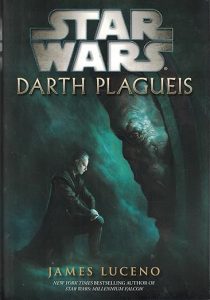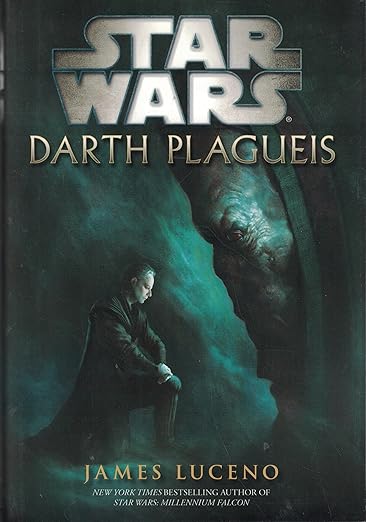
Luceno's craft in Star Wars: Darth Plagueis has always been more novelistic than cinematic, and Daniel Davis's narration reinforces that quality from the opening pages of this audiobook. Where most Star Wars tie-in fiction moves at the velocity of the films, Plagueis operates at the tempo of a political novel - unhurried, structurally deliberate, interested in process rather than spectacle. That's either the book's defining virtue or its central challenge depending on what you bring to it.
The premise draws directly from Palpatine's monologue in Revenge of the Sith. Darth Plagueis the Wise could use the Force to influence midi-chlorians and prevent death - and Luceno builds an entire novel around that single piece of mythology, tracing Plagueis from his own murder of his master through his cultivation of the young Palpatine, and forward through the decades-long political project that would eventually produce the Galactic Empire. It's one of the few Star Wars novels that treats the prequel trilogy's political content as genuinely interesting rather than an obstacle to reach the lightsaber fights.
First, the Big Picture
The book's most significant achievement is making the Sith Rule of Two feel like a living institutional logic rather than a villain's affectation. Luceno's Plagueis is a scientist-philosopher as much as a dark warrior, and his relationship with Sidious is rendered as a genuine intellectual partnership and a betrayal in the making simultaneously. The tension between master and apprentice is not operatic but structural - two entities who understand each other completely, and whose understanding makes treachery inevitable rather than incidental.
One review cited the novel's interest in political economy and corporate merger as a weakness, but that objection misreads what Luceno is doing. The Sith's rise in this book runs through legitimate channels - financial manipulation, Senate procedure, trade consortium politics - because that is how power actually consolidates, and the novel's refusal to short-circuit that process through action set pieces is precisely what distinguishes it from lesser entries in the tie-in catalog. The midi-chlorian manipulation research, the careful cultivation of political allies, the engineering of the Trade Federation blockade that the prequel films take as backstory: Luceno makes all of this coherent and deliberate rather than arbitrary.
Why Star Wars: Darth Plagueis Works as an Audiobook
Davis's narration is the right instrument for this material. His voice has an aristocratic quality that suits Plagueis's Muun physiology and centuries-spanning perspective, and he handles the Sidious sections without impersonating Ian McDiarmid, which would have been both legally complex and aesthetically unfortunate. The restraint pays off in the scenes where Plagueis and Sidious interact directly - Davis distinguishes them through cadence and register rather than gross vocal performance, which makes the scenes feel like conversations between equals rather than theatrical exercises.
At just under seven hours, this is a notably compressed audiobook for the amount of narrative it contains. Luceno's prose is efficient and the production moves without filler, but the density of political and organizational detail means that distracted listening will lose threads. This is a book that rewards sustained attention rather than background play during other activities. Listeners who put in that attention will find that the final sequence, in which the decades of patient political maneuvering by both Plagueis and Sidious converge with the events of The Phantom Menace, is genuinely satisfying as a piece of long-form narrative architecture. The final convergence with the events of The Phantom Menace is handled with particular precision.
A Few Reservations
Listeners should be aware that this novel, originally published in 2012, exists in a complicated canonical position. It was published before Disney's acquisition of Lucasfilm and the subsequent reorganization of Star Wars continuity into Canon and Legends. The novel is now classified as Legends, meaning its events are not considered official continuity. For some listeners this is irrelevant; for those deeply invested in current Canon, it's worth knowing upfront that the specific details of Plagueis's identity, the midi-chlorian research, and the political backstory presented here may not align with what current Canon establishes or implies.
The novel also assumes familiarity with the prequel trilogy and specifically with the political and organizational structure of the Republic as depicted in Episodes I through III. Listeners coming to Star Wars primarily through the original trilogy or the sequel films may find the Senatorial and Trade Federation politics opaque without that context.
Who Should Pick Up Star Wars: Darth Plagueis
This audiobook is for Star Wars readers who engaged seriously with the prequel-era political content and found Palpatine's long game genuinely compelling. Those who wondered how the Republic's fall was engineered at the institutional level, rather than through dramatic acts of Sith power, will find Luceno's reconstruction satisfying and specific. Readers of his other work in the Extended Universe, particularly Labyrinth of Evil, will find this consistent with his approach and probably his best single volume.
Listeners who found the Senate scenes in the prequel films tedious, or who come to Star Wars primarily for action and spectacle, will likely find the middle sections slow regardless of how competently Davis delivers them. The book is not what it would be if written to the same rhythms as Timothy Zahn's Thrawn novels. It has different priorities, and those priorities won't suit every Star Wars reader - but for the right audience, it is among the most intellectually substantial things the expanded universe produced.
Frequently Asked Questions
Is the Darth Plagueis audiobook considered Star Wars Canon or Legends?
This novel is classified as Legends, not current Canon. It was published in 2012 before Disney's reorganization of Star Wars continuity, so its specific account of Plagueis's identity and the midi-chlorian research does not represent official current Canon.
Do I need to have seen the prequel trilogy films to follow this audiobook?
Yes, familiarity with Episodes I through III is strongly recommended. The novel functions as a prequel to the prequels and assumes detailed knowledge of the Senate, Trade Federation, and political structures those films establish.