Quick Take
- Narration: Marc Thompson is one of the definitive Star Wars audiobook performers, and his work here is full-cast in spirit even when working solo, distinguishing character voices with remarkable consistency across a sprawling cast.
- Themes: Political intrigue in a crumbling empire, loyalty and betrayal, the cost of war on both sides
- Mood: Propulsive and cinematic, with the pacing of a summer blockbuster
- Verdict: For anyone already invested in the Thrawn Trilogy, this is the best possible way to experience the middle chapter.
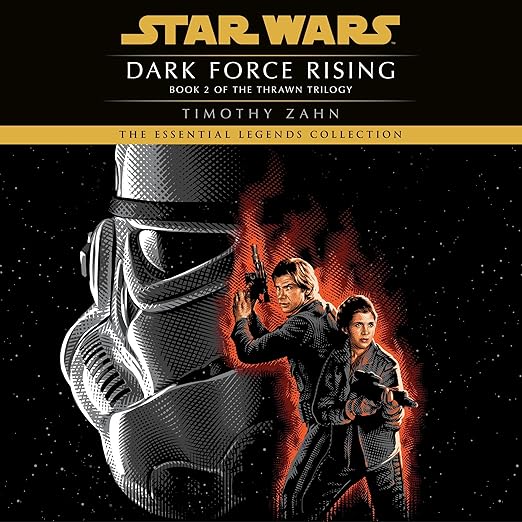
I first read Timothy Zahn’s Thrawn Trilogy in paperback, the mass market editions with the dark cover art, sometime in my mid-teens. I remember carrying Heir to the Empire on a school trip and losing track of where we were because I was somewhere between Coruscant and the Outer Rim. Coming back to Dark Force Rising now, through Marc Thompson’s narration rather than the page, was something I had been putting off in the way you put off revisiting things you loved when you were young. I was worried it would not hold. I was wrong.
Dark Force Rising is the second of the three Thrawn novels, set roughly five years after the Battle of Endor. The New Republic is struggling to consolidate its victory. Grand Admiral Thrawn, the Empire’s most dangerous surviving commander, is executing a strategy of calculated attrition. Han and Lando are chasing a lead on a secret fleet of Katana Dreadnoughts. Luke is being targeted by a dark-side adept named Joruus C’baoth, a clone of a dead Jedi Master whose mental stability is visibly deteriorating. Leia is on the Noghri homeworld trying to negotiate a defection. The plot strands are numerous and Zahn manages them with the craft of a writer who understood, back in 1992, exactly what the Star Wars universe needed and what it was capable of holding.
Our Take on Dark Force Rising
What struck me most on this listen was how seriously Zahn takes the political dimensions of his story. The Imperial remnant is not simply evil waiting to be defeated. It has factions, internal tensions, officers who genuinely believe in what they are fighting for. Thrawn himself is the most intellectually interesting villain the Star Wars universe produced until much later, and his reliance on understanding enemy cultures through their art is deployed here with more sophistication than in his later canonical appearances. One reviewer called him probably the best Star Wars villain since Vader, and I think that assessment holds. He is not more frightening than Vader. He is more unsettling, which is a different and in some ways more durable quality.
Why Listen to Dark Force Rising
Marc Thompson is the reason to choose audio for this trilogy. He voices characters distinctly enough that you never lose track of who is speaking, which matters enormously in scenes where several named characters are in conversation. His Thrawn is cool and deliberate. His C’baoth carries an edge of unhinged authority that grows more uncomfortable as the book progresses. His Han is recognizably Harrison Ford without being a mere impression. At nearly fifteen hours, this is a substantial listen, but Thompson earns every minute of it. A reviewer described the book as preserving the fast and epic feel of the Star Wars films, and that is accurate, though it undersells what Zahn is doing structurally. The dual-perspective treatment of the war, following both Republic and Imperial characters through the same events, gives the narrative a weight that the films, operating on a more mythic register, never quite achieved.
What to Watch For in Dark Force Rising
One reviewer noted the pacing as occasionally rushed, and I take that point. Zahn is working with a lot of characters and a lot of plot, and some of the middle chapters feel like they are bridging toward the conclusion rather than earning their own space. The Mara Jade thread, which was so central in Heir to the Empire, is somewhat reduced here, and listeners who found her the most compelling addition to the cast may feel the shift. The Joruus C’baoth material, by contrast, gets more space than it strictly needs, though Thompson’s performance makes it consistently listenable. These are minor calibrations in an otherwise confidently executed audiobook.
Who Should Listen to Dark Force Rising
Anyone who listened to Heir to the Empire should move directly to this one. It does not work as a standalone entry point to the trilogy. If you came to Star Wars Legends late, as the second reviewer in the sample did, after being disappointed by the sequel films, the Thrawn Trilogy is the obvious place to start, and this middle volume is where Zahn’s world-building investment starts to pay its biggest dividends. Casual fans who want action and familiar characters will find those things. Readers who want something more structurally ambitious than the average film novelization will also find that, which is rarer than it should be.
Frequently Asked Questions
Do I need to have listened to Heir to the Empire before starting Dark Force Rising?
Yes. Dark Force Rising picks up directly from the events of the first book and assumes familiarity with the main characters and political situation. Starting here would be disorienting.
How does Marc Thompson handle the large cast of characters in terms of distinct voices?
Thompson is widely regarded as one of the best Star Wars audiobook narrators working, and he differentiates the major cast members clearly. His Thrawn and C’baoth are particularly distinctive.
Is this considered Star Wars canon or Legends?
This trilogy is Legends, meaning it was removed from the official Star Wars canon when Disney acquired Lucasfilm. A canonical version of Thrawn exists in later novels by Zahn, but these original three books operate in their own continuity.
What is the Katana fleet, and is it explained for listeners who are not deeply familiar with Star Wars lore?
Yes. Zahn introduces the Katana fleet as a plot element within this book and provides enough context for listeners to understand its strategic importance without requiring outside knowledge.