Quick Take
- Narration: Paramahamsa Vishwananda narrates his own commentary, which creates an intimate transmission quality, the voice carries the material’s devotional weight in a way no outside narrator could approximate.
- Themes: The guru-disciple relationship, divine love as spiritual path, liberation through grace
- Mood: Reverent and immersive, designed for deep contemplative listening rather than background absorption
- Verdict: A devotional audiobook of significant depth for those within or drawn to the Bhakti tradition, requires genuine interest in Hindu scripture to be fully accessible.
There are audiobooks you listen to while doing other things, and there are audiobooks that ask you to stop doing anything else. Sri Guru Gita falls firmly into the second category. I put on a pair of headphones, closed my laptop, and gave it the kind of attention I usually reserve for poetry. That is not a neutral observation about the format, it is a description of what the material demands.
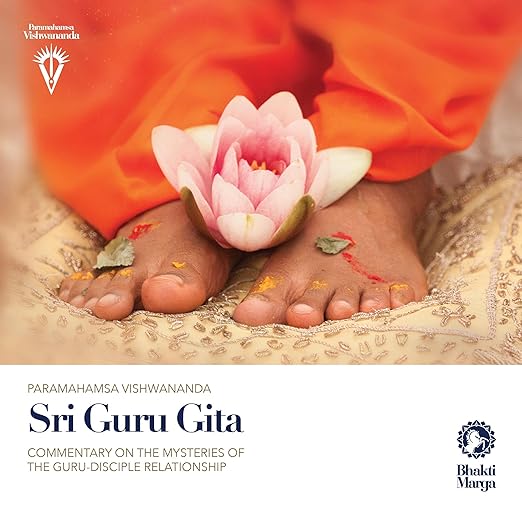
Paramahamsa Vishwananda’s Sri Guru Gita is a commentary on a sacred text drawn from the Skanda Purana, narrating a dialogue between Shiva and his wife on the glories and nature of the Guru. The English audio edition runs over eleven hours, narrated by Vishwananda himself, who is the Satguru of the Bhakti Marga movement and the spiritual master whose insights form the commentary layer wrapped around the original verses.
Our Take on Sri Guru Gita
What makes this recording unusual is the relationship between narrator and text. When Vishwananda reads and comments on verse 88.1, I remember my Guru, who is Parabrahman, the statement carries a different weight than it would coming from a professional audio performer. He is not interpreting someone else’s experience of the Guru-disciple relationship; he is describing his own. One reviewer called this book the most helpful text to understand the most important relationship in one’s entire life, and another described Vishwananda as an enlightened, living spiritual Master, which gives some indication of the devotional register within which this recording operates.
The Guru Gita as a sacred text predates modern publishing by centuries and is considered essential scripture within several Hindu traditions. Vishwananda’s contribution is the contemporary commentary that brings the ancient verses into contact with present-day spiritual life. Reviewers who come from within the Hari Bhakta Sampradaya describe this edition as a must-have, essential in a word they use without irony or marketing reflex.
Why Listen to Sri Guru Gita
The audio format is particularly well-suited to devotional scripture. Many Hindu texts are meant to be heard rather than read silently, the oral transmission carries its own kind of energy in a tradition where the spoken word is considered sacred. Vishwananda’s voice in narration is calm and unhurried, with the confidence of someone who is not performing a text but living inside it. A reviewer from a Western background described how the recording helped them understand why a Guru is considered an essential part of the path toward liberation, one of those notes that says something useful about how the content reaches people across cultural distance.
The core message, as Vishwananda states it plainly in the synopsis, is that God is love, God is everything, and God is Guru, and that approaching that understanding through the Guru Gita builds the proximity to grace that the tradition considers necessary for spiritual liberation. The recording does not hedge this claim. It commits to it fully, which is both its integrity and the thing that makes it a niche rather than a general-audience text.
What to Watch For in Sri Guru Gita
This audiobook requires genuine openness to the tradition it inhabits. The Guru-disciple relationship, as understood in Hindu Bhakti practice, is a concept that Western listeners often misread through cultural frameworks that do not quite fit. A reviewer noted that for Westerners, it can be hard to understand why a Guru is an essential part of the liberation process, and that this scripture helps uncover some of those secrets. That is an honest framing of the learning curve involved.
With only twenty-five reviews on Audible and no badges, the reach of this recording is limited to those who are actively seeking it out. It is not an introduction to Hinduism or a general spirituality listen, it is a deep dive into a specific tradition for people already oriented toward that tradition or seriously curious about it.
Who Should Listen to Sri Guru Gita
This recording is specifically for practitioners or serious students within the Bhakti tradition, those exploring the Guru-disciple relationship in Hindu philosophy, and listeners drawn to devotional audio texts rather than analytical ones. Someone approaching it as an outsider with genuine curiosity and patience will find much of value, but should not expect a gentle introduction. Those who want a broader entry point into Vedantic or Hindu thought would benefit from starting elsewhere before arriving here.
Frequently Asked Questions
Do I need to be a practicing Hindu or part of Bhakti Marga to get something from this audiobook?
Familiarity with the tradition helps significantly. Listeners who are curious about the Guru-disciple relationship from outside the tradition have found it illuminating, but the commentary assumes a level of openness to devotional practice that purely secular listeners may find difficult to sustain over eleven hours.
What is the relationship between the Sri Guru Gita text and Vishwananda’s commentary?
The Guru Gita is an ancient scripture drawn from the Skanda Purana, structured as a dialogue between Shiva and his consort on the nature of the Guru. Vishwananda’s edition pairs the original verses with his own contemporary commentary, making this both a sacred text and a living teacher’s interpretation of it.
Is this suitable for listening during other activities, or does it require focused attention?
Devotional listeners tend to engage with it as a focused practice rather than background audio. The material is dense and contemplative, and the full benefit of the commentary comes from attentive listening rather than half-attention while commuting.
How does Paramahamsa Vishwananda’s self-narration affect the listening experience?
Reviewers within the tradition describe it as adding a transmission quality that a hired narrator could not replicate. For those already connected to Vishwananda as a spiritual teacher, hearing his voice is itself part of the devotional experience.