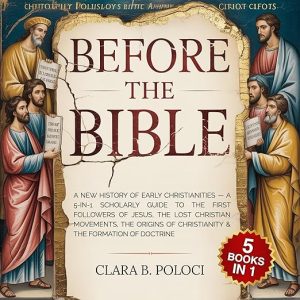
Clara B. Poloci's approach in the audiobook Before the Bible is built on a clean structural premise: five parts, twenty-five chapters, a single through-line tracing how a Jewish teacher in Roman Palestine became the center of an institutional Church, and how competing visions of Jesus were slowly filtered, argued over, and eventually suppressed or absorbed into what became orthodox Christianity. Narrator Gerhard Weigelt delivers this material in a measured, calm register that suits the scholarly approach without tipping into lecture. For a four-hour-and-three-minute listen, the craft of the thing is in how much conceptual ground it covers without losing its narrative spine. The book positions itself explicitly as historical scholarship rather than theology, and that distinction is the whole of its method.
That framing matters because the argument being made, that early Christianity was not singular but plural, that multiple communities with genuinely different understandings of Jesus coexisted, competed, and only gradually resolved into something recognizable as the religion we know, is not a claim designed to destabilize faith. Poloci's stated aim is comprehension: she wants the curious listener, the student of religion, and the person rethinking inherited belief to understand how the canon and the creeds came to be. The book's introduction sets that frame plainly and holds to it throughout, which means it reads neither as an apologetic nor as a debunking exercise but as an account of something interesting that happened in human history.
Early Jesus Movements Were Genuinely Plural
The strongest sections of Before the Bible are those dealing with the variety of early Jesus movements, the role of women's leadership in pre-institutional Christian communities, and the political and theological decisions that shaped how heresy was defined and enforced. The chapter on Jewish-Christian groups, communities who maintained Jewish practice alongside belief in Jesus, is particularly useful because this dimension of early Christianity is often absent from popular introductions to the subject. Poloci explains how Paul's mission created communities with a very different relationship to Jewish law and tradition, and how the tension between these orientations shaped the textual canon we inherited over several generations of community formation and controversy.
Constantine's influence receives dedicated attention as well, and Poloci is careful to present the evidence rather than argue a thesis. The book does not take the position that the institutionalization of Christianity was a betrayal of something pure that came before. It takes the position that the process was human, contingent, and shaped by people with specific interests and commitments, which is both less dramatic and more intellectually honest than the alternatives. The twenty-five chapters give the material room to unfold without cramming it into a polemic, and the structure allows listeners to follow the thread from early community formation through creed-making to canon finalization without losing the chronological logic.
Gerhard Weigelt Paces a Dense Historical Tour
Weigelt's narration works well for this material because the prose itself is written at a level that rewards careful listening rather than background play. The book is dense with names, communities, and historical events, and the twenty-five-chapter structure provides clear waypoints for listeners who want to pause and absorb between sessions. At just over four hours, it moves quickly enough to feel like a guided tour rather than a textbook, which is the balance the author explicitly aims for: academic rigor explained in plain language, with storytelling that makes complex history listenable. Weigelt's pacing does not rush through the complex passages, giving listeners time to track the unfamiliar names and community labels without needing to rewind constantly.
For listeners coming from a devotional background, it is worth knowing that the book does not demand any particular outcome. It neither asks you to abandon faith nor reinforces any specific theological position. Its argument is that knowing the plural origins of Christianity, including which texts were excluded and why, and which communities were declared heretical and on what grounds, makes for a richer and more honest engagement with the tradition. That is a position most curious readers, regardless of starting point, can engage with on their own terms without feeling that the material is working against them.
Creed-Making Turns Debate Into Enforced Doctrine
The section on creed-making, where Poloci traces how theological debates about the nature of Jesus moved from contested community discussions into formal doctrinal statements with institutional enforcement behind them, is where the book's arguments become most consequential. This is the hinge between the plural early period and the singular institutional Church, and Poloci handles it with appropriate care, resisting the temptation to make the outcome feel inevitable. Listeners will also want to attend to the section on why certain texts became scripture and others were lost, which connects the canon debate to the power dynamics of the period rather than treating the resulting Bible as an inevitable or purely theological product. These are the chapters that will generate the most reflection after the audiobook ends.
The coverage of women's leadership in early Christian communities is one of the book's less expected dimensions, and it connects directly to why the institutional Church developed in the hierarchical form it did rather than the more distributed leadership structures of some earlier communities. Poloci does not overstate this argument, but the evidence she presents makes a clear case that the forms Christianity took were not the only available options at the time they were being decided.
Complementary to Ehrman, Pagels, and Armstrong
This audiobook suits curious general readers, students of religious history, and anyone working through questions about Christian origins who want context built on contemporary scholarship rather than devotional framing. It is not a book for listeners who want their existing theological conclusions reinforced in either direction. It is a book for people who want to understand how the tradition took shape. Listeners already familiar with scholars like Bart Ehrman, Elaine Pagels, or Karen Armstrong will find Poloci's approach complementary rather than redundant, and the tighter four-hour format gives it a different utility than their longer academic works. For complete newcomers, it functions excellently as a first map of territory that rewards further exploration.
- Narration: Gerhard Weigelt's calm, measured delivery suits the scholarly tone and keeps complex historical material accessible without over-dramatizing it.
- Themes: Plural early Christianity, canon formation, heresy and orthodoxy as political processes
- Mood: Calm, intellectually generous, and clarifying
- Verdict: A well-structured four-hour audiobook for anyone who wants to understand early Christian history through scholarship rather than theology or polemic.
Questions Listeners Ask
Is this audiobook written from a Christian perspective or a secular academic one?
Poloci explicitly positions the book as historical scholarship rather than theology. It does not argue for or against faith. It presents the plural origins of early Christianity using contemporary academic research and leaves the listener to draw their own conclusions.
Do I need background in religious studies to follow this audiobook?
No. The book is designed for curious general listeners and avoids assuming prior knowledge. It introduces key figures, communities, and debates clearly before building on them. Students of religion will find it moves quickly through material they may already know.
Does the audiobook cover the Gnostic gospels and excluded texts, or only canonical material?
Yes, the book specifically addresses why some texts became scripture and others were lost, connecting the canon formation process to the power dynamics and theological debates of the period. It is one of the more substantive sections.