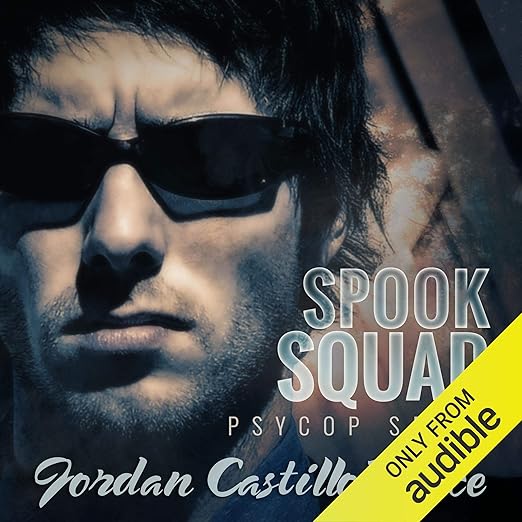
Quick Take
- Narration: Gomez Pugh has been the voice of Victor Bayne across the entire PsyCop series, and by book seven the performance is lived-in and irreplaceable; Vic’s dry internal commentary lands perfectly.
- Themes: Psychic surveillance bureaucracy, partnership under institutional pressure, debt and obligation in covert systems
- Mood: Tense and dry, with flashes of dark humor and genuine emotional stakes
- Verdict: PsyCop 7 rewards series readers with a payoff built across six previous installments, and Gomez Pugh’s narration remains one of the strongest performance-to-character matches in LGBTQ+ paranormal fiction.
I came to the PsyCop series late, which meant I had the dubious luxury of burning through the first six books over a compressed stretch of evenings last year. By the time I reached Spook Squad, Victor Bayne and Jacob’s dynamic had become genuinely familiar territory, and Gomez Pugh’s voice for Vic had settled into my internal reading voice for the character. That is a specific kind of series-listening investment that Jordan Castillo Price builds deliberately, and book seven is where it pays off most clearly.
For readers new to PsyCop: Victor Bayne is a police psychic, a medium who works homicide cases by communicating with the recently dead. His partner Jacob, calm, capable, and emotionally steadier than Vic in every situation, has given up his badge and infiltrated the Federal Psychic Monitoring Program, a government body that sounds bureaucratic and turns out to be considerably darker. The tension at the start of Spook Squad is quietly domestic: two people sharing a large cannery space, carefully not discussing the thing that needs discussing. Vic owes Director Dreyfuss an exorcism from a previous book’s debt, and the reckoning is overdue.
The Debt That Finally Comes Due
What Castillo Price understands about serial fiction is that the best entries do not require a monster-of-the-week plot to feel substantial. The central tension of Spook Squad is less about any single supernatural event than about what happens when the institutional structures surrounding Vic and Jacob are no longer avoidable. Jacob’s silence about what he actually does inside the FPMP has been a slow-building pressure point across multiple books, and Spook Squad forces it into the open without betraying the careful characterization Price has established. Jacob’s restraint is not coldness; it has always been a form of protection. Watching Vic reckon with that distinction is where the book earns its emotional depth.
One reviewer described the mystery plotting as well constructed and noted that keeping track of multiple moving parts remained manageable even as the stakes escalated. That is consistent with what Price does best: complex paranormal procedural plots that do not collapse under their own weight. The FPMP’s operations, the question of what Director Dreyfuss actually wants from Vic, and the cost of psychic debt in this world’s specific rules all interlock without requiring the reader to hold an unwieldy amount of world-logic in working memory.
Gomez Pugh and the Art of the Unreliable Narrator
Victor Bayne is a first-person narrator whose perception of reality is genuinely unreliable. He medicates heavily to manage the constant psychic noise, which means his read on events is filtered through both pharmacological fog and personal avoidance. Gomez Pugh has developed an extraordinary sensitivity to that layering. His Vic is not stupid or slow; he is strategically incurious, which is a harder thing to perform. The moments when Vic almost figures something out, when the reader is slightly ahead of him and watching him approach a truth he does not want to reach, are where Pugh’s restraint is most effective.
The side characters also benefit from his range. Crash, whose absence in this book is mourned by at least one reviewer in terms best experienced without foreknowledge of why, was always a vehicle for a different register entirely, and Pugh’s performance of those dynamics across the series has been one of its consistent pleasures. The ensemble of the FPMP operatives, particularly Director Dreyfuss, gains specificity from how Pugh differentiates their speech patterns and motivations from Vic’s own stripped-down perspective.
What Pugh has developed across seven books is a particular skill with Vic’s silences. The moments where Vic deliberately does not ask the question that is sitting right in front of him, because the answer would require him to act, are rendered not with obvious hesitation but with a very slight change in rhythm and register that communicates everything without stating it. That kind of performance craft accumulates across a long series, and by book seven it has become one of the things that distinguishes the PsyCop audiobooks from the text alone.
Where This Entry Sits in the Series Arc
Spook Squad is not the right entry point if you have not read the series. The book assumes detailed knowledge of the FPMP’s history, Dreyfuss’s prior interactions with Vic, and the specific nature of Jacob’s sacrifice in giving up his badge. One reviewer compared it favorably to Camp Hell as a series highlight, and that comparison makes sense: both books deal with institutional threat to the central relationship and both force Vic into situations where avoidance is no longer possible.
For committed series listeners, this is the installment where the tension that has been held in careful suspension across six books finally breaks the surface. The resolution is not tidy, because Castillo Price does not write tidy, but it is satisfying in the way that genuinely character-driven fiction is satisfying: you understand these people better at the end than you did at the beginning, and what they have built together feels, despite everything, more durable than before.
Who This Belongs To
Committed PsyCop readers will want this without question. LGBTQ+ paranormal fiction listeners who have not yet started the series should go back to Among the Living, the first entry, and give themselves the context. Listeners who enjoy paranormal procedurals with significant romantic stakes but prefer clean series entry points should bookmark this for later. The payoff here is real, but it is earned across the full run rather than available on its own terms.
Price has also built into this series a consistent awareness that psychic ability in her world is not a gift so much as a government resource to be managed and monitored. That surveillance dimension, which the FPMP embodies most fully, gives the paranormal procedural element a political texture that distinguishes PsyCop from lighter entries in the genre. By book seven, the full weight of that texture is fully present, and Spook Squad uses it to maximum effect.
Frequently Asked Questions
Can Spook Squad be listened to as a standalone, or is series order essential?
Series order is essential. Spook Squad is PsyCop book 7, and it builds directly on relationships, debts, and institutional plots established across the previous six books. Starting here would lose most of the emotional context.
How has Gomez Pugh’s narration of Victor Bayne developed across the PsyCop series?
Pugh has voiced Vic from the beginning, and the performance has deepened considerably. By book seven, his rendering of Vic’s dry internal monologue and strategic avoidance is fully internalized, making this one of the more convincing long-running narrator-to-character pairings in the genre.
Does Spook Squad resolve the tension between Victor Bayne and Jacob about the FPMP?
It brings it to the surface and forces a confrontation that has been building for several books. The resolution is character-consistent rather than conventionally tidy, which is in keeping with how Jordan Castillo Price handles the central relationship throughout the series.
Is the paranormal mystery plot in Spook Squad as strong as the relationship dynamics?
Both work, though longtime readers will likely find the relationship and institutional stakes more compelling. The mystery plotting is solid and well-constructed, but what makes this a standout entry is how the FPMP infiltration and Dreyfuss’s debt converge with Vic and Jacob’s partnership.