Quick Take
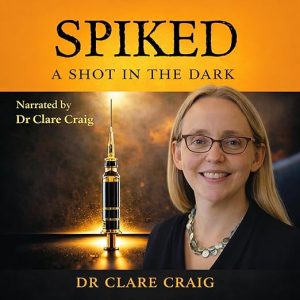
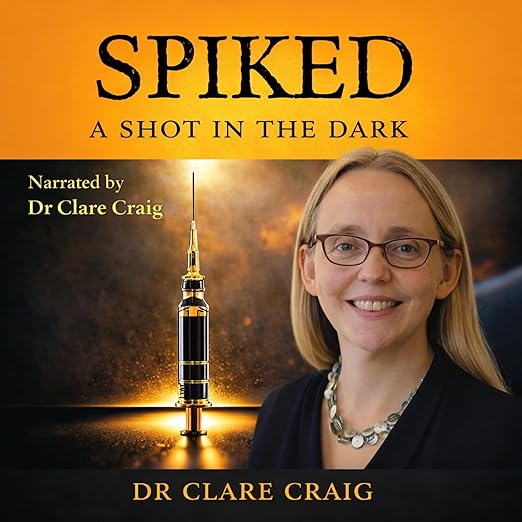
- Narration: Dr. Clare Craig self-narrates with the precision of a pathologist presenting findings, which gives the critique a clinical detachment that distinguishes it from more polemical COVID accounts.
- Themes: COVID-19 policy failures and institutional accountability, informed consent and bodily autonomy, scientific groupthink and suppression of dissent
- Mood: Forensic, measured, and quietly devastating
- Verdict: The most methodically constructed COVID-19 policy critique in audio form, strongest when Craig stays within her scientific domain and more contested when she draws broader systemic conclusions.
I had followed Clare Craig’s work through her public commentary during the pandemic, when she was among the small number of credentialed pathologists publicly raising questions about PCR testing methodology and case definition. I had found some of her interventions compelling and others premature, which made me genuinely curious about what a full-length treatment of her COVID-19 analysis would look like. Spiked does not disappoint as a work of critical examination, even where I find myself disagreeing with specific conclusions.
The framing is deliberately post-mortem, borrowed from Craig’s professional vocabulary. She is not writing a conspiracy account or an emotional reckoning; she is conducting what she calls a meticulous post-mortem of a global response, applying the same systematic approach she would bring to examining why a patient died. The question she is asking is not whether COVID-19 was dangerous but whether the interventions deployed to address it worked, and whether the process by which they were evaluated and implemented reflected good scientific practice.
PCR Testing, Case Definition, and Craig’s Home Ground
The chapters on diagnostic testing are where Craig is most unambiguously in her element and most persuasive. Her critique of PCR testing at high cycle thresholds, the resulting inflation of case counts, and the downstream effects on policy decisions draws on documented technical debates that were not widely communicated to the public during the pandemic. The distinction between a positive test and an infectious individual, and the consequences of conflating them in case definition, is a legitimate scientific argument that deserved more public airing than it received.
Similarly, her examination of clinical trial design in the vaccine authorization process engages with real methodological questions. The distinction between relative risk reduction and absolute risk reduction in the original efficacy presentations is a documented feature of how the data was communicated, and Craig presents it clearly. These are mainstream statistical literacy points that the scientific community routinely debates in peer review but that rarely reached public health communication.
Reviewer Mr. Peter Gilbert described Craig as conducting forensic analysis that is eye-opening rather than inflammatory, and that characterization holds for these sections. The book’s strength is in applying scientific literacy in the service of critical examination rather than in advancing a predetermined conclusion.
Groupthink, Dissent, and the Harder Questions
Craig’s account of how dissenting scientific voices were treated during the pandemic is the book’s most uncomfortable section, because it is largely accurate in its description of the social and professional mechanisms by which heterodox views were marginalized. Scientists who raised questions about lockdown effectiveness, school closures, or natural immunity were in many cases subjected to professional pressure and public ridicule that exceeded what peer review or good-faith scientific debate would justify.
That Craig was among those scientists gives her account both particular authority and a particular limit: she is both observer and participant, which requires the reader to hold both perspectives simultaneously. The more difficult question is whether the book adequately weighs the genuine uncertainty that existed in real time, when the consequences of being wrong in either direction were severe. Craig writes with the clarity of retrospect, which is appropriate for a post-mortem but occasionally understates the epistemic difficulty that decision-makers faced.
Why Self-Narration Was the Right Call
Craig’s decision to narrate this herself was the correct one. A professional narrator reading this material would insert an emotional register that would either inflame or flatten the argument. Craig’s own delivery is forensic in the best sense: she presents evidence, draws inferences, and lets the listener feel the gap between what was claimed and what was known. When she describes institutional groupthink overriding scientific debate, her restraint is more damning than outrage would be. The narration is not polished in the broadcast-radio sense, but it is precisely right for the kind of careful reckoning Craig is attempting.
Who Should Listen, Who Should Skip
Spiked is essential listening for anyone who wants a scientifically credentialed critique of COVID-19 policy grounded in data rather than political identity. It is most valuable in its diagnostic testing and clinical trial sections, where Craig’s expertise is directly relevant. Listeners seeking validation of preexisting views will find it, but so will listeners who are genuinely uncertain about what the evidence shows and want a careful guide through it. Those who found the pandemic response appropriate and proportionate will disagree with much of Craig’s analysis, but the scientific literacy she demonstrates makes engagement worthwhile regardless of where one lands.
Frequently Asked Questions
What is Craig’s professional background and why is it relevant to the book’s arguments?
Clare Craig is a consultant pathologist, formerly at the NHS, and a cofounder of the HART group in the UK. Her professional background in diagnostic testing is directly relevant to several of the book’s core arguments about PCR testing methodology and case definition.
Does Spiked claim COVID-19 was not dangerous or that vaccines caused widespread harm?
No. Craig’s argument is more specific: that the evidence for specific interventions was weaker than presented, that key data was communicated in ways that obscured important limitations, and that the process of scientific debate was compromised by institutional pressure. She critiques the response, not the existence of the disease.
How does this compare to other COVID-19 policy critiques like The Real Anthony Fauci?
Craig’s approach is considerably more methodologically specific and less politically adversarial than Kennedy’s. Where Kennedy builds a systemic prosecution, Craig conducts a chapter-by-chapter examination of specific decisions against specific evidence. Both are critical of official responses, but the rhetorical registers are very different.
Is the book’s perspective mainstream or does it represent a minority scientific view?
The specific technical arguments about PCR cycle thresholds, absolute versus relative risk reduction in trial reporting, and clinical trial design reflect legitimate ongoing debates in epidemiology and evidence-based medicine. The broader conclusions Craig draws about systemic suppression of dissent represent a more contested interpretation that mainstream scientific bodies dispute.