Before You Press Play
- Performance: Joseph Nguyen self-narrates with unhurried deliberateness that models the very presence the book describes, a quieter and more intimate delivery than most self-help audiobooks.
- What it covers: Psychological suffering and thought identification, consciousness expansion over quick-fix tactics, anxiety and inner peace
- Feel: Calm and introspective, like a long exhale
- Our call: A short, sincere introduction to a non-dual approach to mental suffering, best as a first step into this territory rather than a comprehensive guide.
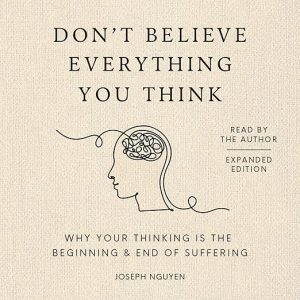
Joseph Nguyen's expanded edition of Don't Believe Everything You Think lands at two hours and thirty-six minutes, and that brevity is a feature, not a limitation. The central argument is that psychological and emotional suffering has a single root cause: excessive identification with thought. Nguyen does not bury this claim in preamble. He states it plainly in the opening section and then spends the audiobook carefully unpacking what that means, what it does not mean, and what becomes available when you stop treating every thought as a report on reality. Self-narrated by Nguyen himself, this is an audiobook that benefits from the intimacy of an author speaking directly to you about his own framework rather than performing it through a hired voice.
This Argument Is Structural, Not Positive Thinking
The book is the first in the Beyond Suffering series, and it arrived on the New York Times bestseller list with endorsements from Simon Sinek, Deepak Chopra, Dr. Nicole LePera, and Lori Gottlieb. That combination of endorsers signals the audience accurately: this sits at the intersection of popular psychology, mindfulness, and what might be called contemporary wisdom literature. Nguyen himself is careful to distinguish his approach from positive thinking or brain-rewiring techniques. His argument is structural rather than therapeutic: he is not asking you to replace negative thoughts with positive ones, but to question the nature of your relationship to thinking itself. One of his clearest formulations, borrowed implicitly from the tradition of Three Principles psychology, is that an expansion of consciousness is permanent where tactics are temporary.
Reviewer McKenzie Green, a psychotherapist with twenty-seven years of experience, recommends the book specifically for people with anxiety diagnoses, calling it 'practical, easy to read,' and noting that it 'combines wisdom with knowing and doing.' That is a useful assessment from a clinical practitioner. Reviewer Laneshia Smith described it as offering 'a refreshing and grounding perspective' on thoughts and self-awareness, and noted that recognizing that not every thought deserves your attention can be 'incredibly freeing.' Both assessments point to the same quality: the book is accessible without being vague, and it is grounded without requiring a clinical vocabulary.
Nguyen's Slow Pace Models Unhurried Attention
The expanded edition adds material that addresses reader questions and feedback since the original publication, along with journaling prompts, contemplative exercises, and original poetry. In audio form, the poetry sections are particularly interesting: Nguyen reads them with a quietness that functions almost as a meditative pause between the more conceptual chapters. The journaling prompts are delivered with enough specificity to be genuinely useful, though listeners who want to follow them properly may need to pause and write rather than absorbing them passively.
Nguyen's self-narration deserves specific attention. He reads with a slowness that some listeners may initially find too measured, but which reveals itself as intentional. This is a book about the quality of your attention, and the narration models the kind of unhurried presence that the content describes. He does not push, editorialize, or try to move you emotionally through vocal performance. The effect is of someone speaking from inside the experience rather than explaining it from outside, which is a meaningful distinction for this kind of material.
Two Hours Outperforms a Genre's Twelve-Hour Padding
The runtime of two hours and thirty-six minutes means that the framework is compressed. Nguyen covers a great deal of conceptual ground, but he does not always have room to develop the supporting evidence or case studies that might help listeners test the framework against their own experience. This is more of an introduction to a way of thinking than a comprehensive manual for implementing it. Listeners who want extensive clinical research, case histories, or step-by-step exercises may find the brevity limiting. Nguyen himself seems aware of this: the expanded edition's journaling prompts and new chapters are an attempt to address that gap.
The book also operates within a tradition of non-dual philosophy that is not always acknowledged directly. Listeners familiar with Eckhart Tolle, the Three Principles movement, or non-dual spiritual teachings will recognize the intellectual lineage and may feel that Nguyen's framework is less original than presented. For listeners new to this territory, however, the compressed and accessible format is precisely what makes it effective as a starting point. Reviewer Abba quoted Dostoevsky: 'to think too much is a disease, a real, actual disease.' That framing captures the mood of the book: serious about its subject matter, committed to practical freedom, and honest about the cost of unexamined thinking.
What separates Don't Believe Everything You Think from the broader mindfulness genre is not originality of the underlying insight, which belongs to a long tradition, but the tightness of its delivery. Nguyen does not pad the argument with case studies designed to fill a minimum page count. The two hours and thirty-six minutes he uses are genuinely earned. For a genre where books routinely stretch a single idea across twelve hours of repetitive elaboration, that economy is itself a quality signal.
The endorsements from Simon Sinek, Deepak Chopra, Dr. Nicole LePera, and Lori Gottlieb span several distinct professional communities, and that breadth signals something useful about the book's positioning. This is not a self-help audiobook aimed at one demographic. Sinek's endorsement speaks to the professional performance angle; LePera's speaks to the psychological healing angle; Chopra's speaks to the spiritual angle; Gottlieb's, as a therapist and author of 'Maybe You Should Talk to Someone,' speaks to the therapeutic utility. The same short audiobook is being recommended by people with quite different ideas about what it is for, which is either a sign of genuine versatility or a reminder that short books about consciousness tend to mean different things to different readers.
Mindfulness Newcomers Get a Clear Entry Point
This audiobook works well as an entry point for listeners exploring mindfulness, anxiety management, or the psychology of thought for the first time. The two-hour runtime makes it an achievable first step rather than a commitment, and Nguyen's self-narration creates enough intimacy to hold attention across the full listening. Experienced readers of mindfulness literature may find the terrain familiar and the framework less thoroughly supported than they would want. Listeners looking for clinical research, evidence-based cognitive behavioural techniques, or a structured therapeutic program will need to supplement this with other resources. For anyone carrying a heavy thought load and wanting a clear, calm argument for why they might choose to carry it differently, this is a good audiobook to start with.