Quick Take
- Narration: Rhonda Pownall delivers the guided meditation with a slow, grounded pace well-suited to somatic and hypnotic content, allowing the language to land without performance pressure.
- Themes: inherited money beliefs and nervous system response, somatic regulation, subconscious pattern release
- Mood: Quietly interior and unhurried, designed for a lying-down listening environment rather than active engagement
- Verdict: A focused two-hour guided meditation on financial belief patterns that works within its scope, though the quantum framing adds nothing the somatic content needs.
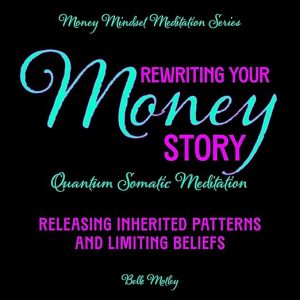
This arrived in my queue on a morning when I was doing research into the broader landscape of somatic and hypnotic audio programming, and the title gave me pause before I let it run. Rewriting Your Money Story is a compound of terms that have been deployed with varying degrees of rigor in the wellness space, and the quantum modifier in particular tends to function as either genuine scientific framing or marketing decoration depending on the author. Belle Motley’s approach, as it emerges across the two-hour runtime, is closer to legitimate somatic therapy methodology than the title’s more speculative vocabulary might suggest.
The core of what Motley has built here is a guided somatic meditation focused on the specific emotional charge that financial patterns carry in the nervous system. This is not a metaphor in the way that money mindset language sometimes treats it. There is genuine clinical support for the idea that early financial conditioning, family dynamics around money, and emotionally significant economic events create patterned nervous system responses that persist independently of rational belief change. The approach of working directly with somatic awareness rather than cognitive reframing reflects the same theoretical ground occupied by practitioners like Peter Levine and Pat Ogden.
The Somatic Approach to Money Beliefs
What distinguishes Motley’s framework from most money mindset content is the explicit commitment to bypassing the analytical mind. The synopsis is precise about this: the meditation does not require identifying specific beliefs, reliving financial experiences, or forcing new perspectives. This is a meaningful clinical distinction. Most cognitive approaches to limiting beliefs ask the practitioner to identify, examine, and consciously replace the belief, which requires working within the same cognitive register that generated the belief in the first place. Somatic approaches work at a different layer, targeting the physical holding patterns and nervous system activation that maintain the belief’s grip regardless of what the rational mind thinks about it.
The language Motley uses throughout, slow pacing, gentle hypnotic address, guided somatic awareness, reflects this methodology. The references to quantum mechanics in the title are not developed as a technical framework within the meditation itself, which is functionally appropriate even if it represents an unexplained gap between marketing language and content. The meditation works as a somatic and hypnotic intervention regardless of whether the quantum framing adds anything.
Rhonda Pownall and the Qualities This Format Requires
Rhonda Pownall’s narration is well-matched to the content. She speaks slowly, without the breathy over-warmth that some guided meditation narrators adopt as a substitute for genuine presence. The pacing in somatic work matters significantly: statements about bodily sensation, invitations to notice internal states, and permission-giving language need to arrive with enough space between them to allow the listener to actually do what is being asked. Pownall maintains that space consistently throughout the two hours, which is harder than it sounds across that duration.
The meditation is book two of the Money Mindset Meditation Series, though the synopsis gives no indication that it requires book one as a prerequisite. The somatic meditation format is self-contained: listeners arrive with their own money-related history and the meditation creates a container for engaging with it, regardless of prior exposure to Motley’s framework.
What Two Hours Can and Cannot Do
At just over two hours, this is a focused intervention rather than a comprehensive program. The synopsis lists five specific support aims, including releasing inherited patterns, reducing emotional charge around financial decisions, and increasing clarity and ease with finances. These are reasonable claims for a single guided session to contribute toward, with the understanding that nervous system change through somatic work is cumulative and typically requires repeated engagement rather than a single session to become durable.
The 23 five-star reviews suggest that listeners are finding the experience genuinely useful within that realistic scope. Somatic meditation content in this category rarely accumulates substantial review volume, which means the 23 ratings represent a moderately engaged audience reporting satisfaction rather than a marketing artifact. That said, the absence of any critical reviews makes the record less useful than a mixed response set would be for understanding specific limitations.
Appropriate Expectations and Honest Caveats
This is a relaxation and personal development product, not a substitute for financial therapy or clinical treatment. Motley’s own disclaimer in the synopsis is appropriately explicit on this point. For listeners dealing with clinically significant financial anxiety, trauma related to economic hardship, or complex psychological histories around money, professional support is the appropriate first resource. For listeners in a stable enough situation to benefit from reflective somatic work on belief patterns and emotional charge, this is a well-structured, honestly presented offering. Listen in a comfortable, supported position, in an environment where two hours of quiet is genuinely possible, and approach it with the patience that somatic work requires.
Frequently Asked Questions
What does somatic meditation mean in the context of this program, and how does it differ from standard guided meditation?
Somatic meditation specifically works with bodily sensation and physical experience as the primary entry point, rather than visualization or cognitive reframing. Motley’s approach guides listeners to notice how money-related patterns feel in the body and creates space for the nervous system to release those patterns through regulated awareness rather than analysis.
Is book two of the Money Mindset Meditation Series accessible without having listened to book one?
The synopsis describes this meditation as self-contained, requiring no identification of specific beliefs, reliving of experiences, or prior preparation. The somatic meditation format is designed to work with whatever the listener brings, making it functionally accessible without prior exposure to Motley’s framework.
Does Rhonda Pownall’s narration suit the slow, body-based nature of the content?
Yes. Pownall maintains a deliberately slow pace with appropriate spacing between somatic awareness invitations, which is essential for this type of content. The delivery is grounded without being artificially warm, allowing the therapeutic language to land without feeling performative.
What does quantum mean in the title, and does the meditation engage with quantum theory?
The quantum modifier appears in the title but is not developed as a technical framework within the meditation itself. The content operates within somatic therapy and hypnotic suggestion methodology. The quantum framing appears to be marketing language rather than a description of the meditation’s actual mechanism.