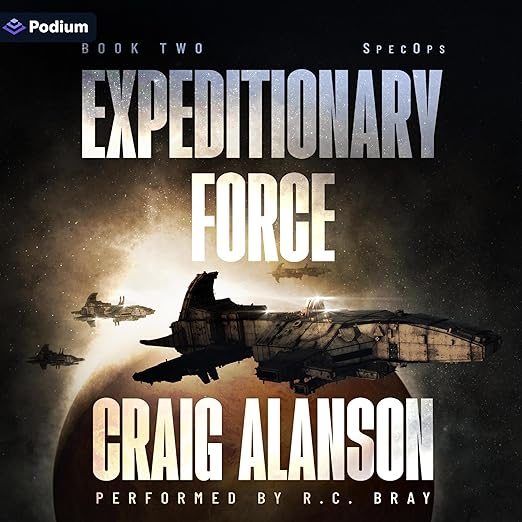
Quick Take
- Narration: R.C. Bray is one of the best voices in science fiction audio, and his handling of Skippy the AI is a genuine performance highlight that elevates every scene the character inhabits.
- Themes: Human ingenuity against overwhelming odds, the nature of AI consciousness, comedy as a coping mechanism in impossible situations
- Mood: Fast, funny, and surprisingly emotional in unexpected moments
- Verdict: A confident, entertaining sequel that deepens the Skippy-Joe dynamic and delivers exactly what fans of the first book came for.
I started SpecOps on a commute after finishing Columbus Day, the first book in Craig Alanson’s Expeditionary Force series, and I was skeptical that a sequel could sustain what made the original work. The comedy-space-opera blend is a difficult tonal balance to hold across multiple books, and it often collapses in sequels when authors either over-explain the humor or abandon it for gravitas. Alanson does neither.
SpecOps picks up directly from Columbus Day, with Colonel Joe Bishop making good on his promise to take the captured alien starship Flying Dutchman back out into space. The UN has decided, against Joe’s better judgment, to fill the ship with nearly 70 Special Operations troops, pilots, and scientists. Joe thinks the mission is suicidal. He is not wrong, but he underestimates the creative mayhem that Skippy the Magnificent, the uber-AI at the heart of the series, is capable of generating.
Our Take on SpecOps
What Alanson has understood from the beginning is that the relationship between Joe and Skippy is a classic odd-couple pairing, and it gets richer in this installment. Skippy is pursuing something called the Collective, a mystery that threads through the series, and the tension between his vast cosmic ambitions and Joe’s very human pragmatism generates most of the book’s best moments. One reviewer described laughing so hard and then being punched with an unexpected emotion, and that rhythm is real. The book is genuinely funny and then, without warning, genuinely moving.
The criticism that the series sometimes drags is fair, and it applies here too. There are stretches in the middle section where the mission planning becomes granular in a way that tests patience. But Alanson earns his pacing because the payoffs are usually worth it. The book’s final act is properly satisfying in the way sequel military science fiction often fails to be.
Why Listen to SpecOps
R.C. Bray is not just a narrator here; he is a co-creator of the character of Skippy. His vocal performance gives the AI a specific personality, somewhere between insufferable genius and genuinely vulnerable being, that the text alone does not fully convey. Multiple reviewers singled out the narration as a reason to choose the audio version over print, and that assessment is accurate. Bray handles both Joe’s wry frustration and Skippy’s enormous ego with a comic timing that feels lived-in by this second installment.
At nearly 16 hours, this is a substantial listen, but the pacing rarely makes it feel like a chore. Bray’s delivery keeps even the quieter exposition sections moving. The audio version is very much the definitive way to experience this series.
What to Watch For in SpecOps
New readers should be aware this is book two in a series with strong continuity. One reviewer specifically recommended reading Columbus Day first, and that advice holds. The setup for SpecOps relies heavily on relationships and plot threads established in the first book, and jumping in here would create confusion around who the characters are and why their dynamic matters.
For returning readers, the evolution of the Expeditionary Force itself as a concept is worth tracking. As one reviewer noted, the titular force is no longer the central subject of the series; the real story has become about what Skippy is searching for and what that means for humanity’s place in an indifferent galaxy. That shift is handled with more confidence in SpecOps than in Columbus Day.
Who Should Listen to SpecOps
Fans of light military science fiction with strong character chemistry will find this a very satisfying listen. If you enjoyed the first book, this one delivers more of what worked and deepens what mattered. The humor is not optional here; it is structural. Listeners who want their science fiction grimly serious will struggle with the tone.
Start with Columbus Day first. This is not a standalone entry point, and the payoff of the Joe-Skippy dynamic depends entirely on having seen where it began.
One additional thing worth flagging for series newcomers: the humor in SpecOps is structural, not decorative. Joe’s deadpan frustration with Skippy runs beneath every tactical briefing and mission debrief. If that dynamic does not land for you in the first two hours, it is not going to convert you later. But for listeners who find the rhythm, this is one of the most enjoyable ongoing dynamics in contemporary science fiction audio.
Frequently Asked Questions
Can I start the Expeditionary Force series with SpecOps, or do I need to read Columbus Day first?
You need Columbus Day first. SpecOps picks up directly from the events of book one and assumes familiarity with the characters, the Flying Dutchman, and the Joe-Skippy relationship. Starting here would be confusing.
How important is R.C. Bray’s narration to the experience of this audiobook?
Very important. Multiple reviewers specifically cited Bray’s performance as Skippy as the reason to choose audio over print. His comic timing and vocal characterization of the AI are a significant part of what makes the series work in this format.
Is the humor consistent throughout, or does it fade as the series becomes more serious?
The humor remains a structural part of SpecOps rather than decoration. The book has serious moments and emotional beats, but Alanson does not abandon the comedy for gravitas. The balance holds across the runtime.
Does the series expand beyond its military science fiction setup in this book?
Yes, and noticeably so. The focus shifts from the Expeditionary Force as an institution toward the mystery of Skippy’s origins and what he is searching for. The series becomes more about AI consciousness and humanity’s cosmic situation, which some readers find richer than the first book’s setup.