Quick Take
- Narration: Adjoa Andoh’s performance is exceptional, bringing the Arthurian material into the present with a vocal authority that makes the gender-subversive retelling feel earned rather than revisionist for its own sake.
- Themes: Arthurian legend reimagined, queer identity and belonging, the cost of living outside your assigned role
- Mood: Lyrical and intense, with the compressed power of a short novel that knows exactly what it is doing
- Verdict: A fiercely beautiful novella that uses the Arthurian framework as a lens for exploring desire, identity, and the price of authentic selfhood.
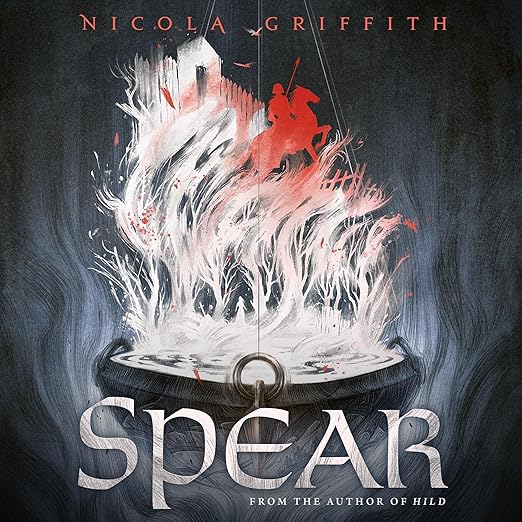
I finished Spear in a single sitting, which is not particularly remarkable given its length but is quite remarkable given that I listened to the last forty minutes with the specific quality of absorbed attention that only the best fiction generates: completely still, barely registering the room around me, genuinely reluctant for the experience to conclude. Nicola Griffith has written novellas before and clearly understands exactly what the form demands and what it cannot sustain. Spear is not a compressed novel or an extended short story; it is a piece of fiction that treats the novella as its own distinct discipline with its own specific demands, and it executes within that discipline with the full confidence of a writer operating at the height of her considerable craft and with deep command of the mythological source material she is transforming.
The premise is a reimagining of the Arthurian legend through the perspective of a young woman, Peretur, who has grown up in deliberate isolation and discovers that her destiny is entangled with Caer Leon and the remarkable fellowship of warriors and mages gathered there around a common purpose. Griffith is working in the tradition of Arthurian revisionism with full awareness of the tradition she is entering and with a clear sense of what she wants to add to it that has not yet been done well in this specific form. Her contribution is shaped by a dual and inseparable concern: the feminist and queer dimensions of her protagonist’s story and identity, and the lyrical, myth-saturated prose style that Griffith deploys with total commitment to all of its formal demands. The result is a book that earns comparisons to the best of the revisionist tradition while being unmistakably, specifically itself.
Peretur and the Myth Beneath the Myth
Griffith draws on the Peredur legend, one of the oldest Welsh sources for the Arthurian tradition, for her protagonist’s name and the basic architecture of her story, and this choice gives Spear a different and less colonized mythology to work with than the more familiar Malory-derived versions of the Arthurian world that most readers bring to the subject. The choice also allows Griffith to keep her distance from the most over-familiar Arthurian furniture and to build something that feels authentically mythologically grounded without being weighed down by the accumulated expectations that attach to Lancelot, Guinevere, the Round Table as commonly imagined, and the other elements that have been revisited and reinterpreted so many times that their capacity for genuine surprise has diminished. Peretur’s quest, her encounter with great power, her fellowship, and her love all feel simultaneously ancient and present-tense in ways that more familiar Arthurian retellings rarely manage.
The Prose as a Third Character
Griffith’s prose in Spear operates at a register that is unusual in contemporary genre fiction and that the audiobook format makes fully audible and fully present in a way that silent reading sometimes allows to pass without the full attention it deserves. The prose is not archaic or deliberately alienated from contemporary sensibility and contemporary readers. But it has a density, a rhythmic intentionality, and a quality of careful compression that rewards the kind of active, engaged listening that audiobooks can demand when the material is working at that level of craft and ambition. Adjoa Andoh’s narration is the ideal delivery mechanism for this prose; she clearly understands not just what Griffith is saying but what she is doing formally and rhythmically, and she responds to both with the care, precision, and authority that this specific writing requires. The result is an audiobook experience where the narration and the text feel genuinely made for each other.
Adjoa Andoh and the Weight of the Material
Adjoa Andoh is among the finest audiobook narrators working today in any genre, and Spear gives her material that is fully worthy of her exceptional talents and her particular gifts as a performer. Her vocal command of the mythological and lyrical register, her precise and careful rendering of Peretur’s developing interior life and her growing understanding of what she is and what she wants, and her management of the love scenes with exactly the tenderness they require without allowing that tenderness to tip into the sentimentality that would undermine the material’s emotional seriousness, all demonstrate a performer who is fully and deeply engaged with the material she is serving rather than executing it at professional distance. The sections dealing with Peretur’s awakening sense of her own identity and desire in a world without language or framework for it are narrated with a quality of care and recognition that elevates the text beyond what it can do alone.
Why the Length Is Exactly Right
Some of the most persistent criticisms of Spear center on its length: that it is too short to fully develop the world, the secondary characters, and the specific quality of the central relationship, that the compression forces the narrative to move too quickly through some of its most emotionally significant territory. I think these criticisms, while understandable as expressions of genuine appetite for more of what the novella provides, fundamentally misunderstand what Griffith is doing formally and why the form she has chosen is not a constraint she is working against but a structural choice she is working with deliberately. The novella’s compression is not a deficiency; it is inseparable from the book’s mythological ambition and from the specific kind of emotional impact it is designed to produce. Myth does not build characters through accumulation the way psychological realism does; it illuminates them through concentrated symbolic action. Spear is operating in that mode, and its length is precisely calibrated to that approach.
Frequently Asked Questions
Is familiarity with Arthurian legend necessary to appreciate Spear?
Helpful but not required. Griffith provides enough context for readers unfamiliar with the tradition, and the emotional and thematic content of the novella is accessible without detailed knowledge of the Arthurian sources.
How explicit is the queer romantic content in Spear?
The romantic content is present and clearly written but not graphic. Griffith’s approach is lyrical rather than explicit, and the love story is handled with care and emotional precision rather than serving as the narrative’s primary focus.
Is Adjoa Andoh’s narration essential to the experience or is the print version equally good?
Both formats have their advocates. Andoh’s narration adds a dimension to the mythological prose that is genuinely exceptional, and many readers have found the audiobook superior to the print experience specifically because of what Andoh brings to the text.
How does Spear compare to other recent Arthurian retellings?
It is among the most literarily ambitious recent entries in the tradition. The combination of deep mythological sourcing, queer perspective, and prose working at the level of the best contemporary fantasy makes it distinctive rather than simply another feminist revision.