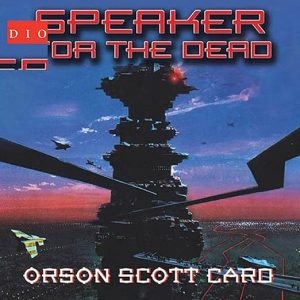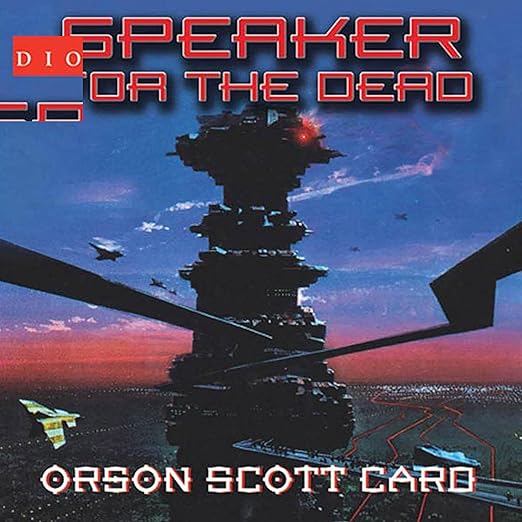
- Voice: David Birney's reading is steady and serves the material's intellectual weight, though the 2002 production lacks the sonic density more recent SF audiobook recordings bring to complex ensemble casts.
- Big ideas: guilt and moral reckoning, the ethics of first contact, cultural relativism versus universal humanity
- Atmosphere: Philosophical and deliberate, with flashes of genuine anguish beneath the intellectual surface
- Worth it?: A more demanding and ultimately more ambitious book than Ender's Game, and a richer listen for the patience it asks of you.
I remember being warned about Speaker for the Dead before I read it for the first time. The warning always took the same form: it is nothing like Ender's Game. That caveat is true and incomplete. It is nothing like Ender's Game in tone, pacing, or focus, but it is operating in direct conversation with the earlier novel's deepest question, what do you owe the beings you have destroyed? and the answer it constructs is more complex, more painful, and in some respects more honest than the one Ender's Game reaches.
Orson Scott Card published Speaker for the Dead in 1986, a year after Ender's Game, but the narrative is set three thousand years later, which is one of the more audacious structural choices in the Ender Quintet. Ender Wiggin himself is still alive, traveling between star systems at relativistic speeds and arriving in worlds that have aged generations while he has barely changed. He carries the guilt of the Bugger War like a stone and has made his life's work into something small and precise: speaking for the dead, telling the true story of a life to the community that survives it.
What Orson Scott Card Delivers
The planet Lusitania is where the book plants itself, and it is one of Card's better world-building achievements. Portuguese colonists live in careful proximity to the Pequeninos, the piggies, a second alien species that humans are determined not to destroy as they destroyed the Buggers. The protocols limiting contact are rigid and generate their own forms of violence. When members of the colony die under circumstances that suggest the Pequeninos are responsible, Ender is called to speak for them, which means investigating the true nature of those deaths before he can speak truly.
What Card has embedded in this structure is a sustained meditation on the difficulty of genuine understanding across difference. The Pequeninos' practices, the ones humans read as horrifying, turn out to be comprehensible, even moving, once the logic behind them is understood. That revelation, and the slow, methodical way Card builds toward it, is the novel's central achievement. One reviewer described it as "geared more towards a mature reader" than Ender's Game, and that is accurate. The book is less interested in the pleasure of a child prodigy mastering a game and more interested in whether genuine comprehension of the other is possible at all.
Card also weaves Portuguese Catholic colonial culture through the fabric of the story in ways that are more integrated than decorative. The religious life of Lusitania, the tension between the ecclesiastical authority and the scientific community studying the Pequeninos, the specific texture of a diaspora community maintaining its traditions far from home, these details enrich the story's central questions rather than decorating them.
What Orson Scott Card Gets Right
David Birney's narration handles the philosophical density of the book with a steady, unhurried authority. This is not a performance-forward audiobook; the prose is too interior for that, and the narrative moves at its own pace, which is considerably more deliberate than Ender's Game. What Birney delivers is clarity and consistency, which is what this particular book needs more than dramatic flair. The author's postscript, which Card wrote and recorded specifically for this edition, adds genuine value for listeners interested in the novel's origins and Card's intentions.
The novel also works better as a standalone than most series sequels. One reviewer came to it without having read Ender's Game and found the prior history assembled itself coherently through the text. Ender's past is present as context and moral weight rather than as a knowledge requirement, which is an unusual structural grace for a second volume.
Where Orson Scott Card Loses Some Ground
The slower pace and higher philosophical register mean this is not the audiobook for listeners hoping to recapture the propulsive momentum of Ender's Game. The early chapters in particular move carefully, establishing the social and religious fabric of Lusitania before the central mystery takes shape. The emotional payoff depends on having absorbed that texture, so listeners who push through to the investigation are rewarded, but the opening requires a different kind of attention than military SF typically demands.
The 2002 recording is also showing its age compared to what contemporary audiobook productions offer. The sound quality is clean but not immersive, and the cast of characters across multiple communities would benefit from more distinct vocal differentiation than a solo reader can provide.
Who Orson Scott Card Is Writing For
Readers who finished Ender's Game and want more of exactly that experience should look elsewhere in the Quintet. Readers who finished Ender's Game and found themselves lingering on the moral question at its end, what exactly happened when Ender destroyed the Buggers, and what it would mean to genuinely reckon with it, will find Speaker for the Dead a profound and demanding continuation. This is the book for listeners who prefer their science fiction to ask difficult questions rather than resolve them cleanly, and who can pace themselves through a novel that trusts them to wait for the answers.
Before You Listen
How different is the tone from Ender's Game, is it still accessible to readers who loved the first book?
Very different. Speaker for the Dead is slower, more philosophical, and structured around cultural mystery and moral reckoning rather than military strategy and tactical brilliance. Reviewers consistently describe it as significantly more mature in register. Readers who loved the pace and game-like structure of Ender's Game should be prepared for a fundamentally different kind of novel.
The Pequeninos are described as alien but also comprehensible, does the book explain their culture in a way that makes sense?
Yes, and the process of that explanation is the novel's central achievement. Card builds toward a full understanding of Pequenino practice and belief over the course of the narrative, and the revelation of what initially appears horrifying turns out to be grounded in a coherent, even moving, cultural logic. That payoff requires patience with the earlier sections but genuinely rewards it.
Is David Birney's narration from 2002 adequate for a novel this philosophically dense?
Adequate is the right word. Birney reads clearly and at a pace appropriate for complex material. He handles the intellectual content without stumbling. What the 2002 production lacks compared to more recent audiobooks is sonic depth and vocal differentiation across the large ensemble cast. It is a functional performance that serves the text, but it is not a demonstrably excellent one.