Quick Take
- Narration: Neill Thorne brings Rusty’s voice to life with an easy charm and a warm comedic timing that suits the series’ unhurried pace. Multiple reviewers single out the audio performance specifically.
- Themes: found family, comedic fish-out-of-water, low-stakes cozy adventure
- Mood: Cheerful and warm, like a road trip with people you are very glad you ended up stuck with
- Verdict: The second No Stress Space Express book delivers exactly what the first promised, and Bodett has found a formula that is genuinely difficult to write badly but that he executes with real skill.
I picked up Spacebound and Down on a Friday afternoon when I needed something that would not demand anything from me except a few hours of uncomplicated pleasure. I was halfway through a week of dense literary reading, the kind where every page is doing something interesting and the interesting things accumulate into a particular kind of tiredness. What Jack Bodett’s second No Stress Space Express book gave me was the opposite of that: a story that knows exactly what it is and delivers it with genuine warmth and a better sense of comic timing than most authors in this corner of science fiction manage.
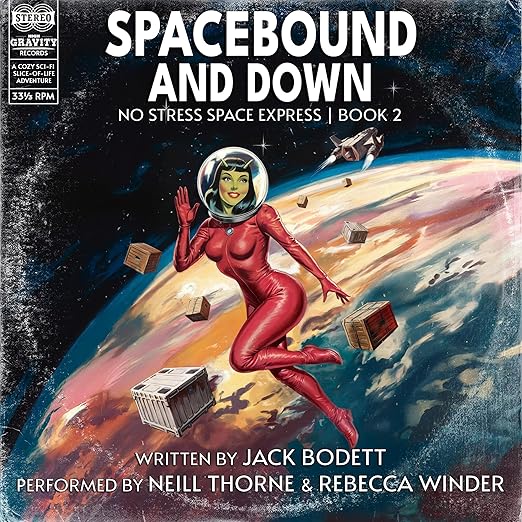
This is the second entry in a series about Rusty Ray Dixon and Mike Harlan, two Earth-born truckers who wound up accidentally abducted aboard an alien mothership and, finding no way home, decided to roll with it. In the first book they met Martian women Piper Skyflare and Jenna Moondrift, and by the time Spacebound and Down begins, Rusty and Piper are married and planning a honeymoon on what he describes, with characteristic understatement, as the galaxy’s least romantic budget. They have also acquired a spaceship, a fixer-upper with landing gear that squeals and plumbing that misbehaves, which they are trying to turn into a working freight operation while also building what Rusty calls a real home, one rusty bolt at a time.
The Comedy of Competent Incompetence
Bodett’s humor is not the kind that comes from characters being stupid. Rusty and his crew are resourceful, good-natured, and practically minded, and the comedy arises from the gap between their real-world competence and the alien contexts in which they have to apply it. The spaceship repair sequences have the same satisfying logic as a good plumbing joke: the problem is recognizable, the solution is improvised, and the outcome is technically a success even if nothing works the way it was supposed to.
A reviewer described this book as evoking Jerry Boyd’s Bob and Nikki series and Travis Baldree’s Legends and Lattes, and the comparison to Baldree is particularly apt. Both writers are doing something that looks easy but requires real craft: creating a world in which the stakes are genuinely low without making the reader feel like nothing matters. Bodett achieves this through the specificity of his characters and the consistency of their relationships. You care about Rusty and Piper and Mike and Jenna not because they are in danger but because Bodett has made them particular enough to be worth spending time with.
What Neill Thorne Does with Six Hours
Neill Thorne is the right narrator for this material. Several reviewers specifically praise the audio performance, and one described the series as one of the better Audible experiences they have encountered, with Thorne singled out alongside the story itself. Thorne delivers Rusty’s first-person narration with an easy Southern warmth that never tips into parody, and his timing on the comedic passages, especially the running gag about the ship’s various malfunctions, is consistently good. At six hours and forty minutes the runtime feels appropriate rather than compressed or padded. Bodett knows when he has delivered the scene and when to move on.
The series description explicitly positions itself against tension and drama. No Stress Space Express is the name, and it is a genuine promise rather than marketing copy. The book has conflict in the sense that there are problems to solve and decisions to make, but the narrative never manufactures urgency by threatening characters you have grown fond of. A reviewer who said the book gives readers what we are all in dire need of was being sincere, and I think they are right about what the series is doing at a cultural moment when a lot of entertainment is competing to see how dark it can go.
What Holds This Together Past the Premise
Cozy science fiction lives or dies on its characters, because once you remove the standard genre machinery of threat and resolution, all you have left is the quality of the company. Bodett’s characters are drawn with enough specificity to sustain the premise across multiple books. Rusty’s voice is consistently fresh rather than mechanical, and the supporting cast, including Mike’s developing relationship with Jenna and the various alien characters they encounter in this volume, gives the main relationship room to develop without carrying all the weight alone. The 4.6 rating across nearly a thousand listeners reflects a readership that found the series by looking for something specific and was satisfied. That is not a small thing to achieve.
Who Should Listen and Who Should Skip
Listen to this if you are specifically looking for science fiction that is funny, warm, and genuinely low-stakes, or if you finished the first No Stress Space Express book and want more of the same quality. Skip it if you want narrative tension, complex plotting, or science fiction that does anything with the genre’s speculative potential. This is not that book, and it does not pretend to be. Listen to the first book before this one if you have not already.
Frequently Asked Questions
Does Spacebound and Down work as a standalone, or do you need to read the first No Stress Space Express book first?
You can follow it without the first book, but the character dynamics will be richer if you come in with the prior context. The series has a continuous cast and ongoing relationships that develop from book to book, and the humor often builds on established character traits. Starting with book one takes only a few hours and makes this book significantly more rewarding.
How does this compare to other cozy science fiction series in terms of humor and tone?
The comparison to Travis Baldree’s Legends and Lattes and Jerry Boyd’s Bob and Nikki series in the series description is accurate. Bodett’s humor is grounded and conversational rather than absurdist, and the tone is consistently warm without being saccharine. Listeners who enjoyed those comparisons will likely respond well to Bodett’s approach.
Is Neill Thorne’s narration consistent across the series, or does each book have a different narrator?
Based on reviewer comments, Thorne narrates alongside Rebecca Wilder for the series, and the casting is consistently praised. The audio performance is frequently mentioned as a specific reason listeners return to the series, which is the highest compliment a narrator can receive.
What age range is the No Stress Space Express series appropriate for?
The content is clean and the humor is accessible to a wide age range. Reviewers describe it as wholesome and suitable for family listening, with no mature content. Adult readers who enjoy cozy fiction and younger readers who like science fiction comedy should both find it accessible.