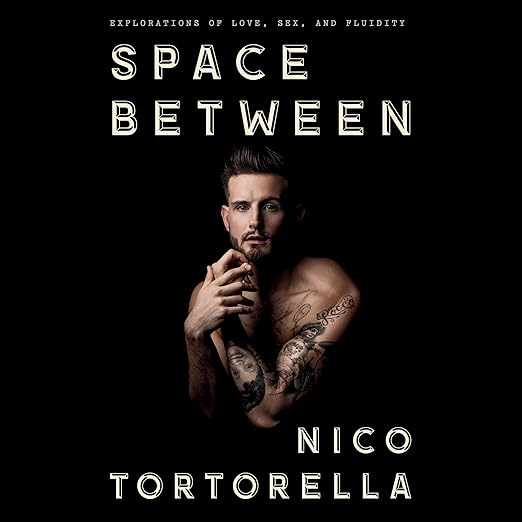
Quick Take
- Narration: Nico Tortorella narrating their own memoir is the only version that makes sense, the intimacy is irreplaceable, and the self-narration gives the more vulnerable passages a quality no hired voice could reproduce.
- Themes: Nonbinary identity and gender fluidity, polyamory and unconventional partnership, addiction and recovery as self-discovery
- Mood: Introspective, searching, and genuinely vulnerable, the memoir of someone still working things out, written in real time
- Verdict: A candid and searching self-examination that works as both personal narrative and an accessible entry point into conversations about gender fluidity and nonbinary identity.
I started listening to Space Between on a quiet Thursday evening and found myself still in my headphones two hours later than I had planned to be. Nico Tortorella’s voice has a quality that is hard to name precisely, not quite confessional, not quite performative, somewhere in the space between (the title earns itself early). They are telling their own story with the awareness that they are still inside it, that the conclusions have not fully arrived yet, and that quality of live-wire searching gives the memoir a texture that posthumous wisdom would have flattened.
Tortorella is probably best known to television audiences as Josh from Younger, but that context is both relevant and reductive. The book is not a celebrity memoir in the conventional mode. It is a genuine attempt to map an interior landscape, addiction, gender fluidity, the specific texture of growing up in an Italian American family with strong gender expectations, the discovery of a queer identity that exceeds the available language for it, and to share that map with readers who might be navigating similar territory without any map at all.
Our Take on Space Between
The book organizes itself around Tortorella’s central project: understanding what it means to exist in the space between fixed categories. Between male and female. Between monogamy and promiscuity. Between sobriety and addiction. Between fame and authenticity. Between the Ram Dass-inflected spiritual upbringing of their childhood and the Hollywood machinery they stepped into as a young adult. None of these tensions is resolved into a tidy conclusion, which is both the book’s most honest quality and its most potentially frustrating one for readers who want a clear arc.
The sections on addiction and recovery are among the most precise in the book. Tortorella writes about drinking and the specific seduction of self-destruction with the clarity of someone who has done genuine therapeutic work on these experiences. The sections on their unconventional marriage to Bethany Meyers are more guarded but offer real insight into how two people negotiate a deliberately open partnership with intention rather than accident. The gender identity material, the emergence of a nonbinary self that had been present long before the language for it was available, is the heart of the book and where Tortorella is most willing to be uncertain on the page.
Why Listen to Space Between
Self-narration is the right choice here, and not just for the obvious reason that no hired voice actor could replicate Tortorella’s own. There are moments in this audiobook where the slight hesitation, the shift in breath before a difficult sentence, the occasional rawness in delivery communicates something the text alone cannot carry. Tortorella is not a professional narrator, and that inexperience is audible, but it is audible in ways that serve the material. When they are describing something painful or still partially unresolved, the voice reflects that. The imperfection is the authenticity.
The endorsements the book carries, RuPaul’s description of Tortorella as embodying the twenty-first-century human, Alok Vaid-Menon’s more specific praise of the book’s tangible intimacy, reflect genuine engagement from people who understand the territory the book maps. These are not celebrity blurbs; they are responses from people with stakes in the conversations Tortorella is contributing to.
What to Watch For in Space Between
The book does not resolve. Tortorella’s identity is a work in progress at the time of writing, and the memoir reflects that. Readers who want a tidy transformation narrative, the person who was lost finding themselves and arriving at a stable self, will need to adjust their expectations. The book is more interested in process than destination, and it is honest that the destination does not fully exist yet.
Some readers have also found the prose occasionally elliptical or metaphorically dense in ways that require patience. Tortorella writes with the influence of their spiritual background (Ram Dass, Eastern philosophy, the specific language of addiction recovery) woven through the text, and that language will feel native to some readers and unfamiliar to others. A reviewer who was already gay noted coming to the book without much prior thought about nonbinary experience and finding it genuinely clarifying; a different reader looking for a quick survey of LGBTQ+ identity might find it too interior and slow.
Who Should Listen to Space Between
This is the right listen for: people navigating questions about gender identity, sexuality, or both who want the company of a voice that has been in similar territory, readers who appreciate celebrity memoir that takes the inner life seriously rather than delivering anecdotes, and anyone who has watched Nico on Younger and wondered who the person behind the performance actually is.
Less suited to: listeners who want narrative resolution and clear identity conclusions, those who find the language of gender fluidity and nonbinary experience unfamiliar and are not willing to engage with it on its own terms, and readers looking for a broad survey of LGBTQ+ experience rather than one deeply specific individual account. This is a first-person singular book, and its power comes from that singularity.
Frequently Asked Questions
Does Space Between require familiarity with Nico Tortorella’s work on Younger to appreciate?
No. The celebrity context is useful background but not required. Tortorella references their career and the tensions between Hollywood performance and authentic identity, but the book works as memoir for readers who have never seen the show. Knowing the public persona adds a layer but is not a prerequisite.
How explicitly does the book address polyamory and Tortorella’s marriage to Bethany Meyers?
The marriage and the deliberately open partnership with Meyers are addressed with candor about the emotional and logistical work of building that kind of relationship intentionally. Tortorella is more guarded about specifics of other partnerships but open about the philosophical framework. The book treats polyamory as one component of a larger inquiry into the fluidity of love and identity rather than as the central subject.
What pronouns does Nico Tortorella use, and does the audiobook reflect that?
Tortorella uses they/them pronouns, and the book was written and narrated from that perspective. Self-narration means there is no translation layer, Tortorella speaks in their own voice about their own experience, and the pronoun usage feels natural rather than imposed.
Is this book more useful for LGBTQ+ readers already familiar with nonbinary identity, or for readers encountering these ideas for the first time?
Both audiences have found it valuable for different reasons. Reviewers who share Tortorella’s experience of gender fluidity and polyamory describe it as recognizing themselves in the text. Reviewers coming from outside that experience, including one who described themselves as a heterosexual white woman and another as a gay man who had not thought much about nonbinary experience, found it genuinely expanding their understanding. The book works as both mirror and window.