Quick Take
- Narration: Wyatt Baker brings Aubrey Grant’s quirky, affectionate energy to life with real charm, though Jun Tanaka’s quieter register is less distinctively rendered.
- Themes: Historical mystery layered onto contemporary crime, found family, LGBTQ+ romance with low angst
- Mood: Sun-warmed and buoyant, with a bittersweet historical current running beneath
- Verdict: An easy, charming listen that earns its place in C.S. Poe’s interconnected universe without requiring you to have read the Snow and Winter books first.
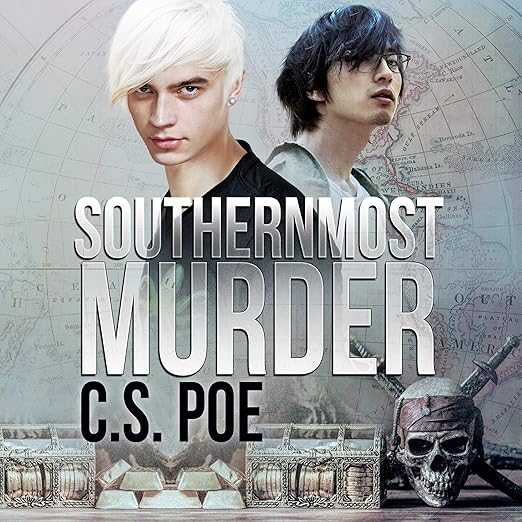
I started this on a Friday afternoon when I needed something that would pull me somewhere visually distinct and not make excessive demands on my emotional reserves. Key West in the summer, a skeleton in the closet of a historical sea captain’s property, and a narrator with narcolepsy and an FBI agent sort-of-boyfriend on his first visit: this was exactly the right prescription. C.S. Poe has built a particular kind of cozy mystery that carries more warmth than the genre usually permits without tipping into saccharine, and Southernmost Murder demonstrates that she can translate that tone to a new setting and new characters without losing what makes it work.
Aubrey Grant is a historian managing the Smith Family Historical Home, a character who loves strange things, functions as comic relief without being diminished by it, and carries the story’s energy in a way that the more contained Jun Tanaka can’t and doesn’t need to. Jun is quiet, competent, and clearly smitten, but he operates as a supporting presence in Aubrey’s story rather than as an equal co-lead, and the book is honest about that dynamic.
Our Take on Southernmost Murder
The mystery operates on two levels, which is one of the more satisfying structural choices Poe makes here. The contemporary murder is interesting but not the book’s real treasure. It is the century-old story underneath, involving a pirate king, long-lost treasure, and the restless spirit of Captain Smith, that gives the book its distinctive texture. One reviewer described the historical mystery as bittersweet, which is accurate: the resolution of that old tragedy has genuine emotional weight in a way that the present-day crime does not quite match. Poe has an instinct for what her historical material can carry emotionally, and she uses it well here.
What reviewer Kris Olsen called “potato chip” reading is fair as a description of the experience rather than a criticism of the quality. Southernmost Murder is not trying to be a deeply layered psychological thriller. The characters are charming rather than psychologically complex, the mystery is engaging rather than labyrinthine, and the resolution, while well-executed, does not require you to reassemble everything you thought you knew. Poe is working in the pleasurable-and-skillful register of the genre, and she is very good at it.
Why Listen to Southernmost Murder
Wyatt Baker understands Aubrey. That matters enormously in a first-person-adjacent narrative where the protagonist’s voice is the book’s primary appeal. He captures the particular combination of loveable chaos and genuine intellectual enthusiasm that makes Aubrey work as a character, and he handles the humor without pushing it into mugging. The Key West setting benefits from audio performance: the loose, sun-soaked energy of the environment translates well when someone is reading it to you rather than you sitting with it on the page.
At 7 hours and 13 minutes, this is a comfortable single-day or weekend listen. The pacing is smooth across the full runtime, with no mid-book drag, and the balance between the historical investigation and the contemporary romance-adjacent elements is well-maintained throughout.
What to Watch For in Southernmost Murder
Readers looking for substantial character development or interiority in the romance should adjust expectations. The relationship between Aubrey and Jun is given enough space to feel real and is genuinely warm, but the book’s focus is the mystery rather than the relationship. Jun in particular is, as multiple reviewers noted, a quiet character who recedes somewhat when Aubrey is in full flow. If you want the agent to feel like an equal partner in the story, you may leave slightly underwhelmed on that front.
The book sits in C.S. Poe’s interconnected universe alongside the Snow and Winter series, and if you have read those, there are pleasures of recognition here. Snow himself appears in the extended Poe world, and Aubrey is originally introduced as Snow’s friend. That connection enriches the reading experience but is absolutely not required. Southernmost Murder functions as a standalone without any need for prior context.
Who Should Listen to Southernmost Murder
An obvious choice for fans of C.S. Poe’s other work, for listeners drawn to cozy mysteries with LGBTQ+ leads, and for anyone who wants a well-executed vacation-set mystery with warmth and humor. It is also a good entry point to Poe’s universe if you have been considering her work. If you are looking for something with significant romantic or psychological depth, or a mystery that will genuinely stump you until the final chapters, there are better-suited options. But for what it is doing, it does it with skill and real affection for its characters.
Frequently Asked Questions
Do I need to have read the Snow and Winter series before listening to Southernmost Murder?
No. Southernmost Murder functions as a complete standalone. Aubrey Grant is introduced in Poe’s extended universe, but the book provides everything you need to know about its characters and situation. Existing Snow and Winter readers will find additional resonances, but there is no required background.
How well does Wyatt Baker handle the dual register of historical mystery and contemporary romance in his narration?
He is strongest in Aubrey’s present-day voice, which he renders with real charm and comic timing. The historical flashback sections, which carry the book’s more melancholy undertone, are handled competently. Jun Tanaka’s quieter register is the least distinctively realized character in the audio performance.
Is the narcolepsy element handled sensitively, or does it feel like a novelty trait?
Reviewers have not flagged it as exploitative, and within the narrative it functions primarily as a plot device that creates vulnerability and occasional comic timing rather than as a medical condition explored in depth. Listeners seeking a nuanced portrayal of narcolepsy should know the book uses it more as character texture than as its subject.
Is the historical mystery subplot resolved fully, or does it leave threads open for future books?
The historical mystery is resolved satisfactorily within this book. The contemporary murder investigation is also fully concluded. Poe leaves room for future Grant and Tanaka stories through character dynamics and setting establishment, but Southernmost Murder does not end on a cliffhanger or require a sequel to feel complete.