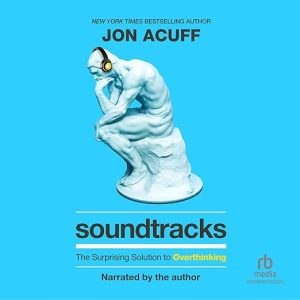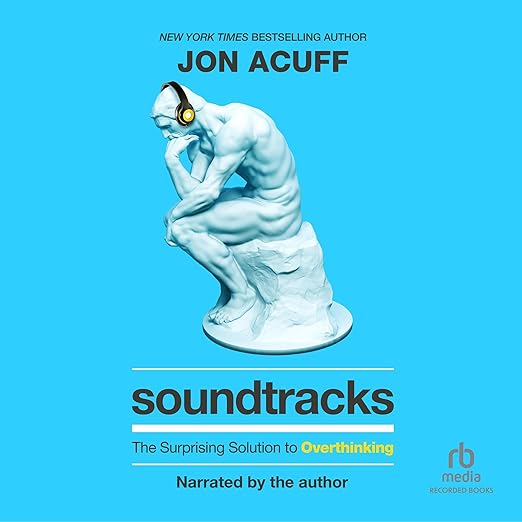
Overthinking was something I had convinced myself was productive research into my own indecision. Jon Acuff's Soundtracks disrupted that convenient fiction early in my listening. I picked up this audiobook during a period when I was cycling through the same three concerns on rotation, unable to move forward on a project I cared about, and Acuff's central reframe, that overthinking is not a personality trait but a learned behavior that can be interrupted, landed with the specificity of a good diagnosis rather than the bluntness of a motivational slogan.
Acuff narrates the audiobook himself, and that choice matters here in a way it does not always. His comedic timing is a genuine part of how this content works: the self-deprecating examples, the research findings delivered with dry acknowledgment of their absurdity, the way he undercuts the earnestness of self-help frameworks just before they start to feel ponderous. At five hours and fourteen minutes, the runtime is short enough that the tone never outstays its welcome, and Acuff's delivery keeps the energy from flagging.
The central metaphor of the book, that our repeated mental loops function like music tracks playing on autopilot, is more analytically useful than it sounds in summary. Acuff uses it to distinguish between 'broken soundtracks' (the intrusive, self-limiting loops that overthinking runs on) and intentional ones (replacements that you choose and rehearse). The three-part framework for evaluating any internal voice, is it true, is it kind, and is it useful, is simple enough to remember and specific enough to apply, which is the test of any self-help framework worth its runtime.
The research he commissioned, 10,000 respondents with 99.5 percent reporting overthinking as a challenge, is mentioned repeatedly. Some listeners may find the sample size doing more rhetorical work than scientific work. But Acuff is transparent about the limits: he is not presenting a clinical intervention, and the book functions best as a coach's playbook rather than a researcher's handbook.
What Works
The audiobook earns its reputation among Acuff's existing audience primarily because of the comedic accessibility he brings to material that would read as dry CBT-adjacent self-help in a different voice. One reviewer describes his previous book Finish as a surprise hit for them, which tracks with the experience of this audiobook: the content is less revelatory than it is well-packaged and genuinely entertaining to consume. The listener who noted that Soundtracks helped them recognize that intentional thinking could replace automatic worry is describing the book's actual utility: it shifts a behavior pattern rather than introducing entirely new information.
The DJ metaphor Acuff uses for the process of choosing your soundtracks, the idea that you can learn to spin different tracks rather than just accepting what plays, extends through the book's final section and provides a practical framework for the behavioral work. It is gimmicky in the way that all self-help metaphors are gimmicky, but Acuff earns it by staying consistent and returning to it with enough variation that it does not collapse under repetition.
Weak Spots in Soundtracks
Listeners who come to this audiobook expecting systematic cognitive behavioral therapy protocols will find something lighter. Acuff works from research and his own experience, but the advice is experiential and anecdotal rather than clinical. People who have done actual CBT work may find some of the frameworks familiar under different names. The value here is the delivery and accessibility, not novelty.
The short runtime is both a strength and a limit. At just over five hours, Soundtracks cannot go very deep into any individual strategy. It is better understood as an introduction to the concept of intentional thinking that opens doors rather than a comprehensive curriculum. Listeners who want deeper engagement with the psychology would benefit from pairing it with more academically grounded material on rumination and cognitive restructuring.
The 99.5 percent figure also surfaces something real about the audiobook format's relationship to this particular topic. Overthinking is, at its core, an auditory experience: the voices are internal, but they are voices. Acuff's choice to present this content as an audiobook rather than primarily as a print text seems genuinely intentional. When he describes the mechanism of a broken soundtrack, the loop that plays without your permission, the listener is experiencing something structurally similar in real time. The medium reinforces the message in a way that works better here than in most self-help audio.
Acuff's research commission, 10,000 respondents on overthinking, serves a dual purpose in the audiobook. It validates the premise by establishing that the problem is nearly universal, but it also creates a subtle rhetorical move: if 99.5 percent of people report struggling with overthinking, then any listener who dismisses the premise as not applicable to them is in a very small minority. Acuff deploys this efficiently, not as manipulation but as permission-giving: you are not uniquely broken, and the approaches here are calibrated for normal human cognition under pressure, not for clinical pathology. That framing is what makes the audiobook accessible to listeners who would resist a more clinical intervention.
Who It's For
Best suited to professionals and motivated individuals who know they overthink but have not found a framework that makes interrupting the pattern feel possible and even enjoyable. Acuff's audience tends toward driven people who respond to humor-forward coaching rather than clinical language, and this audiobook is precisely calibrated for that listener. Skip it if you are looking for research-dense behavioral science or if self-help in a comedic register is not your format. New listeners to Acuff can start here without any prior context from his earlier books.
Questions Listeners Ask
Do I need to have listened to Jon Acuff's other audiobooks like Finish or Do Over first?
No. Soundtracks is a standalone audiobook and works without any prior context from Acuff's catalog. Existing fans will recognize his voice and approach, but new listeners can follow everything without setup.
How is the audiobook structured, and does it include exercises or worksheets?
The audiobook follows Acuff's three-part framework: identifying broken soundtracks, replacing them, and rehearsing new ones. The practical exercises are described verbally rather than in worksheet format; listeners who want written materials should check whether a companion guide is available separately.