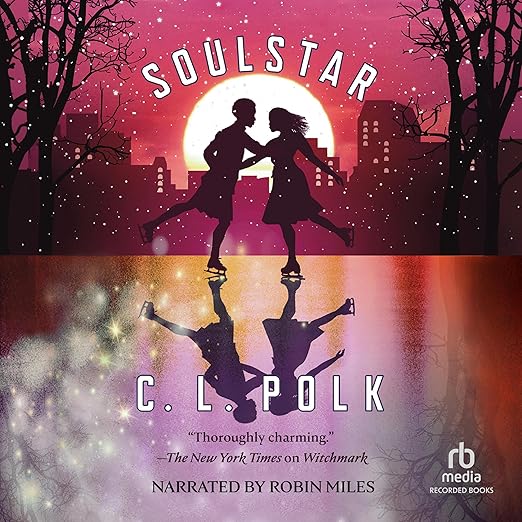
Quick Take
- Narration: Robin Miles is exceptional, bringing distinct vocal identities to a large cast and handling the political intrigue passages with the same assurance as the more intimate emotional scenes.
- Themes: Revolutionary politics and democracy-building, queer identity and long-deferred love, the aftermath of systemic oppression
- Mood: Tense and emotionally layered, with moments of genuine warmth
- Verdict: A satisfying conclusion to a trilogy that earns its political idealism through precise character work, though it works best for listeners who have completed Witchmark and Stormsong.
I spent a long weekend last winter working through C.L. Polk’s Kingston Cycle, and by the time I reached Soulstar I had the particular kind of investment in fictional people that makes a series ending feel genuinely consequential. Robin Thorpe had appeared in Witchmark as a secondary character, and I was curious whether Polk could make her carry a full novel after the more overtly charismatic Miles and Grace. The answer, it turns out, is yes, though not without complication.
Soulstar is a book about what happens after revolution begins but before it succeeds, and Polk is more interested in that painful middle space than most fantasy writers are willing to be.
Our Take on Soulstar
The setup asks Robin to do something difficult: rebuild her life and plan a revolution simultaneously while managing her feelings for a childhood love who has just emerged from twenty years in an asylum. That last element is the emotional engine of the book, and Polk handles it with more care than a simple second-chance romance would require. The asylum system in Aeland, established across the earlier books as one of the cycle’s central acts of institutionalized violence, casts a long shadow over the reunion, and Robin’s feelings are complicated by guilt as much as longing.
The political dimension is equally demanding. As freed witches flood Kingston and begin rebuilding their lives, Robin is trying to negotiate with a desperate monarchy, prevent assassination, survive kidnapping and arson, and push Aeland toward democracy without triggering the kind of violent collapse that would destroy what’s being built. One reviewer listed the book’s contents approvingly: “a long lost love returned, politics, revolution, an assassination (that shocked the heck out of me), kidnapping, arson, magic, romance and emotional blackmail.” That inventory is accurate. Soulstar is busy, and Polk manages the traffic better in some sections than others.
Why Listen to Soulstar
Robin Miles is one of the best narrators working in speculative fiction, and her work here is no exception. She finds distinct voices for Robin Thorpe, Grace Hensley, and the various political figures without leaning on vocal caricature, and her handling of the emotional scenes between Robin and her returned love is restrained in the way that allows the listener to feel the weight of those twenty years without the narration telling them how to feel. The audiobook runs over twelve hours, which is the longest of the three Kingston Cycle volumes, and the pacing never lags.
One reviewer noted that Polk’s political dirty tricks felt disturbingly close to contemporary events, which speaks to the series’ prescience. The January 6th comparison is mentioned specifically, and while Polk’s Aeland is a fully imagined secondary world, the mechanisms of authoritarian resistance to democratic transition are rendered with enough specificity that the parallels are impossible to miss.
What to Watch For in Soulstar
The division of opinion among readers largely centers on Robin as a protagonist. One reviewer found her “not as good a protagonist as Miles or Grace,” arguing that she felt “plain” and that the romance was “somewhat weak,” while another called the choice of Robin as protagonist “excellent” for the way her perspective differs from the more central characters of the earlier books. This is genuinely a matter of taste rather than craft. Robin is quieter than Miles and less strategically brilliant than Grace, and the book is asking the reader to find value in that quietness. If you need your protagonist to be the most capable person in any room, Soulstar will frustrate you. If you’re interested in what solidarity and community-building look like from inside rather than from the top, it will reward you.
The series conclusion is tighter than some reviewers expected. One wrote that they “didn’t see how she could manage it, but she did,” which is about as good an endorsement of a trilogy finale as you can get without spoiling the mechanism.
Who Should Listen to Soulstar
This is almost entirely a book for listeners who have completed Witchmark and Stormsong. The political context, the character relationships, and the emotional weight of the reunion all depend on prior investment in the cycle. Listeners coming in cold will be technically able to follow the plot but will miss most of what makes it affecting. For those already in the series, Soulstar is a worthy and emotionally honest conclusion. Listeners who prefer their fantasy endings triumphant and clear should know that Polk’s resolutions are satisfying but complicated rather than simply victorious.
Frequently Asked Questions
Can Soulstar be listened to as a standalone, or is the Kingston Cycle essential reading in sequence?
Soulstar functions almost exclusively as the conclusion to a trilogy. The political situation, the characters’ relationships, and the emotional core of Robin’s romance all build on Witchmark and Stormsong. Starting here is possible but not recommended; you’ll understand what’s happening but not why it matters.
How does Robin Thorpe compare as a protagonist to Miles in Witchmark and Grace in Stormsong?
Robin is quieter and less overtly powerful than either of her predecessors, which is partly the point. Polk is interested in what revolution looks like from a community organizer’s perspective rather than from the protagonist who has the clearest view. Some readers find her refreshing for this reason; others find her less compelling. It’s one of the book’s genuine artistic choices rather than a misstep.
Does Soulstar resolve the magical and political plot threads satisfactorily?
Yes, more than some readers expected. The combination of assassination, kidnapping, storms, and democratic negotiation gets resolved in ways that feel earned rather than convenient. The romantic thread is similarly concluded, though it’s less dramatically resolved than the political one. Whether ‘satisfying’ means ‘tidy’ or ’emotionally true’ depends on what you’re looking for from a finale.
How does Robin Miles’ narration handle the political debate and negotiation scenes versus the more intimate romantic passages?
Miles is consistently excellent across both registers. She handles political dialogue with appropriate sharpness and the intimate scenes with a restraint that lets the emotional history of the relationships do the work. The vocal distinction between characters is clear throughout, which matters in a book with a large cast of political actors.