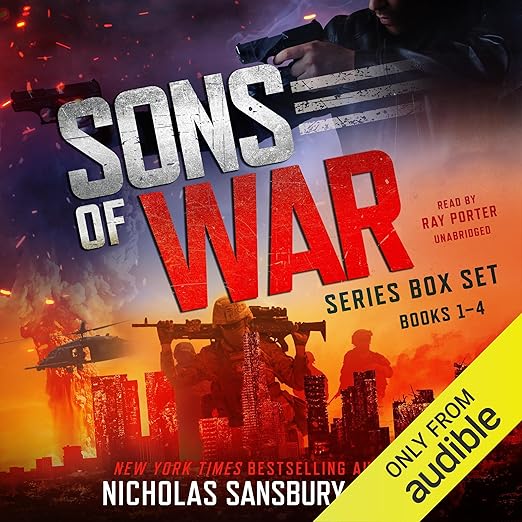
Quick Take
- Narration: Ray Porter delivers the dual-family saga with the authority and grit that post-apocalyptic fiction demands, anchoring both the Salvatore cop side and the Moretti crime side with distinct vocal weight.
- Themes: societal collapse and civil war, family loyalty versus institutional corruption, the blurred line between law and criminality
- Mood: Propulsive and brutal, with a slow-burn family drama underneath the carnage
- Verdict: Four books of post-apocalyptic Los Angeles mafia warfare in one sitting is an overwhelming value for readers who want scope and sustained tension, though those expecting moral clarity will find themselves in uncomfortable territory.
I started the Sons of War box set on a long weekend when I had no interest in leaving the house, and I did not leave the house. Forty-nine and a half hours of Nicholas Sansbury Smith is not a casual commitment, and I want to be upfront about that before anything else. But if you have spent any time with Smith’s other work, the Extinction Cycle or the Hell Divers series, you already know what you are signing up for: relentless forward motion, characters who earn their scars, and a worldbuilding instinct that makes catastrophe feel uncomfortably plausible.
The premise here is a second American civil war triggered by economic collapse, and what follows is less a war story than a crime saga set inside one. By the time Los Angeles has fractured into cartel territories in book two, Sons of War: Saints, the series has fully committed to its Sopranos-meets-the-apocalypse register. One reviewer used exactly that comparison, and it is apt. The Salvatore family thread tracks Marine Sergeant Ronaldo and then his son Dominic through the LAPD. The Moretti thread follows the Italian-American crime family expanding its grip on a city that no longer has a functioning government to stop them. Smith is interested in how institutions corrode, and how people inside those institutions choose between complicity and resistance when the rules no longer hold.
Our Take on Sons of War Series Box Set, Books 1-4
What distinguishes this series from straightforward post-apocalyptic genre fiction is the patience Smith brings to his two family structures. The Salvatores are not simply noble lawmen; Dominic’s undercover Saints operate in moral grey zones throughout book three, Sinners, and the question of whether fighting corruption requires becoming corrupt is never tidily resolved. The Morettis, meanwhile, are given enough interiority that Don Antonio’s hunger for territory reads as something close to tragedy rather than pure villainy. Smith and co-author Tom Abrahams stick the landing in the fourth book, Soldiers, by refusing to give every character the ending they deserve. Some do. Some do not. That asymmetry feels honest.
Ray Porter is as reliable here as he has always been for this genre. His voice carries weight without melodrama, and he manages the transition between the police procedural sections and the crime family scenes without losing coherence. A box set of this length lives or dies on narrator stamina, and Porter has it. The few reviewers who have noted the series has a political slant are responding to something real: Smith does not pretend that a second civil war would be politically neutral, and some readers will find his assumptions about the causes of collapse uncomfortable. That is a legitimate response, and worth knowing before you start.
Why Listen to Sons of War Series Box Set, Books 1-4
The pacing across all four books is genuinely impressive. Smith avoids the middle-book sag that kills many serialized stories by keeping both family arcs active and in genuine conflict with each other. There is no quiet second book here. Saints raises the stakes almost immediately by introducing the question of police corruption, and by Sinners the Saints unit is operating with the kind of moral ambiguity that makes crime fiction interesting. The action sequences are vivid without being gratuitous, and the city of Los Angeles is rendered with enough geographical specificity that you feel the territory disputes as physical rather than abstract.
The box set format rewards patience. Reading the four books consecutively lets you track how Smith develops Dominic from a young cop trying to honor his father into a man making choices his father would not recognize. That arc is the emotional spine of the series, and it benefits enormously from not having months between installments. Reviewer Julie Blaskie noted that the characters feel very real and human, not perfect but doing the best they can under the circumstances. That is precisely right, and it is the quality that makes nearly 50 hours feel earned rather than exhausting.
What to Watch For in Sons of War Series Box Set, Books 1-4
The worldbuilding is dense in the early chapters and requires some patience with establishment. Smith is not interested in hand-holding, and the economic collapse backstory is delivered in fragments rather than exposition dumps. Some listeners find this rewarding; others find it slow. The war sections in books one and two are also extended, and at least one reader found the battle sequences repetitive by the midpoint. That is a fair criticism. Smith’s strengths are character pressure and institutional rot, not necessarily tactical combat choreography.
Book four, Soldiers, is co-written with Tom Abrahams, and the seam is occasionally visible in shifts of register and pacing. It does not sink the conclusion, but listeners who have been with Smith’s voice for three books may notice the change. The ending is decisive rather than open, which will satisfy some and disappoint others depending on what they wanted from the finale.
Who Should Listen to Sons of War Series Box Set, Books 1-4
This box set is built for listeners who want scope, sustained tension, and morally complicated characters in a post-collapse setting. It rewards those who have patience for a multi-book setup and who find crime family dynamics as interesting as action sequences. Fans of Smith’s previous work will find this among his most ambitious projects. Skip it if you need a tidy moral framework, if extended battle sequences wear you down, or if you prefer your apocalypse fiction without the crime saga overlay. At nearly 50 hours, this is a full investment, and it is one that pays off most for readers prepared to sit with discomfort.
Frequently Asked Questions
Do I need to read the Sons of War books individually before buying this box set?
No. The box set contains all four books in sequence and is designed to be consumed as a complete saga. Starting fresh with the box set is the intended experience, and many reviewers note that having all four books available at once is a significant advantage over waiting for individual releases.
How does the dual-family structure affect the listening experience across 49 hours?
The alternating Salvatore (law enforcement) and Moretti (crime family) perspectives create a natural rhythm that prevents either thread from becoming monotonous. Smith is careful to give each family genuine interiority, so the switching feels like dramatic tension rather than interruption.
Is book four noticeably different since it was co-written with Tom Abrahams?
Some listeners detect a slight shift in register and pacing in Soldiers compared to the first three books. It does not significantly undermine the conclusion, but those who have spent 40-plus hours with Smith’s solo voice may notice the change in the final installment.
Does the political framing of the civil war become heavy-handed?
At least one reviewer found the political assumptions underlying the collapse scenario frustrating. Smith does take a position on what kind of breakdown triggers the conflict, and listeners who disagree with that framing may find it intrusive. Others will find it a reasonable and plausible foundation for the story.