Quick Take
- Narration: Elizabeth Saydah handles both the political intrigue and the supernatural horror elements with strong vocal range, distinguishing a large cast without losing clarity.
- Themes: War and empire, queer love under siege, the corrupting nature of power
- Mood: Epic and brutal, with moments of piercing tenderness
- Verdict: A rare second book that surpasses its predecessor, deepening both the worldbuilding and the emotional stakes considerably.
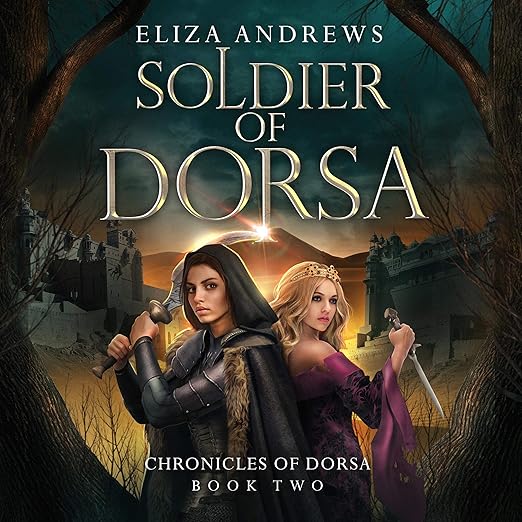
I started listening to Soldier of Dorsa very late on a Thursday night, intending to listen for an hour before sleeping. I was still going at 2 a.m., somewhere in the middle of a battle sequence I could not pause. This is the second volume of Eliza Andrews’s Chronicles of Dorsa trilogy, and it runs twenty-one hours and forty-five minutes. That runtime felt like a gift rather than a commitment.
The setup requires context from the first book, Princess of Dorsa. But the short version is this: Natasia, the Empire’s greatest living sword master, is separated from Joslyn, the Empress in exile, by circumstances that have left war brewing on two separate fronts simultaneously. One is the conventional political conflict the synopsis describes as the war everyone already knows about. The other is older and stranger: a war between the Shadowlands and the mortal world, a supernatural threat that the Brotherhood of Culo has been warning about for generations while nobody listened. Elizabeth Saydah navigates between these two registers with impressive command throughout a very long book.
The Shadowlands Arrive and Change Everything
One of the most consistent observations in the reader reviews is that the second book expands the supernatural elements dramatically compared to the first. The shadows and the Shadowlands that Andrews introduced as background menace in Princess of Dorsa become a genuine threat here, with their own internal logic and a horror register that sits in productive tension with the political intrigue. Andrews manages this tonal expansion without losing narrative coherence, which is genuinely difficult to pull off when the book is already carrying the weight of an ongoing dynastic conflict.
One reviewer who described the first book as good but this one as a powerful, enveloping embrace is responding to exactly this shift. The worldbuilding becomes denser and more confident, and Saydah’s narration adjusts accordingly. Her voice in the Shadowlands sequences carries a different texture than her delivery of court politics or battle choreography, a subtle vocal choice that helps the listener track which kind of scene they are in without the author needing to announce the tonal change explicitly.
What Separates the Main Characters for Most of This Book
The synopsis promises that Natasia fights time itself to return to Joslyn, and Andrews is not being metaphorical. The primary structural tension of this book is that its two protagonists spend most of its considerable length separated from each other. One reviewer noted this directly: the main characters do not meet until the last five chapters or so, which they called kind of terrible while still rating the book highly.
This is actually a bold structural choice that pays off precisely because Andrews knows how to write both characters independently. Joslyn’s political maneuvering to reclaim her crown, and Natasia’s increasingly desperate attempts to cover impossible ground, are each compelling enough to carry sustained narrative weight. The reunion when it comes earns its emotional force because both characters have genuinely changed by the time they reach each other. That transformation is the point. Andrews is writing a story about what love costs under pressure, not a romance that happens to have battles in it.
The reviewer who flagged too many flashbacks as a frustration is not wrong that the book uses that device heavily. The flashbacks fill in Natasia’s history with the Empire and add texture to the Shadowlands mythology, but they do slow the forward momentum at certain points. Listeners who find interrupted chronology frustrating should know this going in before committing to twenty-one hours.
The LGBTQ Element as Default Rather Than Exception
Several reviewers made a point worth amplifying: Andrews built a world where queer love is not transgressive but simply present. One lesbian reviewer wrote that she wished she had books like this when she was younger because the representation felt casual enough not to make her feel othered while simultaneously honest about the challenges that women who love women face. That calibration, normalizing the relationship while not pretending the world is perfectly just, is harder to achieve than it looks, and Andrews pulls it off across both books.
Saydah’s narration honors this by never treating the romantic elements as a separate category from the political or action sequences. The tenderness between Natasia and Joslyn is given the same weight as the battle sequences, neither sentimentalized nor minimized. It reads as a love story that happens to be embedded in an epic fantasy rather than as an epic fantasy that has been amended to include a love story.
Saydah and the Demands of a 21-Hour Performance
Twenty-one hours is an unusually long commitment to ask of a narrator. Saydah does not flag. The consistency of her character voices across that runtime is a technical achievement that deserves specific acknowledgment: listeners returning to the audio after a break will find the same vocal texture they left, which is the basic contract of series narration but harder to keep than it sounds across a book of this length. Her performance of Natasia in the action sequences carries a physicality that is remarkably difficult to achieve in audio without overplaying.
Listeners Who Will Love This and Those Who Should Start With Book One
Do not start here. The Chronicles of Dorsa has a genuine ongoing narrative thread and emotional continuity that requires Princess of Dorsa first. Listeners who want queer epic fantasy with serious political worldbuilding, no comic tone, and a willingness to be genuinely brutal with its characters will find the series deeply rewarding. Those seeking a queer romance that resolves comfortably within a single installment should look elsewhere. This is a trilogy in the classical sense: the middle volume ends with significant threads unresolved.
Frequently Asked Questions
Is Soldier of Dorsa accessible as a standalone, or is Princess of Dorsa required first?
Princess of Dorsa is required. Andrews builds her world and characters across the series and book two drops you directly into ongoing consequences from book one. Starting here would mean missing essential context for nearly every relationship and political conflict.
Does the 21-hour runtime feel padded, or is it earned?
Most reviewers consider it earned, though a minority found the flashback sequences slowed the pace. The length comes from genuine narrative density: two separate protagonists, two wars, and significant worldbuilding expansion. It is a big book doing big work.
How brutal is the content? Are there content warnings listeners should know about?
Andrews’s own reviews call it epic and brutal, and that is accurate. Characters die, including characters readers have become attached to. Violence is graphic in places. The series does not protect its cast from consequence, which is very much in the tradition of George R.R. Martin’s approach to consequence in fantasy.
Does Elizabeth Saydah handle the large cast effectively in the narration?
Yes, notably well. The cast is substantial and spans multiple political factions plus supernatural entities. Saydah differentiates voices clearly enough that listeners rarely lose track of who is speaking even in complex multi-character scenes.