Before You Press Play
- Voice: Rachel Cruze narrates her co-authored work, and the dual-author format translates well to audio; her voice carries both authority and approachability.
- Big ideas: financial literacy from childhood, work ethic, the family as financial education system
- Atmosphere: Practical and energizing, the audio equivalent of a good parent-teacher conference
- Worth it?: A focused, no-nonsense guide for parents who want to give their children a financial foundation before college debt and adult spending habits take hold.
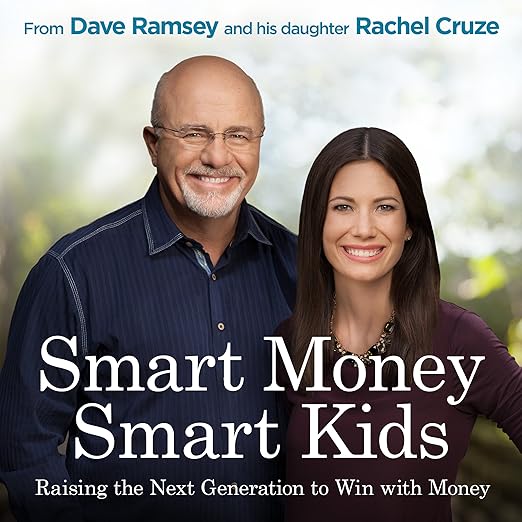
A colleague recommended Smart Money Smart Kids to me right around the time she started an allowance system with her nine-year-old, and I listened to most of it on a Saturday afternoon while doing other things around the house. That is telling in itself: this is not a book that demands your full undivided attention, but it rewards it. Dave Ramsey and Rachel Cruze have written something that is simultaneously a parenting book, a personal finance guide, and a practical manual organized around the specific challenges of teaching money concepts at different stages of childhood.
The setup is distinctive. Ramsey is a well-known figure in the personal finance space, famous for his radio show and his Baby Steps framework for getting out of debt. Cruze is his daughter, who grew up inside the Ramsey approach to money and has built her own career advising on related topics. Their collaboration is not simply Ramsey issuing edicts with a co-author along for the ride: the book alternates perspectives, with Cruze speaking from the experience of having been raised with these principles, and Ramsey providing the broader financial context. Several reviewers describe this as the most effective structural choice in the book, giving the advice a quality of lived reality that purely theoretical personal finance guides often lack.
First, the Big Picture
The book's argument is straightforward: financial habits form early, and most parents either do not teach money deliberately or pass on their own dysfunctional patterns by default. Ramsey and Cruze propose a deliberate curriculum, beginning with the basics of work, spending, saving, and giving, and extending into the more challenging terrain of avoiding debt for life and paying cash for college. The debt-free college argument is one the Ramsey organization returns to often, and listeners who find that position unrealistic in their economic context will need to translate the principle rather than follow the prescription literally.
One reviewer described the book as potentially the best thing a parent can give a child, and while that kind of enthusiasm needs context, the underlying point is that the window for financial education is earlier than most parents realize. An eight-year-old can understand commission, the Ramsey term for connecting work to pay, in ways that lay the groundwork for understanding paychecks, budgets, and interest years later. The framework is genuinely actionable at multiple age levels.
The Best Parts of Smart Money Smart Kids
Rachel Cruze narrating her co-authored work is a strong choice. She has a voice that communicates conviction without condescension, and the personal stories about growing up in the Ramsey household give the audiobook a warmth that distinguishes it from more dryly formatted personal finance titles. One reviewer compared her delivery to a culturally savvy Mary Poppins, which captures the tone accurately: firm, cheerful, and practically organized. At just over seven hours, the book is long enough to cover its ground without overstaying its welcome. The chapters are structured to be returned to at different stages, as children age into each new set of challenges.
A Few Reservations
The Ramsey approach operates within specific assumptions about economic access that not every family shares. The emphasis on cash, on debt-avoidance, and on college savings may feel remote to parents operating under significant financial constraints. The book is most useful as a framework and a set of principles rather than a literal script, and families in different economic situations may need to adapt certain recommendations substantially. Additionally, some of the specific product recommendations and institutional references reflect the book's 2014 publication date and should be verified for current relevance.
Who Should Listen to Smart Money Smart Kids
Parents with children at any age from preschool through high school will find at least some chapters directly applicable to their situation. The book is particularly useful for parents who grew up without financial education themselves and feel uncertain about how to introduce money concepts without passing on their own anxieties. Listeners who are already deep in the Ramsey ecosystem will find this a natural companion to The Total Money Makeover. Those who are skeptical of the Ramsey approach to debt or who operate in economic contexts where debt-free college is not realistic should still find the earlier childhood sections on work and saving practically valuable.
Frequently Asked Questions
Do both Dave Ramsey and Rachel Cruze narrate the audiobook?
Rachel Cruze is the primary narrator. The book was co-authored by both, and her narration draws on both perspectives, including stories from growing up in the Ramsey household.
At what age are the financial concepts in the book most relevant to start applying?
Ramsey and Cruze argue that financial education can begin as early as three to four years old with basic concepts of work and reward. The book covers principles for preschool through college age, organized by developmental stage.